
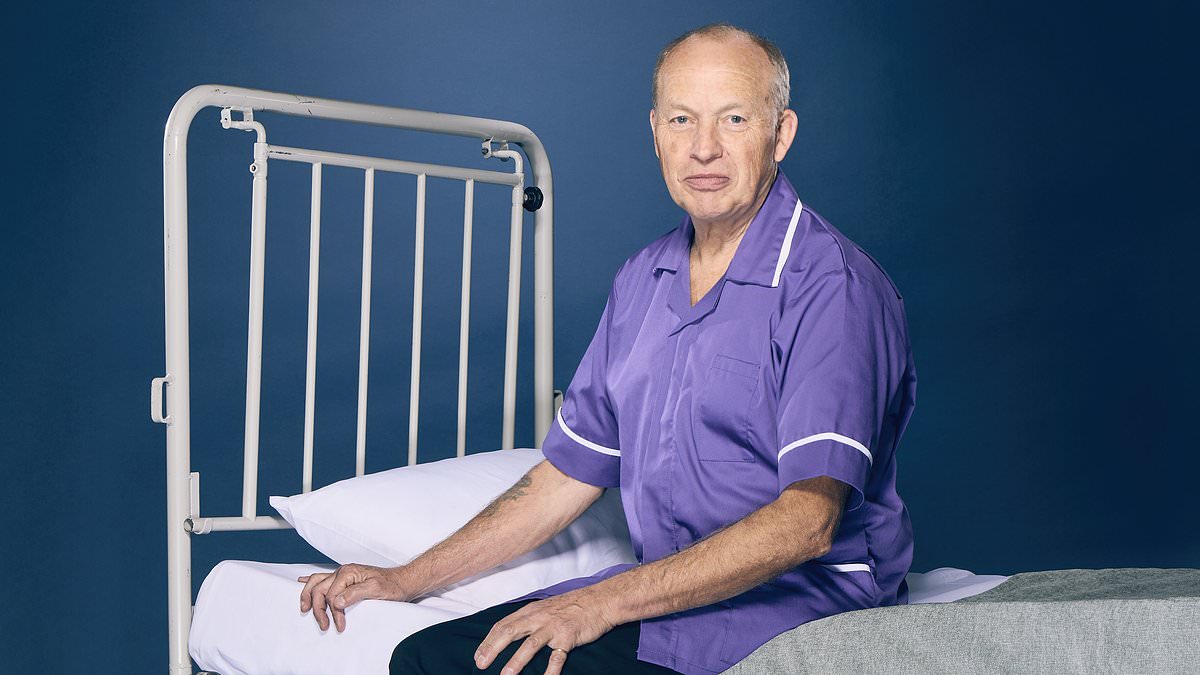
The Daily Mail has partnered with Alzheimer’s Society and the Mail Force charity to launch the Dementia Carers Together appeal to fund a new support network for millions of people across Britain looking after friends and family members with dementia. Here Tom Petherick describes how, in his mid-50s, he made the unusual decision to swap his 30-year career as a top horticulturalist to work as a carer with dementia patients – finding it deeply fulfilling and meaningful in unexpected ways.When I go into her room, Jean is sitting up in bed in the gloom of a low energy light bulb, head sunk in her chest. Asleep. I hope.But why isn’t she lying down? Has she been like this all night? I’m guessing she can’t easily prop herself up; she hasn’t the strength of a kitten.It’s 7.15am and this is my first day as a full-time carer in a late-stage dementia care home in the West Country. I’m a 57-year-old man and my task is to get Jean, who is in her 80s, up and onto a commode, then dressed and down to breakfast. Then do the same again for six more residents.My sole training for this has consisted of shadowing my fellow carers at the home for two weeks. Frankly I feel completely out of my depth.I start to chatter nervously: ‘Good morning Jean, how are you today, did you sleep well?’ but she is not going to answer. She can no longer speak. Alas, she is unwilling to get up at all and doesn’t understand why she must.I prise her out of bed anyway using a combination of guile and promises of the tasty breakfast awaiting her downstairs. Ironically, the task is made easier by the fact that moments after her refusal, she doesn’t remember why she doesn’t want to get up, so is persuaded after all.This is my first experience of trying to cajole someone with dementia into doing what I want, and I find it emotionally gruelling. I realise later that this mental toll is very much part of the job and that I am essentially on my own with it. Tom Petherick, 65, shares his experiences as a care worker in dementia homes across the UKI am in a care home with 26 dying people and eight poorly paid staff, some of whom are part-time agency workers on shift. There is little slack available to let us talk through our feelings.Even so we often work in pairs, totally dependent on each other to keep our charges safe, and I find strong bonds and a sense of trust develops naturally between us all. They are a mix of nationalities – Polish, Czech, Indian, African, French, Portuguese and Filipino – and they have varying levels of English, but we natter away to each other in as much as our respective languages allow. I am grateful that they quickly welcome me into their ranks, seeing me as just another pair of hands.But as I contemplate Jean, I realise how naive I have been. I had no idea I would have to wipe women’s bottoms, assuming I would be assigned men only. Only now do I see that such considerations are unworkable when the staff numbers are so low. Intimate care like this is just what we do, over and over and over again. In time it becomes normal because, well, it is normal.When I first announced my intention to work in a dementia care home a decade or so ago, many of my friends found it hard to hide their shock, disgust even.Most of us have a mortal dread of these places, after all. There are nearly one million dementia sufferers in this country, and many are tucked away in homes just like this, lost to the world. We see these places as sinkholes for old people – preferably not members of our own families or ourselves, of course.And besides, I don’t exactly fit the usual mould. Carers are rarely male, for a start, not many are British, and very few decide to pivot to caring in their fifties.Before this, I built a 30-year career as a horticulturalist, working at The Lost Gardens of Heligan in Cornwall, among other places, and writing books in conjunction with my wife, Melanie Eclare, a garden photographer.Then in 2016 Melanie died of leukaemia, at the age of 53.For several years my life felt as though it had been cut loose from its moorings. By the time our daughter Rose had grown up, I knew I wanted to do something different, more meaningful, working with humans not plants. Since Mr Petherick's first day at a home, he has worked as an agency carer in numerous types of care homesI’d had a great role model. My mother had been a tireless social worker, and when I was young I desperately wanted to do similar work in developing countries. Indeed for a while in my thirties I worked in India before coming back to the UK and settling down with Melanie. I sensed that focusing on others instead of myself would help my grieving process.So, back in 2018, I set out to find myself a new role in life. It didn’t take long to find work. There was – and still is – a drastic shortage of carers in England and the care homes were desperate. After the standard checks on my background, which took a couple of weeks, and a cup of tea on the day of the interview, they hired me. I signed a contract to be a carer for 32 hours a week on the minimum wage, which at the time was £7.83/hour (overtime optional, uniform supplied).Which is how I find myself grappling with Jean that first day.Jean’s bedroom is on the first floor. It is unremarkable like all of them in the home. Few if any pictures on the wall, dreary-coloured paint, scant furniture – basic pine cupboard, chest of drawers, one chair, single bed. Her whole world is in here and it doesn’t amount to much: three framed photographs, a necklace, hairbrush, powder. There is a son who visits occasionally and brings her sweets.‘Jean’s got ever such a sweet tooth,’ the senior carer often mutters.Sometimes that’s all there is to say about Jean. This is dementia, a contracted world into which the suffering unwittingly retreat, and from which there is no coming back.‘Stand up, Jean,’ I say. ‘Come on my love, help me out here, please.’ She somehow manages to achieve a standing position without my pulling her arms out of their sockets and I help her to grab onto her frame. It is just me and my ageing backbone and a woman of 11st. When I’ve got her dressed, I wheel her up the corridor, into the lift, down to the ground floor, along the passage and into the lounge where whoever is in charge will give her some breakfast, which she won’t eat, before she immediately falls asleep, exhausted by the marathon operation that has just taken place.As am I.But I have done it and survived even though I am reeling. I stagger towards the computer to record the fact I have delivered Jean safely to the lounge and given her personal care and cleaned her glasses.But when I get there, I find that Miroslav, the grumpy and very scary Polish carer, is inputting his own records. Upsetting Miroslav is a terrifying prospect for a newbie like me. This is a man who spends his spare time training for Iron Man contests. He is enormously muscular, shaven-headed, covered in tattoos and surly with it.To us staff, he cuts an ominous figure. The residents, on the other hand, love him. He is a top-notch carer, with the most gentle and sensitive manner towards them.Yet even Miroslav’s glowering can’t dull my glorious sense of achievement that first day. Jean is up, dressed, safely and comfortably positioned at the breakfast table in the dining-room. All this pulled off roughly on time.One down. Only six to go…Since that first day at the home, I have worked as an agency carer in numerous types of care homes – dementia homes, old people’s homes, secure homes for young adults with profound and complex needs and, at the other end of the scale, assisted-living communities where the residents have a degree of independence but still need 24-hour support.More often than not, and certainly in the dementia homes, there are a lot of younger workers from abroad and I am the only Englishman of a certain age. While, ostensibly, this could enhance the bonding with elderly male residents, in reality, very often they’re not in a position to tell the sex or nationality of the carers looking after them.Few of us really know what happens in ordinary care homes. We assume it is all overcooked cabbage and bad smells – or, worse, hidden cameras and elder abuse. Yes, they are whiffy, but they are also places of extraordinary compassion, kindness and respect. Despite the devastating reasons for people’s admission to a dementia care home, there is very little despair here and a great deal of simple humanity.The carers work like trojans – but like so much menial work, care is understaffed, underpaid and overlooked. Young people should be encouraged to carve a career in care work, but few aspire to it and schools barely mention it as a career option.We must change this – the low pay most of all, but also the perception of care work as unskilled and boring. It is surely the most AI-proofed of all jobs, the work is readily available, and as I found, meaningful in quiet, hidden ways that reveal themselves when you least expect it. 'The carers work like trojans - but like so much menial work, care is understaffed, underpaid and overlooked,' writes Mr PetherickOn countless occasions, cleaning someone up after an accident would prompt a look from somewhere deep within them, that I took to be gratitude. Often, too, on my drive home after a long shift, I would be flooded with a sense that I had made a tangible difference to people’s lives, no matter how diminished those lives were.Indeed, once you are over various hurdles – and the inevitable emotional upset when someone dies – working in care is hugely fulfilling. Honestly, I think we should all spend a period of our lives doing it.Today, at nearly 65, I do care work on a part-time basis. I had to give up the full-time job when my back began to ache in a new and ominous way. I have worked physically all my adult life, but leaning over at a 35 degree angle to move heavy men and women puts inordinate stress on ageing vertebrae and I need the downtime in between shifts.All over the country there are people doing this fabulous work with little thanks or recognition. The wonderful carers at my wife Melanie’s hospice, who showed us compassion of a kind I had never known before. My own mother’s live-in carer and the agency staff who visited her four times a day after a series of strokes in her 90s. It was only because of their love and sweetness, bestowed without fail every day, that she was able to stay in her own home until she died at the age of 96. The work is valuable beyond price.Back when mum was still alive but my wife had gone, I told one of her carer’s – Denise, a fabulous woman from the West Midlands with plenty of attitude which my mother appreciated – that I was thinking of applying to work in a care home myself. Without looking up, she said: ‘I expect you’ll love it.’Maybe Denise recognised that it would suit me and help with the pain of grief.Months passed before I saw her again, but when our paths did cross, I didn’t need to tell her that I had started working at the home. She could see that my shoulders were less hunched, my expression less stricken and that my step was lighter. She looked at me and, smiling, said: ‘I told you you’d love it!’All Names have been changedWho Cares: The Adventures of a Care Worker (£15, The Authors’ Collective) is available from Amazon and theauthorscollective.com BOOK OFFER TK (ISBN: 978-1-0669076-7-0) Dementia Carers Together Dementia Carers Together is raising money to fund new courses across the UK to give tens of thousands of struggling unpaid dementia carers vital emotional and practical support. For further information, visit dailymail.com/dementiaHow you can donateOnline: Click here.By Text: To donate £10, text CARER to 70115. To donate £20, text LOVE to 70115. To donate £30, text HEART to 70115. Texts will cost your donation amount plus your network charge.By phone: Call 0300 1234577. Standard charges may apply.By cheque: Send cheques made payable to Mail Force Charity to:Dementia Carers Together, 42 Phoenix Court, Hawkins Road, Colchester CO2 8JY
It's emotionally gruelling work but I'll never regret becoming a dementia carer at 57
Full Article
Original Source
Read the full article at Dailymail →KhanList aggregates and links to publicly available news content. We do not host full articles from third-party sources. Always verify important information with original sources.