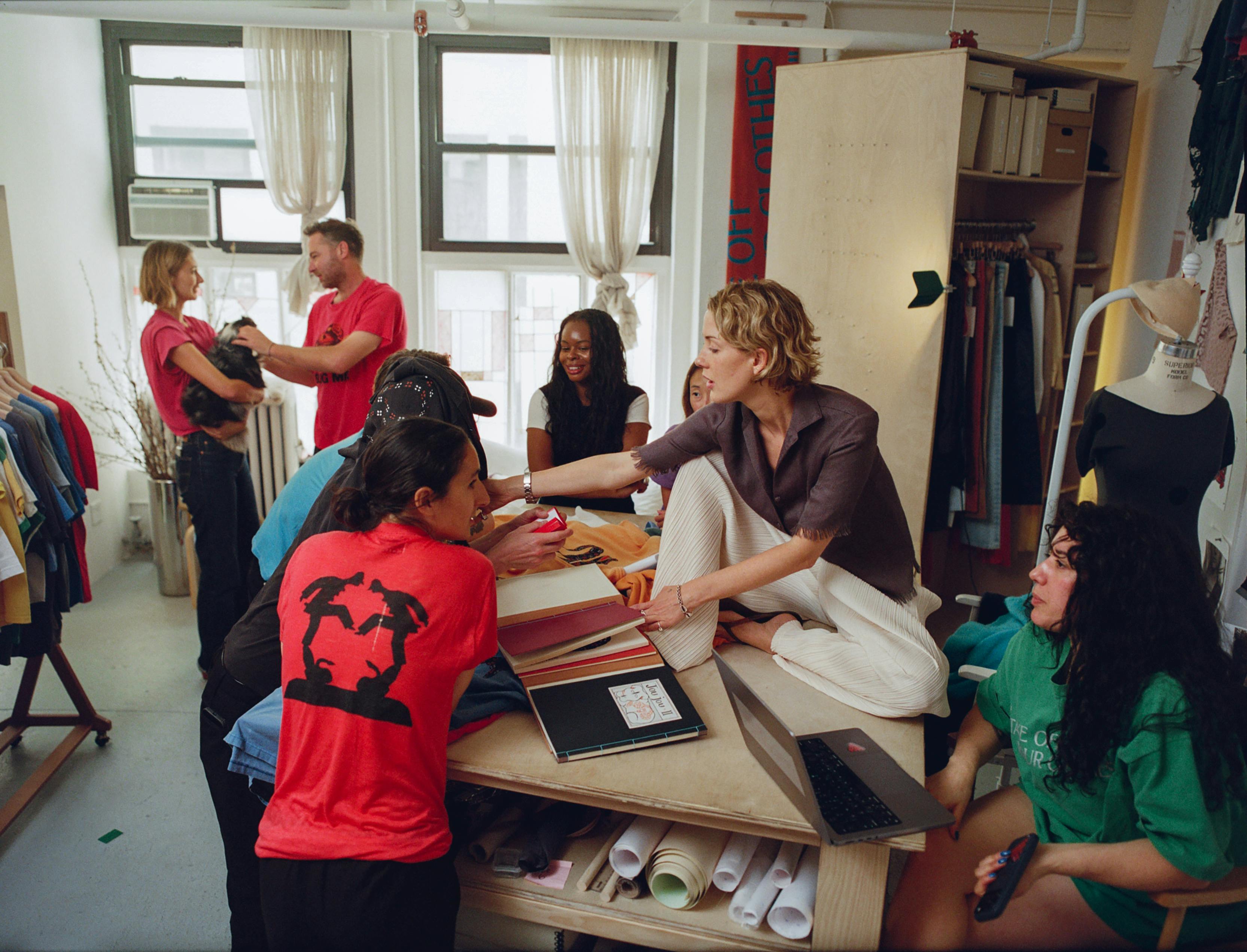
When she first came to Chrystie Street, everyone worked in one room. It was really hot, she tells me. Kinetic, chaotic. It was fun, but it had to be temporary. Over time, her neighbors on the floor started to leave. An architect friend gave up his office, so she turned it into hers. A one-man pickling operation gave up his pickling room; it became a VIP showroom. The space started to come together. She collaborated with a woodworker to make shelves, a coffee table. Her friends came and visited her at work. Not long after, so did everyone else. It has been about a year since Emily Dawn Long took over the sixth floor of 195 Chrystie. The studio is housed in an unassuming office building. When you get off the elevator, you go down a long white hallway. You smell the series of rooms before you see them: Flamingo Estate’s tomato-scented candle burns in each one. Dawn Long’s office comes into view, all light-colored wood, a big desk, a work table. Her stockroom is behind it, ruthlessly organized, full of interns. At the end of the hallway are the two showrooms. “The Boys’ Room,” aka the VIP showroom, is carpeted, no shoes allowed (XXL Japanese slippers are available for guests), a deep closet, a set of leather poufs. The third room is the one you’ve seen, perhaps on Instagram. This is “The Yellow Room,” also known as The Shop. Light blue floors, high ceilings, lots of light. Everything is where it belongs. French barrettes are arranged in neat rows. A soft yellow curtain with cutouts (also a shawl) is draped over a tension rod. There’s a plate full of small charms. A cowrie shell bracelet and a cowrie shell necklace, both made of burnished metal. On the wall there are dozens of reference images. Old collections she likes, stills from films, swatches of fabric. The clothes all hang on one long rack. There’s a long green dress with a drop waist and an entirely open back. A plaid button-up men’s shirt. The shirt is called Jeff. A sheer gold disco dress. Coffee-colored trousers. A baseball cap that says, in all caps, “TAKE OFF YOUR CLOTHES.” This showroom-slash-studio-space-slash-office-slash-beat-lab looks a lot like the inside of Dawn Long’s brain. “I don’t know if it phases me now that I have all of this space,” she says. When I visit in June, Dawn Long is getting ready to travel to Paris for Men’s Fashion Week. She’s going to throw a big party at a club where you actually have to dance. She’ll also have a showroom set up, but she won’t be showing a whole new collection. Instead, she’ll bring some fan favorites: vintage T-shirts screenprinted by a friend in Brooklyn with things she likes, such as two ladybugs on top of each other with the slogan “BUG ME!” An image of a dragon from a book of Japanese woodcuts. All of these images come from the ecstatic moodboard that is Dawn Long’s head. She is expecting all of it to sell out pretty quickly because it always does. Dawn Long is someone who launched a brand for a built-in audience. Fellow New Yorkers who work in the arts. Cool people who know cool people. Her clothing sells well, she’s in demand, coveted by everyone from the very famous to my friend who is training to be a Lacanian analyst to the girls who host the popular fashion podcast Nymphet Alumni (and who recently waxed poetic about Dawn Long’s ability to “scoop the fuck out of the back” of her tops and dresses). Part of this is because of the way you interact with her clothing. Dawn Long is selective about which stockists she works with, encouraging people to make an appointment to come to Chrystie Street and try on items in her showroom. During my visit, we play a little dress-up. I make a few vague comments about what I’m looking for — “some kind of dress?” “pants??” — and she goes into her stockroom and hands me some things she thinks will look good on me. A white 1920s-style drop-waist dress called Dammit Janet, named after her mom. A pair of foldover pants, also in white. I look at myself in the mirror while I’m wearing the dress. “This is doing something really good to my body,” I tell her. Dawn Long’s friend Nile Greenberg, the architect who also used to rent on Chrystie Street, tells me that she “has a very keen sense of understanding what people really want. She makes things that have value to people.” Her brand is “a social project in the way that Vivienne Westwood was a social project,” Greenberg adds. “Or older designers, all the way back in the ’50s, where they would really work with people in this much more direct way. Not this elitist form of fashion. No one else does what she’s doing.” Dawn Long is a designer who works very intuitively, serendipitously, too. Prior to launching her namesake line in 2019, she spent almost a decade working elsewhere in fashion. In college at SCAD in Georgia (the state where she grew up), she initially wanted to study interior design, but she switched to fashion, following the advice of her professors. After graduating, she worked at brands such as 3.1 Phillip Lim and Jill Stuart. Then, in 2016, she had a brief stint as a photo editor at Vogue.com where she was fired after posting a picture of herself on Instagram in a nude bodysuit. Around this time, she read an editor’s letter by Olivier Zahm of Purple about freeing the nipple. “I was, like, drunk and sent him the photo and told him it had gotten me fired from Vogue. You should hire me. He responded and was like, ‘Funny you say that, my assistant just left and I’m in New York right now.’” She did everything at Purple. She booked models, she styled, she assisted. “I forgot my own social security number at one point,” she says, “because I was doing so much.” Assisting Zahm led Dawn Long to Los Angeles, which led her to a chance meeting with Amber Heard, then a brief career as a celebrity stylist working with Heard and her then-boyfriend Elon Musk. Styling wasn’t what Dawn Long wanted to do for the rest of her life. She styled Musk and Grimes for the Met Gala, then decided she was out. “I feel like I’m a cat with nine lives,” she says.She never really set out to make clothes; she just wanted to make things that made her friends’ lives easier. In practice this involved a lot of crowdsourcing: asking the people in her life what they were looking for right now, what they wanted. Was it the perfect dress to wear to a wedding? A sweater that is boxy but soft and plush instead of itchy and scratchy? A silver cowrie shell bracelet that is not entirely silver because it also sports a single gold charm? While I’m hanging out at her showroom, a magazine editor stops by and mentions how hard it is to find a place to buy jewelry in New York City. Later, over a margarita, I mention offhand that I can never find sunglasses that fit my small face. I watch her take mental note of this. “So what we need to do right now,” she says, “is to make sunglasses for thin-faced women and open a jewelry store.” The ideas come fast and loose. “I’m a stoner and I’m ADHD,” Dawn Long says. This means she does a little bit of everything. She designs clothing both for men and women. She also designs spaces, homewares, precious little objects. It means she’s working basically all the time. Dawn Long is a magnetic person to be around. Chaotic and funny. Very referential. She talks fast. She changes her outfit a lot, wearing mostly her own clothes. She has a little blonde pixie that makes her look like Gwyneth Paltrow in the ’90s. She loves ladybugs so much that she collects dead ones that she finds in the studio (“They follow me around,” she says). She is one of those people who either texts you back in five seconds or in two days (I am also like this). And while I’m with her, she constantly jots down notes. Or she’ll call for her studio manager, Victoria Campilongo, to work through an idea. I’ve written before about why you should basically only buy something if you get to experience it in person. There is no better example of this in practice than spending an afternoon in Dawn Long’s showroom. The stylist Dione Davis met Dawn Long like this: “I DM’d her and said I wanted to buy a hat, and so she was like, ‘Come over to my house and try the hats on.’ I bought a hat and it’s my favorite hat ever,” she says.“She gets ideas in her head and she can execute it very quickly,” Davis adds. “She’s incredibly thoughtful about what the market needs and also deeply strategic from a business sense. I think she’s so intelligent and just playful, too.” “We are constantly sold out of [Dawn Long’s Kipling] tank top,” says Lucy Weisner, one of the founders of Café Forgot. This makes sense to me because I own one of the tanks. I have worn it almost every day that it has been over 80 degrees this summer, including to a rave (it holds up). Weisner also shares that Dawn Long designed her wedding dress (she’s married to Greenberg). Dawn Long’s clothing has also been worn by some very famous people who have been put onto it by their stylists, or just by plain old word of mouth. Like Pedro Pascal. Dawn Long shows me a photo of him wearing one of her shirts taken by his stylist, Jamie Mizrahi (who also styles Jeremy Allen White, another Dawn Long fan). Justin Bieber was recently spotted wearing one of her T-shirts (a long-sleeved purple BUG ME! shirt). Kendrick Lamar and Hailey Bieber have been seen wearing her clothes. “I don’t pay for PR or whatever,” Dawn Long says. “It’s all organic.” Some other cool people who stop by the showroom that afternoon include the aforementioned magazine editor as well as the artist Aria Dean. I stay for the editor’s appointment, and it runs pretty similarly to mine. The editor stays and chats with us for more than an hour. Dawn Long walks in and out of the back room with all of the stock. And the more time I spend in her space, the more I feel like I understand why people are so drawn to her work. Vivienne Westwood, as Greenberg points out, is a fitting analog to what Dawn Long is doing, but so is Halston’s eponymous label. Halston worked in a similar palette to Dawn Long. Lots of color. Sexy clothes that you can really dance in, preferably at Studio 54 (or, if you’re Dawn Long, a sweaty basement downtown with good music). Halston, too, loved a long torso on a dress, a cut-out around the armpit to get some side boob in there. But Dawn Long’s muses aren’t a mute Karen Bjornson or various other Halstonettes. They are the people around her and, crucially, herself. The reason Dawn Long did now show a whole new collection in Paris this summer is a simple one: She is a CFDA/Vogue Fashion Fund finalist. She’ll be showing two capsule collections in September instead. (The prize encourages all of the finalists to show in September.) It’s something that she feels nervous about. Being a CFDA finalist presents an opportunity to deal with what she calls the “tiny chip” on her shoulder (the albatross of institutional validation). She’s ready for Big Fashion to take her seriously. She feels conflicted about what it means for Big Fashion to take her seriously. She wants so much for her brand: to have an ever-expanding, extremely loyal fan base. To make clothes and objects she actually wants to make. To work on her own terms. “My brand has been around for seven years. Everyone in New York wears my brand,” she says. “I feel really happy and satisfied with where I’m already at. I don’t need to do things for recognition.”And yet. She shows me a book she’s made for the judges. “I’m making clothes,” she says, “but it’s also a body of work.” It’s something that lives off of Instagram. The clothes here, from a new collection, come alive on the page. They look beautiful. They’re playful and sexy. Something about them feels more mature. She shows me some of the samples later, in the VIP showroom. In person, the clothes are even more beautiful. They feel like the work of an artist who is entering a transformative period. Dawn Long is becoming someone who does more than make great clothes for her friends. Her vision has crystallized; she is a designer.CreditsBy: Sophie Kemp Photographed by: Maya ToledanoPhotography Assistant: Gili Benita
It’s Emily Dawn Long’s World After All
Full Article
Original Source
Read the full article at Highsnobiety →KhanList aggregates and links to publicly available news content. We do not host full articles from third-party sources. Always verify important information with original sources.