
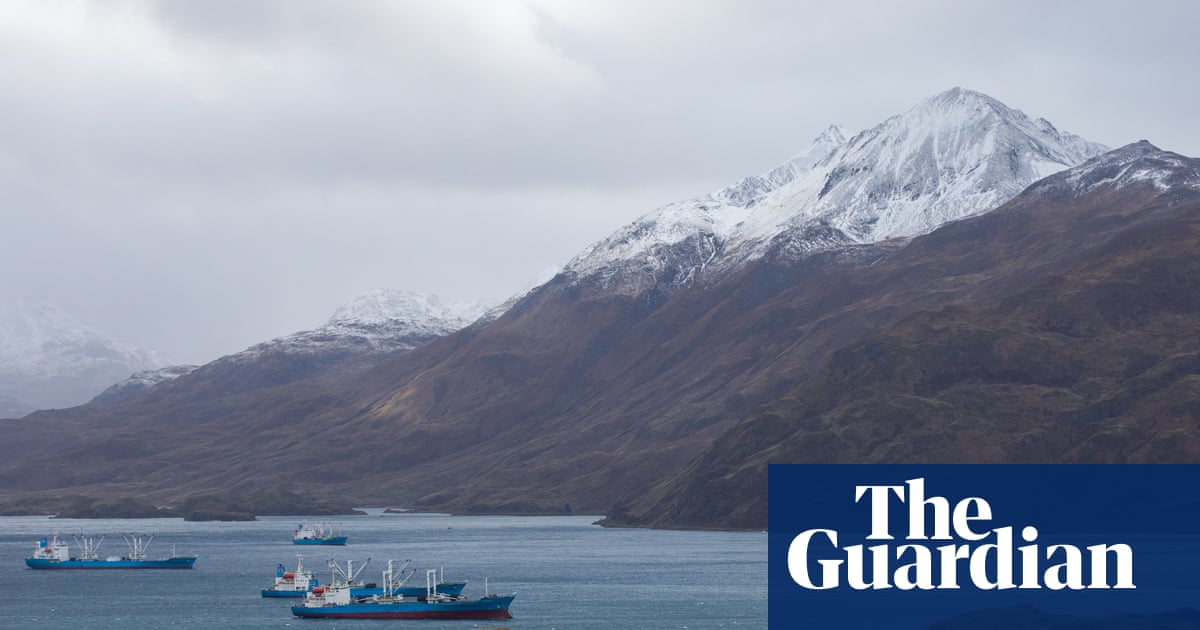
It was less than 17 hours until the start of Alaska’s lucrative Bering Sea crab season, and Oystein Lone was standing on a dock in the city of Unalaska, preparing to embark in rough conditions.The problem wasn’t the next day’s forecast of 60mph gusts, which would kick up white-capped swells and make crabbing, already one of the most dangerous jobs in the United States, even more hazardous. Nor was it the question of whether there’d be enough red king, tanner and snow crabs to go around – state regulators had, in fact, announced higher quotas for the season.What was bothering Lone, as the sun sank lower in the sky that Wednesday evening, was the question of how to make the numbers work when diesel cost more than ever, thanks to the war with Iran.“This is the most challenging time I’ve seen,” said Lone, who has been fishing since 1989. He had already spent $86,000 to put 12,000 gallons of the fuel in one of his two boats, but the price had climbed higher since then, and if he wanted to fill up again, he expected to spend $100,000.Located further west than the Hawaiian islands, Unalaska is closer to Beijing, Tokyo and Seoul than Washington DC. Most visitors arrive on flights from Anchorage, which cost at least $1,600 round trip and are prone to cancellation, due to the region’s unpredictable storms and fog.But Unalaska is by no means a backwater. It has been the country’s most productive seafood port by volume for more than two and a half decades, and when its crab and pollock seasons are open, thousands of deckhands and processors arrive from elsewhere to work tough but well-paying jobs on boats offshore and in seafood plants crowded in the city.Oystein Lone, the captain of the Pacific Mariner. Photograph: Brian Adams/The GuardianEven here, the impacts of Donald Trump’s efforts to remake the US government in his image can be felt. Since Trump returned to the White House, the library, museum, public radio station and local government have had funding they relied on disrupted or canceled altogether. Longshoremen have been tasked with loading empty containers on to ships to avoid tariffs. And the soaring price for diesel has squeezed not just the seafood industry, but all of the nearly 4,300 residents of the city, who rely on the fuel for electricity.“This whole town runs on diesel,” said Daneen Looby, a longtime Unalaska resident who sits on the city council and owns the Norwegian Rat Saloon. With distributors upping the fuel surcharges she pays for food and alcohol shipments, Looby is thinking of raising her menu prices. “I didn’t want to, but I kind of have to, otherwise I’m going to become a charity.”The midterm elections are on Tuesday, and Alaska is set to play a major role in determining if the president’s Democratic foes regain control of Congress. Alaska resoundingly backed Trump in the 2024 election, as did a majority of Unalaska voters, but Democrats believe the president’s plunging public approval ratings together with rising fuel prices have put its two-term Republican senator, Dan Sullivan, at risk of losing re-election to their nominee Mary Peltola, even as scandals rock her campaign.Candidates only occasionally make the trip to Unalaska, and there are just a handful of campaign signs up around town, but outrage over the direction the country has taken since Trump returned to office is prevalent.“I feel like we have a rogue government right now, and I don’t feel like the Republicans are doing their job,” Looby said. “I don’t understand why Congress isn’t getting more involved.”‘In furtherance of the president’s agenda’The name Unalaska derives from a word in the language of the Unangax̂ people who have lived on the island for thousands of years, and roughly translates to “near the mainland” for its proximity to Alaska’s southwestern peninsula.Russian fur traders arrived in the middle of the 18th century, and eventually established a colony that came under American control when Washington purchased the Alaska territory in 1867. As the second world war approached, the US military built bases on the large, mountainous island of Unalaska and the smaller Amaknak island next to it, which were connected by a single bridge in the 1970s. In June 1942, Japan staged back-to-back air raids that killed dozens, and there are still concrete pillboxes and bunkers strewn all over town and on the tops of its treeless, windswept hills.In 2023, the most recent year for which data is available, more than 780m pounds of catch valued at nearly $225m came through its port, Dutch Harbor, according to the National Oceanic and Atmospheric Administration. Pollock, a versatile white fish, is the main product, and if you’ve eaten fish sticks, imitation crab or a Filet-O-Fish sandwich at a McDonald’s in Asia or the United States, its ingredients may well have been processed on Unalaska. The different species of crab found in the Bering Sea are also offloaded here, and the travails of that work are documented every year by camera crews who embark from Dutch Harbor to film the reality series Deadliest Catch.Top: A king crab on display in Amelia’s restaurant. Bottom: Crab pots wait to be unloaded. Photograph: Brian Adams/The GuardianAs soon as he took office in 2025, Trump began signing executive orders billed as rooting out waste from the federal government, together with the efforts of Elon Musk’s now-shuttered “department of government efficiency”. Democrats and good governance groups said the campaign undermined important functions of government, and were of dubious legality.One of Trump’s orders, signed in March 2025, attempted to dismantle a slew of federal agencies, including the Institute of Museum and Library Services (IMLS). The little known office is the source of a yearly grant that Unalaska’s public library receives to buy books, and librarian Karen Kresh expected $6,000 last year, only to be told the money would not be coming.“It had been stable and been reliable for years and years, and that was sort of a surprise to see that instability come up with that grant,” she said.The main repository in the United States for cultural and natural history objects from the island chain is the Museum of the Aleutians in Unalaska. When Trump arrived in office, its staff was at work cataloging a large collection of artifacts dating back to the Russians’ first contact with the Unangax̂, funded by more than $347,000 in grant money from the National Endowment for the Humanities (NEH).At the beginning of April, the museum’s executive director, Virginia Hatfield, received a message saying the grant was being canceled because it “no longer effectuates the agency’s needs and priorities”, and that the funds would be reallocated “in a new direction in furtherance of the president’s agenda”. The cut put the project on hold, and Hatfield was forced to lay off six people.“It’s very heartbreaking, and it kind of truncated important work,” she said.Weeks later, Republicans in Congress approved legislation ending funding for public media outlets, which they have long accused of broadcasting news with a liberal bias. The decision had significant implications for Alaska, the largest state in the country which is full of small, remote communities – like Unalaska – unreachable by road, and where cellphone service can be unreliable.That makes radio the best way to get word out when an emergency strikes, and the same day the Senate began debating whether to cut funding, the island’s public broadcaster KUCB was putting out warning of a potential tsunami. The wave did not arrive, and the station lost half of its budget after Trump signed the bill, said Lauren Adams, the general manager. In the months that followed, KUCB, along with other public media outlets nationwide, experienced a surge in giving from outraged listeners. It was also among more than a dozen Alaska stations to receive temporary funding from the Bureau of Indian Affairs (BIA).Lauren Adams of KUCB radio pictured in Unalaska. Photograph: Brian Adams/The GuardianThe station now has reserves in the bank, Adams said, but no long-term solution to the question of how to stay open, with annual federal funding gone.“When you get just this windfall fundraising from around the United States, what’s the sustainability of that?” Adams asked. “Eventually, we’re going to run out of those reserves and things that kept us going.”Lost opportunitiesThe second Trump administration hasn’t solely been a disruptive force in Unalaska.Iliuliuk Family & Health Services is the city’s only clinic, and deals with everything from checkups to emergencies. Soon, they will open a pharmacy that can replace the mail-order drugs most residents rely on, thanks to more than $400,000 from the federal Rural Health Transformation Program.Created by the One Big Beautiful Bill Act, Trump’s main domestic policy legislation, the program was conceived to address concerns from Republicans that cuts to the Medicaid health insurance program for poor and disabled Americans included elsewhere in the legislation would put rural hospitals out of business.Most of the Medicaid provisions have not taken effect yet, but hospitals nationwide remain concerned that even with the Rural Health Transformation money, they could lose patients vital to keeping their doors open. Christy Fassbender, Iliuliuk’s chief operating officer, said that is unlikely to be an issue in Unalaska.“We have a very small Medicaid population. We are less than 6% for Medicare and Medicaid, and that is because this is a working town,” Fassbender said.Nor has the chaos the federal government experienced when Trump first began his term been permanent. In June of this year, the Museum of the Aleutians was notified that the grant from the NEH was back on, though in the time that the funding was canceled, the project director and outreach specialist Hatfield hired found other work, and the professor who had excavated the artifacts providing a glimpse into Unalaska’s past died.The IMLS eventually restored the funds the library uses to buy books. But recently, Kresh learned that the Federal Communications Commission was considering ending E-Rate, a program that helps the library and Unalaska’s school district provide internet access. If that were to happen, she said, the library would have to look for another way to cover the expense of offering the only free, public wifi in town, which residents and visitors rely on to apply for jobs and stay connected to the world. NEH grants that had been cut nationwide were restored after a lawsuit, and a different suit halted the closure of the IMLS.Unalaska has felt other consequences of Trump’s presidency, for which there appears to be little recourse.At Unisea, one of the largest seafood processors in the city, they’re rebuilding their workforce after shifting away from foreign guest workers, visas which have long been hard to get and eventually became too unreliable, director of Alaska operations Ron Kjorsvik said.Unalaska has felt the consequences of Trump’s presidency. Photograph: Brian Adams/The GuardianThe only foreigners still doing the difficult work of processing pollock, crab, black cod and halibut are 15 Ukrainians on a special visa for nationals of the war-ravaged country, but they’ll be leaving soon – none had their visas renewed, Kjorsvik said.A group of congressional Democrats led by Virginia’s James Walkinshaw had complained to US Citizenship and Immigration Services (USCIS) in March about delays processing such applications, and in a reply seen by the Guardian, the agency’s director said USCIS had “many competing priorities and urgent requests for consideration daily”, and could not “prioritize” Ukrainians with U4U visas.Seafood processing plants on the islands, meanwhile, have their own generators supplying electricity, while the rest of the city runs on a separate, generator-powered grid. Unalaska’s leaders have long contemplated alternatives, including the possibility of tapping geothermal power from a nearby volcano.Under Joe Biden, the Department of Energy (DOE) established the Office of Clean Energy Demonstrations, and Unalaska’s utility director, Erik Hernandez, said the city was in the process of applying for funds to install five one-megawatt wind turbines and a battery system on a windy parcel of land, which could have replaced most of their diesel generators. But after Trump took office, the DOE stopped communicating about the grant, and in June 2025, the city was informed the money was no longer available.The DOE did not respond to a request for comment. Earlier this year, the US Government Accountability Office found that the Office of Clean Energy Demonstrations had lost 85% of its staff over the first six month’s of Trump’s second term, and placed a stop work order on all contracts.The city was as reliant on diesel as ever when the Iran war began and crude oil prices rose in tandem, and the fluctuating rate that Unalaska charges power users to cover the cost of fuel has climbed almost two thirds, from $0.22 per kilowatt hour last year, to as much as $0.36 now, Hernandez said.The fuel price increase has furthered the stress on a fishing industry that was already not having a great year. Pollock in 2026 have been small and scarce, and storms have been frequent. That has meant less work for Dutch Harbor’s longshoremen who move refrigerated shipping containers filled with seafood onto ships bound for Asia or the US west coast. Shawn Schomer, the International Longshore and Warehouse Union’s shop steward at Matson, one of the major shipping lines serving the port, said he’s recently been getting a new and unusual request from his superiors.Certain shipping containers that remain for too long in the United States are considered imports, and thus subject to the tariffs Trump has slapped on trading partners globally.“We got to get these tariff cans out of here. That’s what the management tells us,” when it asks for the containers to be loaded on outgoing vessels, Schomer said.“It can’t be good business to bring in empties and then have to sort them and ship them back out empty,” he said. A spokesperson for Matson declined to comment.‘We’re at the bottom’Lone, 58, has spent his adult life fishing, and expects the high price of diesel to ripple through his industry. Crew members can make six figures in a season, and will see less money, since vessels’ overhead impacts their pay, and the price boats get for their catch could also fall, because processors and shippers will similarly be looking to offset their fuel costs.“Unfortunately, we’re at the bottom. We take the beating,” Lone said. “Everybody else just passes on their cost to us.”He wonders if some of the Republicans he had previously trusted to stand up for Alaska’s interests in Washington DC were doing their job.“I support Sullivan and Begich, but I’m not too sure if they’re doing much for us,” he said, referring to the state’s junior senator and congressman, Nick Begish, respectively. While Lisa Murkowski, the senior senator, has opposed the Iran war and the effort to cut public media funding, Sullivan and Begich supported both, and are facing fierce challenges to their re-elections this year.Captain Chris Studeman of the Kevleen K boat pulls out of the harbor to go crabbing. Photograph: Brian Adams/The GuardianAs he waited to unload a 135-ton haul of pollock, CJ Peterson, captain of the trawler the Pacific Challenger, said he had been contemplating how much more his business could take. One of Alaska’s native corporations owns his vessel, and Peterson knows the grim economics could some day keep him and his crew on land.“If the fish price doesn’t match the fuel costs, they’ll shut us down,” Peterson said.Captain Chris Studeman was not waiting for that to happen. The evening before the noontime start of crab season, he gassed up his boat, the Kevleen K, at one of Unalaska’s marine fuel terminals, and tried not to think about how much more he was paying this year than last.“Don’t have much choice,” Studeman yelled from the bridge, as his crew prepared the vessel, painted white and green and laden with crab pots, to cast off. “Can’t really change your plan. You just got to go for it.”And with that, he turned to port and headed north-east, away from Unalaska and into the Bering Sea.The Kevleen K pulls away from shore. Photograph: Brian Adams/The Guardian
It’s closer to Beijing than Washington – and residents of this Alaskan outpost are reeling from Trump’s policies
Full Article
Original Source
Read the full article at Theguardian →KhanList aggregates and links to publicly available news content. We do not host full articles from third-party sources. Always verify important information with original sources.