
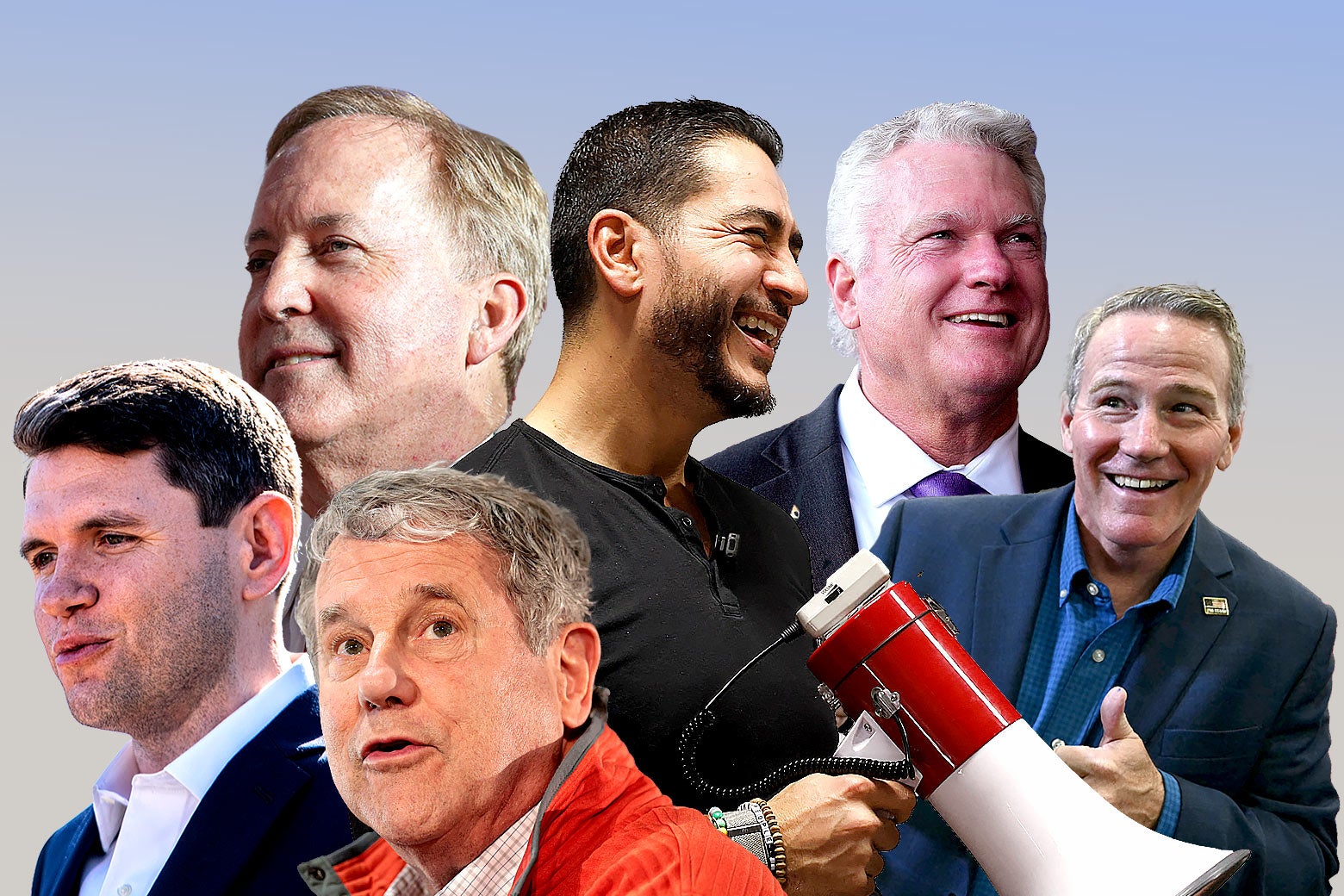
Politics But there’s been progress if you look closely. Photo illustration by Slate. Photos by Sergio Flores/Getty Images, Win McNamee/Getty Images, Michael M. Santiago/Getty Images, Jeff Kowalsky/AFP via Getty Images, Eric Lee/Getty Images, and Kent Nishimura/AFP via Getty Images. Sign up for the Slatest to get the most insightful analysis, criticism, and advice out there, delivered to your inbox daily. In the world of Trump 2.0, perhaps the most notable thing about the left’s collective reckoning with the re-rise of Trump is that it’s been less about Donald Trump himself than a grappling with—and feverish denouncing of—the excesses of Woke 1.0. An overemphasis on race and gender, the now contemporary wisdom goes, combined with a pitched political moment and a large helping of pandemic mania, led many progressives—earnest activists, sanctimonious social media stars, even grandstanding elected officials—to take up positions that struck the average voter as weird, performative, censorious, or even threatening. Now, it seems, one of the only things uniting the broader left is that Woke 1.0 was crazy. A lot of Woke 1.0 was crazy. But the complaints at its core were not. The quick retreat from talking about race and gender is particularly unfortunate because noting pervasive inequalities could have been an advantage for Democrats if done right, especially given the attacks on immigrants and on abortion rights during Trump’s first term. Those issues certainly helped galvanize voters for Joe Biden in 2020, and after the Supreme Court overturned Roe v. Wade, young female voters in particular were livid. But progressives did not exactly stay focused. The GOP did, campaigning on marginal but highly inflammatory issues like trans women in sports and leaning into, rather than away from, the support of rank misogynists. While the left was debating whether we could say that women have abortions rather than the non-gender-specific people, the right was embracing the kind of men who say that women shouldn’t vote, are male property, and are responsible if they’re raped. We know what happened next: Trump won, and the misogynists crowed. (“Your Body, My Choice” was the viral postelection slogan of the online far right.) Ever since, Democrats have quieted down on racism and sexism. Even though roughly a third of American women (and more than half of Black women) live in a state that criminalizes abortion, reproductive rights have hardly been at the forefront of the midterms. The Women’s March is defunct. (No Kings rallygoers are not crying “Yas, queen!” out there.) Landmark civil rights legislation has been systematically dismantled, and any efforts to improve diversity, equity, and inclusion are not just mocked but, in many places—including in government contracts and U.S. foreign aid—totally verboten, the kind of behavior that could get your organization defunded and you personally fired. So perhaps it’s not surprising that the big races to watch in 2026 have seemed conspicuously male. Think of the Democrats who may grab Senate seats or maintain battleground ones: Abdul El-Sayed. Troy Jackson. Jon Ossoff. Sherrod Brown. James Talarico. Adam Hamilton. Among Polymarket’s five biggest races, all of the candidates are men, with the single exception of Susan Collins, in Maine. Close races in Nebraska, Ohio, Georgia, and New Hampshire all feature the same man-vs.-man dynamic. There are exceptions, of course. Three Republican women are running in the country’s most contested races: the aforementioned Collins, Ashley Hinson in Iowa, and Ashley Moody in Florida. Mary Peltola’s campaign in Alaska has been such a success that the Trump administration has already asked the courts to refuse to certify the election if she wins. Angie Nixon, the Democrat running in Florida, has been one of this year’s most exciting surprises—she’s a DSA candidate who initially got little establishment backing but now is running neck and neck with her opponent. But of 22 candidates vying for the most hotly contested Senate seats this year, just five are female. Only one (Nixon) is Black. Whom Democrats select to run their most important races matters, and the underrepresentation of women in these major races certainly says something about the political moment we’re in. But it’s also not the whole story of gender in the midterms. Woke-wary Democrats may not be talking about it, but there are a record number of women running for House seats this year, with the growth entirely on the Democratic side of the aisle. There are a record number of women running for governorships as well—with, again, the growth thanks to Democratic women. The Senate is a less heartening story—numbers of women running are down on both sides from 2020 and 2022 highs—but there are at least many more female candidates in Senate races this year than there were in 2024. And in most of the highest-profile House races, the Democratic candidates are female. This is still not, obviously, a vision of equality. Women account for only about a third of Democratic candidates, and only about a fifth of Republican ones. Feminists have rightly emphasized the dearth of women in American political office and critiqued all of the ways in which the deck is stacked against women’s electoral success: less funding, more scrutiny on their personal lives and appearances, the way power has long been coded as male. In the Goldilocks game of American politics, female candidates are always a little too something, or not quite enough—never the just-right fit. “I’d vote for a woman, just not that woman” is a dark cliché for a reason. But something interesting is happening here too: A whole lot of women are running for office, and few are remarking on it. This suggests that female candidates are increasingly seen as, well, normal. Such is the unsteady path of progress and the reality of social change: It often seems to be accelerating very quickly, but in the aftermath of that acceleration, it moves slowly enough as to sometimes be invisible—until, one day, you look up, look back, and see just how much ground has been gained. In 2016, when Trump took the presidency for the first time, women made up just 17.8 percent of U.S. House candidates; this year, they’re 27 percent. In 2016, 40 women ran for Senate seats; of those, 15 won their primaries and competed on national Election Day. This year, 65 women ran, and 19 moved forward to be on the November ballot. This is not a rapid rate of change. But it is change. There remains far to go. Sixteen states have still never sent a woman to the U.S. Senate. Seventeen have never elected a female governor. Mississippi has never sent a woman to the House at all. And of course, Americans have never put a woman in the White House. Still, it is something of a relief to see women running for office being treated as unremarkable. Feminists want women to be equally represented in the halls of power. But we also want to move away from a cultural view that treats men as the default and women as aberrations, or at least variations on a male norm. One sign that men are no longer widely viewed as the default face of political power is that women are competing for that power in larger numbers, and with less pushback or even notice. It may seem counterintuitive, but in some ways, the sound of progress is the sound of silence. Women 2026 Midterms
It’s Been a Very Male Election Cycle. There’s Still Room for Hope About 2028.
Full Article
Original Source
Read the full article at Slate →KhanList aggregates and links to publicly available news content. We do not host full articles from third-party sources. Always verify important information with original sources.