
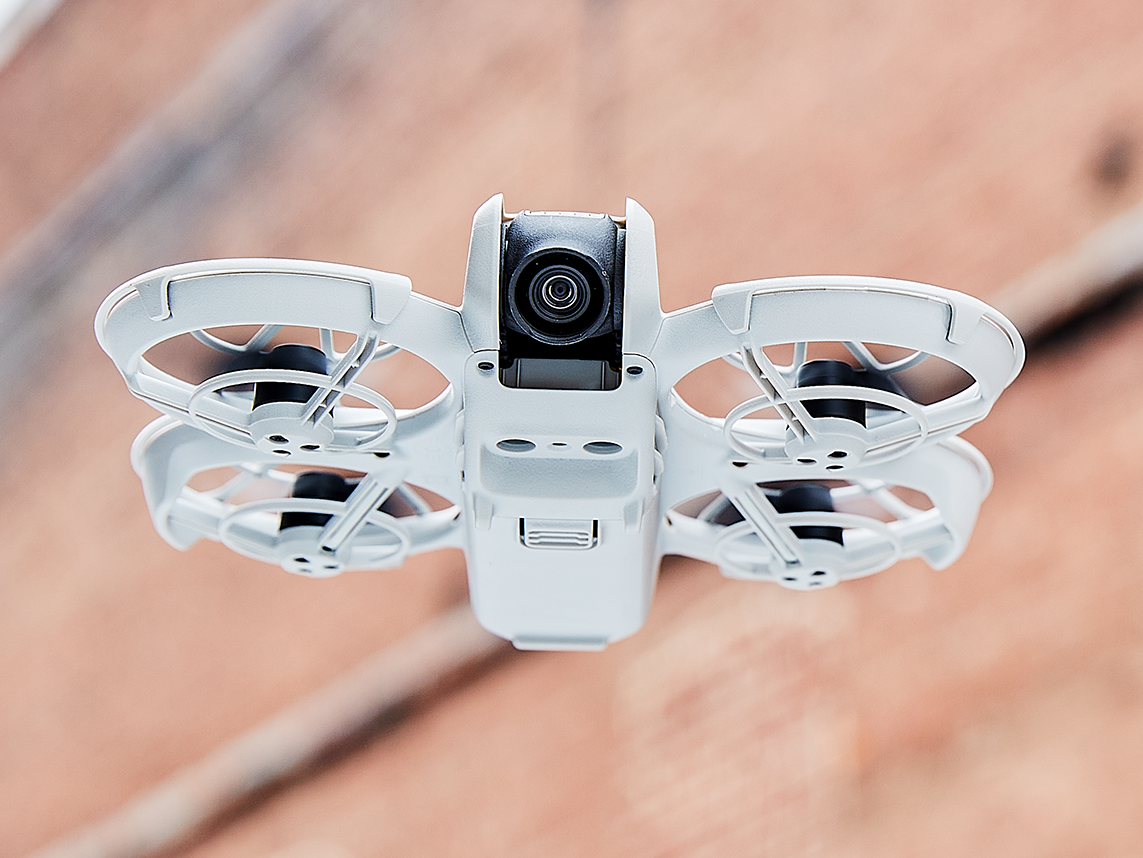
ProsLong range and flight timeTri-camera design produces high quality video and photosConsPro-grade performance, pro-grade price tagDJI’s U.S.-available flagship drone, the Mavic 4 Pro, offers perhaps the best camera capabilities and clarity of footage of any consumer-grade drone out there right now. It has three distinct cameras: a 28mm lens for crisp details and low-light shooting, a 70mm medium tele lens for portraits and medium-range shooting, and a 168mm tele lens for long-range shooting. They operate on a 360-degree gimbal, so you have full control to record stills and video up close or from a distance, and at any angle.Beyond the cameras, the drone comes with a powerful motor and long-lasting battery that allows you to fly in windy conditions and still come home with stable, clear footage. We don’t expect the average person to need three high-resolution cameras, 51 minutes of battery, and a top speed of 50 mph, but if you’re more than a hobby flyer, it’s hard to find a better choice.Key SpecsCamera6K/60 fps video, 28mm 100MP main, 70mm 48MP tele, and 168mm 50MP teleFlight Time51 minutesTop Speed50 mphRange25.5 milesProsEnclosed propellers protects drone during a crashAffordable price pointConsNot as agile as larger DJI dronesOne of the most affordable and easy-to-fly drones from DJI, the original DJI Neo is an older model that’s perfect for a beginner who wants to learn the ropes. The caged propellers are very helpful to pilots who lack a certain level of nuance with the controls and are prone to crashing. The cage prevents damage to the propellers or the motor.At the same time, in our own testing, the Neo was exceptionally easy to steer with smooth, responsive controls and several preset flight modes that fly the drone automatically in specific patterns. While you can’t expect professional-grade footage, the 4K camera will be more than enough for casual fliers.I’ve rated this drone so highly because the price tag is so low. There is a newer version, the Neo 2, with better specs, and normally I’d recommend going with the newer model to reduce the chances that DJI might stop supporting the Neo with security updates. Given the circumstances, though, future-proofing is less of a factor here. And it’s very hard to pass up a drone of this quality at such a low price.Key SpecsCamera4k/60 fps (12-MP photos)Flight Time18 minutesTop Speed36 mphRange6.21 milesAdvertisement - Continue Reading BelowProsThermal camera has real-world public safety applicationsSolid range and speedConsNot built for regular flying and recordingThe Autel Evo II is a thermal imaging drone, primarily designed for search and rescue operations, power plant inspections, and even to assist firefighters. In theory, it could also be a useful tool for hunters looking to identify wildlife from a distance. Its thermal imaging camera can detect a subject from up to 100 meters away, even if they’re visually obscured by brush or obstacles.It’s also quite powerful: The Evo II can fly up to 45 mph, so it can reach the edge of its nine-mile range in just 12 minutes. With 16x zoom, it can also scan nearby areas for small thermal signatures with relative ease.Between its specific use case and very high price tag, this is not a drone for the average person. But it should be very capable in the right hands.Key SpecsCamera640/25 fps (thermal camera), 4k (visible camera)Flight Time38 minutesTop Speed45 mph (ludicrous mode)Range9.32 milesProsFoldable, portable designAutomatic flight modesLike the DJI Neo, the HoverAir X1 is a small camera drone that’s both durable and fairly affordable, which makes it a great choice for beginners. The biggest difference is that the X1 is made for truly novice pilots who don’t trust their skills at all.While you can fly it manually, the drone comes loaded with a number of preprogrammed flight patterns and flying modes that don’t require any piloting at all. The auto-follow feature allows you to essentially launch and forget about it. At a top speed of around 15 miles per hour, you can bike or even snowboard with the drone to capture footage.At the same time, the propellers are protected by the wraparound frame made of a flexible polymer. So, in the case of a crash, no harm, no foul. I personally love the foldable design. Folded down, I’m able to fit the entire drone in my pocket.Key SpecsCamera2.7K at 30 fps (12-MP photos)Flight Time11 minTop Speed15 mphRange3.1 milesAdvertisement - Continue Reading BelowProsExcellent camera for the priceHigh wind resistanceConsNo app-based controlsThe drone we recommend for most people, regardless of experience or use case, DJI Mini 4K, is a decently affordable jack-of-all-trades.For $300, the Mini 4K has a ton of great features that empower both new and veteran users, including pre-programmed routes, one-touch takeoff, and an automatic return-to-home system. The GPS-enabled return home system is a popular feature on many drones but one not common on a model in this price range.That said, the Mini is more than a mere fly-toy. It features a 4K camera and level 5 wind resistance, allowing it to handle in gusts up to 24 miles per hour so you can film on gusty days. The battery life is short, but functional: With the three batteries you get in this set, you should get over 90 minutes of flight time, so it’s set for leisurely flight or most short-term survey and recording tasks.Key SpecsCamera4K/60 fps (48MP photos)Flight Time31 minutes (62 total with extra battery)Top Speed35 mphRange3.7 milesProsGPS auto return featureOver 30 minutes of flight timeConsNo built-in obstacle avoidanceThere aren’t many drone brands with a reputation for making reliable “prosumer” drones that deliver the kind of build quality and performance you want for serious projects at a price hobbyists can afford. As a result, DJI has become a singularly dominant brand, but there are brands like Potensic out there cultivating a similar track record, even if their footprints are smaller.The Atom SE is another great starter, given the price and solid maneuverability. It’s a very solid drone with a lot of cool features and few significant downsides. It can fly continuously for over 30 minutes on a full charge, films in 4K, and has a few programmable flight modes for hands-free flying.Another unique feature is the GPS auto return: No matter where you are, you can press a button and the drone will begin flying to you. This particular SE kit comes with a controller that is compatible with your smartphone for integrated flying and real-time footage.Key SpecsCamera40k/30fpsFlight Time62 minutesTop Speed36 mphRange2.5 milesAdvertisement - Continue Reading BelowProsFoldable designMore pre-programmed flight patterns than the X1ConsLow battery life per chargeWith a more powerful motor and a greater selection of preprogrammed flight patterns than the classic X1, the X1 Promax is a definite upgrade on the classic X1 for folks looking for a bit more power and a wider array of features, even as they’re still getting the hang of drone control.Much like the X1, the Promax is both supremely portable and durable. The protective cage around the propellers means it can take a ton of pretty hefty crashes without causing any serious damage. At the same time, it has the same foldable build so it fits perfectly in a pocket. That makes it an awesome action cam alternative for outdoor adventurers who want a remote cameraman to help film extreme sports like snowboarding or dirt biking.Read Full HoverAir X1 Promax ReviewKey SpecsCamera8K at 30 fpsFlight Time16 minutesTop Speed26 mphRange3.1 milesProsResponsive flight controlsWork with or without a remote controlConsDelicate build may crack if crashing from a heightLike the X1 Promax, the Potensic Atom 2 drone offers a more feature-rich (and expensive) step up from the brand’s basic Atom SE. The drone has an incredibly clear 4K camera, over 30 minutes of flight time, and a pretty impressive top speed of close to 36 mph. In comparison to the SE, the Atom 2 makes some notable improvements. These include filming at a higher frame rate, offering more than double the range, providing a three-axis gimbal for greater video stability, and including AI digital tracking for better hands-free flying.During testing, I was really impressed by how responsive it feels in the air. I was a novice pilot when I used it, but was able to fly it with more finesse and nuance than many of the drones I’d tried before, including some more expensive models. And it’s easy to fly the Atom 2 by pairing it with your phone, though the kit I’ve highlighted here comes with a dedicated controller with a large view screen.If you want clearer, cleaner footage and a bit more power from your motor, this is your answer over the Atom SE.Read Full Potensic Atom 2 ReviewKey SpecsCamera4K at 30 fps (48 mp photos)Flight Time32 minutesTop Speed35.8 mphRange6.2 milesAdvertisement - Continue Reading BelowProsImproved stability over the NeoCaged design offers solid durabilityThe DJI Neo 2 is another upgraded riff on a core favorite of mine, with some notable upgrades and a substantially higher price tag. Unsurprisingly, this upgraded model features upgraded performance across the board, including stronger wind resistance, faster tracking speed, and two-axis stability for smoother video while hovering or flying. It’s also still quite durable, with enclosed propellers that provide extra protection against crashes that might otherwise cause damage to delicate parts of the drone.Key SpecsCamera4k/60 fpsFlight Time19 minutesTop Speed26.8 mphRange6 milesProsNight mode is great for shooting in the darkGreat battery lifeConsAvailability goes in and outThe Atom 3 is Potensic’s newest drone, and the brand’s flagship model. Its best quality is its tremendous battery life, up to 50 minutes of continuous flight on a single charge. The camera also gets an upgrade, with a three-axis gimbal for more control and better stability while shooting on the move, even in high winds.It also boasts a solid top speed of 36 mph, a 4K camera with an AI-enhanced night mode for better clarity during night shoots, and a nearly 10-mile range, which is notably larger than both the Atom SE and Atom 2.The improvements on the Atom 3 won’t be huge for the average flier, but could definitely make a difference for those shooting serious footage or who want to fly for a lot longer before swapping batteries. If the Atom SE is for the new pilots, and the Atom 2 is for moderate hobbyists looking for a premium camera, then the Atom 3 is a serious upgrade for expert pilots who need both precision flight control and a prosumer-grade camera.Key SpecsCamera4k/60 fpsFlight Time120 minutes (three batteries), 50 minute extended batteryTop Speed36 mphRange9.9 milesAdvertisement - Continue Reading BelowPros360-degree cameraImmersive viewfinder gogglesEasily the most notable new drone of 2026, the Antigravity A1 is a high-end camera drone built for speed and aerial acrobatics. The controls include a pair of viewfinder goggles that give you the full UAV pilot experience, which should make for more thrilling flights. (And more precise recording if you’re using it for creative work.) Meanwhile, the hand controls blend conventional button inputs with motion controls for smooth turns and nuanced, intuitive flight control.Candidly, I haven’t tested the A1 yet, but I’m hoping to soon. It’s an interesting and exciting take that represents everything we’d like to see when and if the drone market restabilizes.Key SpecsCamera8k/30 fps 360 degreesFlight Time39 minutesTop Speed35.8 mphRange6.2 milesHoly Stone isn’t as well known as many of the other brands on this list. The brand makes affordable drones with functional controls and solid design. The HS360E isn’t quite as impressive as DJI’s Mini or the HoverAir X1 on paper, but you’re still getting a 4K camera drone with some premium features at a very reasonable price.Key SpecsCamera4kFlight Time30 minutesTop Speed15.6 mphRange3.78 milesAdvertisement - Continue Reading BelowProsAcrobatic capabilitiesWrist activated controlsConsUsers report battery life is often lower than 23 minutesAnother drone that lets you see through the camera using display goggles, the DJI Avata 2 is ideal for acrobatic flying and high-speed video on a bit more of a budget. The goggles offer real-time POV footage of what your drone sees while the one-handed control works using the motion of your wrist to turn or accelerate.What sets this drone apart from most others is how capable it is of genuinely acrobatic flight. It can flip, roll, or even drift 180 degrees with ease, so you can pilot it hard and with intention without fear of going beyond its means.Key SpecsCamera4K/60fpsFlight Time23 minutesTop Speed42 mphRange8 milesPros45 gigabytes of internal storageOmnidirectional obstacle sensionConsExpensive baseline priceWith a close-to-45-minute flight time and both medium- and wide-angle cameras, this is a great drone for long filming sessions over landscapes. In fact, the drone even comes with 45 gigabytes of internal storage so you can save tons of footage directly to the device without worrying about uploading it to a cloud-based storage system.The Air 3S also has omnidirectional obstacle sensing so it will make adjustments to avoid crashing into walls or trees even when flying at high speeds.Key SpecsCamera4K/60 fpsFlight Time45 minutesTop Speed46.9 mphRange12.4 milesAdvertisement - Continue Reading BelowProsBuilt-in bubble machineIncredibly affordable priceI wouldn’t expect this drone to win in a race, but a bubble drone seems like a pretty good time if you’ve got young kids, and it’s the only one I’ve seen from a notable brand with this kind of a feature. The HS320 bubble drone is built with an internal bubble machine that sprays hundreds of bubbles as it flies over you.Notably, this drone does not feature a camera. That it’s more of a toy than a tool works in its favor, I think, because that keeps the price down. At under $100, this is a great way to liven up an afternoon in the backyard, but also a really easy entry point for folks who want to learn how to fly.Key SpecsCameran/aFlight Time30 minutes (two batteries)Top Speed12.3 mphRange1.86 milesTom Price is a reviews editor for Popular Mechanics while also contributing to Runner's World, Best Products, and Bicycling. Here at Popular Mechanics, Tom loves testing out home appliances, smart tech, gear for city life and outdoor adventures, small gadgets like watches and multitools, and anything else you can find piled up at his hoarder's nest of a desk. Prior to working here, Tom attended NYU, graduating with a degree in English and a minor in creative writing. He also wrote for Best Reviews, The Daily Beast, and other publications covering tech, fitness gear, gadgets, and lifestyle products. Furthermore, he covered startup news, pop culture, and even professional wrestling. To follow more of his work, check back here for new stories.
It’s Almost a Year Since the FCC Banned Most New Consumer Drones: We Rank the Ones Still on Sale
Full Article
Original Source
Read the full article at Popularmechanics →KhanList aggregates and links to publicly available news content. We do not host full articles from third-party sources. Always verify important information with original sources.