
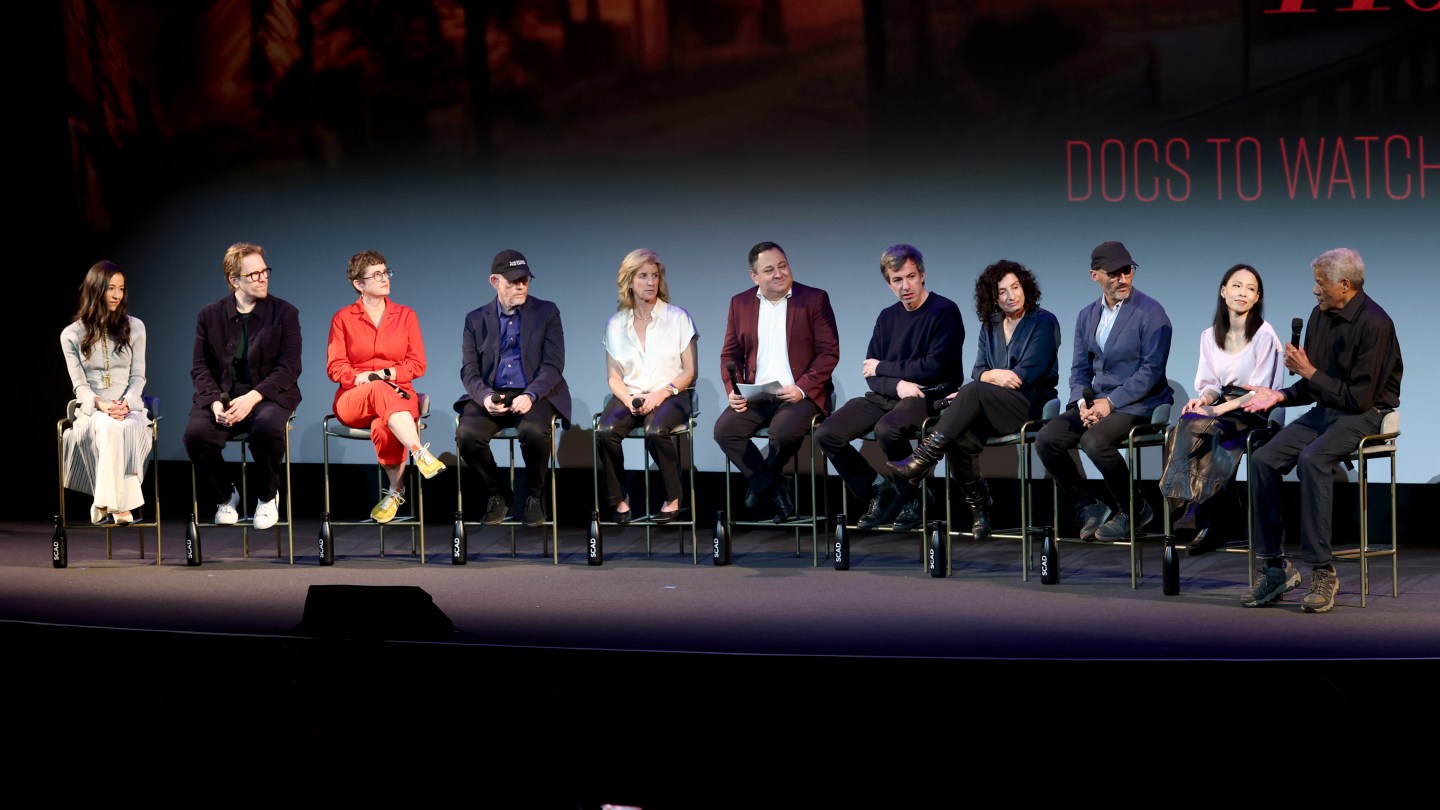
The directors of 10 of 2026’s top documentary features — American Doctor, Avedon, Cookie Queens, Everest: The Other Side, The Last First: Winter K2, My Undesirable Friends: Part II – Exile, Once Upon a Time in Harlem, One in a Million, The Trial of Alec Baldwin and You Can See Everything — gathered at the SCAD Savannah Film Festival in late October for the fest’s 13th annual Docs to Watch panel, which was, as always, presented by The Hollywood Reporter and moderated by yours truly. Below, you can watch — or read a lightly edited transcript of — that one-of-a-kind conversation, which took place in front of a capacity crowd at the 1,237-seat Lucas Theatre. It touched on each of the documentaries’ origins, evolution and impact, as well as how the documentarians calculated what risks were and weren’t acceptable to take, how they navigated complicated subjects (as in, people and topics) and what they are making of the huge of success of You Can See Everything. As you may have noticed, we are living in a golden age of documentaries — indeed, there are so many worthwhile docs made and released each year now that nobody can see all of them… but that doesn’t stop us from trying. For ‘Docs to Watch,’ we screen a ton of docs each year, and then identify 10 truly outstanding examples that we feel deserve to be brought to the attention of SCAD students, SCAD Savannah Film Festival attendees, and yes, the members of the Academy of Motion Picture Arts and Sciences’ documentary branch. Coincidentally or not, over the 12 years that we previously held this panel, 27 films that were represented on it went on to receive best documentary feature Oscar nominations, and eight ultimately won that award: 2015’s Amy, 2016’s O.J.: Made in America, 2017’s Icarus, 2018’s Free Solo, 2019’s American Factory, 2021’s Summer of Soul, 2022’s Navalny and 2023’s 20 Days in Mariupol. In my humble opinion, this year’s Docs to Watch selections — all of which have screened or will be screening here at the fest, followed by a Q&A with their director or directors — are collectively as strong as any year’s yet. Let’s meet 10 of the filmmakers behind them… On behalf of Nat Geo’s Everest: The Other Side, which centers on a couple who share a dream of climbing up and then skiing down the north face of Mt. Everest, please welcome, representing herself and her co-director Jimmy Chin, an Oscar winner for 2018’s Free Solo, Elizabeth Chai Vasarhelyi On behalf of Frontline’s One in a Million, which chronicles a tumultuous decade in the life of a Syrian girl who flees her war-torn country with her family, please welcome, representing himself and his co-director Itab Azzam, Jack MacInnes On behalf of Roadside’s Cookie Queens, which documents four young girls’ efforts, in the face of varying forms of adversity, to meet their goals during Girl Scouts cookie-selling season, please welcome Alysa Nahmias On behalf of Netflix’s Avedon, which explores the life, work and legacy of the hugely influential American portrait photographer Richard Avedon, please welcome an Oscar winner for 2001’s A Beautiful Mind, Ron Howard On behalf of Abramorama’s The Trial of Alec Baldwin, which shadows the polarizing eponymous actor in the aftermath of a 2021 accidental shooting that claimed the life of cinematographer Halyna Hutchins, please welcome an Oscar nominee for 2014’s Last Days in Vietnam, Rory Kennedy On behalf of A24’s You Can See Everything, which offers a look into the mind of Theranos founder Elizabeth Holmes and her partner Billy Evans over the 34 days before she begins serving a prison sentence, please welcome, representing himself and his co-director Lance Oppenheim, Nathan Fielder On behalf of MUBI’s My Undesirable Friends: Part II – Exile, which profiles independent Russian journalists forced to flee their homeland amid Vladimir Putin’s authoritarian crackdown, please welcome Julia Loktev On behalf of Apple’s The Last First: Winter K2, which follows a team of mountaineers as they strive to achieve something never previously accomplished, namely, climbing K2, the second-highest mountain in the world after Mt. Everest, in winter, please welcome Amir Bar-Lev On behalf of Watermelon’s American Doctor, which tracks three American physicians — one Jewish, one Palestinian and one Zoroastrian — as they volunteer at hospitals in Gaza amid the ongoing war there, please welcome Poh Si Teng And last but certainly not least, on behalf of Neon’s Once Upon a Time in Harlem, which captures a one-of-a-kind gathering of Harlem Renaissance luminaries at Duke Ellington’s apartment in 1972, please welcome, representing himself and his co-director, his late father William Greaves, David Greaves Thank you all for being here — what a group! David, the story of Once Upon a Time in Harlem begins with your father. Tell us a little bit about Bill Greaves, who died in 2014, and why he gathered this group of Harlem Renaissance luminaries in the first place. I should note that one of his four cameramen that day was a 26-year-old named David Greaves… DAVID GREAVES Yes. Well, he was born and raised in Harlem. These were people who had mentored him and had encouraged him in life, and he wanted people to remember them and that time. So in 1972, he contacted the librarians from the Schaumburg [Center for Research in Black Culture, a New York Public Library research library in Harlem]. They knew everybody, and they connected them — “Hey, you want to go over to Duke’s house, get together, and remember old times?” Naturally, they all came, and dad had four cameras there to capture these folks. Why wasn’t that footage released for more than a half-century? GREAVES It was kept in storage. They had done some additional shooting — a lot of additional shooting in the ’70s, ’80s, ’90s, and early 2000s, I think, to trace the impact of the Renaissance over time. After my father and my stepmother passed, my daughter and I pretty much decided, “This has to happen.” My stepmother had had the footage restored, and then the question was asked, “Well, who’s going to direct it?” And I said, “I will,” because I couldn’t imagine turning it over to anybody else, frankly. David Greaves takes the stage at the SCAD Savannah Film Festival’s Docs to Watch Panel (Photo by Paras Griffin/Getty Images) Paras Griffin/Getty Images I should note that David is a veteran journalist, but had not directed a film prior to this one. That’s also the case for Poh. Poh, you were born in Malaysia and commissioned docs for Al Jazeera, produced docs, awarded grants for docs through the IDA, worked as a journalist at the New York Times, but never directed a doc before this. Why was this a project that you wanted to direct yourself? POH SI TENG Well, in these very dark times, I was looking for the light. I needed to believe that there are good men, and three presented themselves: the Jewish doctor, Dr. Mark Perlmutter; the Palestinian doctor, Dr. Thaer Ahmad; and Dr. Feroze Sidhwa, the Zoroastrian doctor — three friends who couldn’t be more different in terms of their backgrounds and religion, and yet they were able to work together. I wanted to be in their light and learn from them to help myself. I thought, “I’ve waited long enough — 22 years — and this is going to be the one I’m going to do.” Amir, you have made films about a wide assortment of topics, from a child artist to a football star-turned-military tragedy to the Grateful Dead. It’s impossible to pin you down. How did you even catch wind of the fact that there had been this effort during COVID to conquer K2 in winter? AMIR BAR-LEV I can’t take credit for finding this story. Somebody told me about it and said, “You’re probably not interested because you don’t know anything about mountaineering.” I looked into it, and three years after the events that you mentioned, Scott, there was a lot of finger-pointing, especially along racial lines. This was a convergence of a bunch of different nationalities on K2, and five people died while 10 people summited, so it was presented to me as a kind of an alpine who-done-it. I looked into it, kicked the tires and realized that most of those allegations were not accurate. It really had a lot more to do with commercialization, social media, documentaries, the role of documentary filmmakers and class issues. So I thought, “Okay, those things are a little bit more sea level and I can report on them.” Julia, you were born in the former Soviet Union, came to America when you were nine, made award-winning narrative films, and planned to keep making narrative films — but then wound up back in Russia in 2021, and then have pretty much nonstop since been working on one of the most epic documentary undertakings ever, a two-parter about independent Russian journalists. The first part, released two years ago, was My Undesirable Friends: Part I — Last Air in Moscow, about those journalists and what they were trying to do inside Russia. Part Two — Exile is about them trying to get out, but still report the truth. How did your plans go so far astray? JULIA LOKTEV Well, one answer: Putin. I went to Russia in the fall of ’21 to shoot a film about these very young journalists that were just starting to be called “foreign agents,” which meant they had to put this paragraph disclaimer on all their work, and their Instagram cat pictures, saying that it was “brought to you by a foreign agent.” I had no idea, and they had no idea, that four-and-a-half months later, Russia would start a full-scale war in Ukraine, shut down all independent journalism, and all of the characters that I was following would have to flee their homes in a matter of just hours. Exile follows them from the very first days when they were completely lost. They got to Turkey, which was the only ticket they could buy, got back up on their feet as journalists, and continued to report on the war crimes that their country is committing. By now, most of them have been declared “extremist terrorists” and have prison sentences waiting for them, but they still manage to have a sense of humor. Julia Loktev, Amir Bar-Lev and Poh Si Teng at the SCAD Savannah Film Festival’s Docs to Watch Panel (Photo by Cindy Ord/Getty Images for SCAD) Cindy Ord/Getty Images Nathan, you’ve done so much great work on TV that has, in one way or another, explored the nature of truth and reality. These are things that have blurred the line between documentary and narrative, while you’ve directed them and appeared on camera in them — most notably, Nathan for You and The Rehearsal. Have you always wanted to direct a film like that too, or was it just sort of a happy accident that you and Lance wound up living with Elizabeth Holmes? NATHAN FIELDER Well, this came about in a very different way. From the moment we had this opportunity to document her final days before prison, both of us were drawn-in for reasons you can’t explain. It’s abstract, but we viewed this from the start as very different than the TV work I’ve done, and we understood our responsibility with it — we were entering the home of this family. And I wasn’t even intending to be in this, but I got drawn in because they kept talking to me and they kept acknowledging our presence in the house, so I became a part of it reluctantly — but it was actually a very useful tool to try to uncover what was going on, which became increasingly more complex. I’ve always loved documentaries. They’re my favorite thing to watch and engage with. And because I’ve dealt for so long with stories involving human beings as themselves, I had a lot of thoughts about this subject matter, and a lot of those ideas ended up in it, I think. And collaborating with Lance was amazing. I want to just go back for a second to how you guys even wound up interacting with her. It’s weird enough that she would invite anyone into her home shortly before reporting to prison, but you are not just anyone. Did she know who you were and your body of work? FIELDER I think the mystery of why we were there ended up having to become part of the story just because it was confusing to us and it was part of trying to understand them and what they wanted. We had heard they had approached A24 because they wanted their lives documented in some way before she was going to go to prison. That all fell apart, but we heard about it and then ended up meeting her. I think when I met her, she felt like this person that seemed very sincere and trusting, but in my head I was like, “You can’t trust this.” And that feeling I had never really experienced with a person — I had experienced it with a lot of the world, but not in one human — and so I think there was something that tickled my brain, and Lance’s too, and I think that was the starting point. I think her partner had showed her a clip of something I had made. That’s all she said she had seen before we started. So it’s a little confusing. Nathan Fielder speaks at the SCAD Savannah Film Festival’s Docs to Watch Panel (Photo by Cindy Ord/Getty Images for SCAD) Cindy Ord/Getty Images Rory, I recently had the opportunity to interview Alec Baldwin and he talked about being a big fan of your work, especially Last Days in Vietnam. But did you two know each other personally before this project? And regardless, what inspired both of you to take this leap together just as he was about to enter the most dark and vulnerable period of his life? RORY KENNEDY Alec has actually been a big supporter of documentaries, as you know, and he has the Hamptons Film Festival and the summer series [SummerDocs that he co-curates]. I’ve been lucky to be a part of that over the years, had gotten to know him and had, I would say, a friendly relationship with him. My husband, Mark Bailey, and I, like everybody else, watched this tragic accident happen and were heartbroken for Halyna Hutchins [the cinematographer who was shot and killed on the set of Rust], first and foremost, and her family, and had such a deep sense of empathy and compassion for her and what the family was going through; and then, of course, Alec, for being part of this and witnessing that. As the weeks and months went on, we saw how people were responding to him and were kind of amazed by how much judgment there was. It raised this question of, “How much are we judging through the court of public opinion versus the court of law?” Also, we feel like Alec is a fascinating character, and there really hasn’t been a documentary done on him. So it was kind of a balance of both of those things. We approached him and he was initially sort of resistant and didn’t want to pursue it. Then, maybe six weeks or two months later, when he was about to go start re-shooting Rust in Montana, he called us and said, “Do you want to join me on this journey?” We said basically he couldn’t have any editorial controland he couldn’t get any money out of it, and he was like, “I’m in.” And then we went on this journey together, and it took him to pretty extraordinary depths and places that were unexpected. Why do you think he said yes? KENNEDY I think he said yes for probably the same reason we’re all up here, which is to try to control the story and the narrative. I don’t actually like speaking for Alec or anybody, so I don’t 100 percent know this, but I think that he felt that his narrative was being written by others, and he wanted somebody to pay witness to what was actually happening. Ron, you’ve had so many lives in this business: beloved child actor, beloved young adult actor, beloved adult actor, and terrific adult filmmaker of so many movies we know and love, from Apollo 13 to A Beautiful Mind to Cinderella Man. But I think that what sometimes gets overlooked is how much you have done with your company, Imagine, in the area of nonfiction, with you directing many docs yourself, including several about fellow artists: Pavarotti, The Beatles, Jim Henson, José Andrés and now Richard Avedon. What led you to want to work in docs, and ultimately to Avedon? RON HOWARD Well, Brian Grazer, my partner at Imagine, has always loved docs, and so have I. He was a little bolder. He did one about Deep Throat. This is while we were still under contract at Universal, and Fox for television, and we weren’t supposed to be doing documentaries at all at this point. Our contract was pretty strict, and they actually sent us a cease and desist letter when they found out we wanted to make a documentary. But Brian ignored it and busted on through and did that. He also did one about wrestling. And he was having a lot of fun with it. I’ve loved documentaries my whole life, and I’ve also admired the filmmakers who did scripted and documentaries — people like Spike Lee, Martin Scorsese and Jonathan Demme. Finally, Brian brought me an opportunity to cover the behind the scenes of a Jay-Z music festival. I was a little nervous about it, and after a board meeting at the Jacob Burns Film Center I went to Jonathan and I said, “What do you think?” He said, “Definitely do it. First of all, you’re going to use more of your skills, experience and chops than you realize. And secondly, the only thing that you have to do that’s different” — and this was a lot of wisdom in a sentence or two — “is you have to go in thinking you know what the story will be, and be excited about being wrong and finding the real story.” I have found that to be so true. I would also say that I’ve always been drawn to character studies in the work I’ve done in scripted, and those kinds of movies are getting harder to get made. We still do it and we’re all trying, but the docs for me are all character studies, even something like Avedon, which I didn’t expect to be that. I thought it was just going to be this kind of glamorous romp through his archive and these amazing subjects that he covered. But he surprised me — as I learned more and more about him, it became a character study, and one I’m really proud to have been able to tell. Justin Wilkes, who is president of Imagine, Sara Bernstein, who’s here and is president of docs, they’re always coming in with great ideas. I have my own. And we have a terrific team that helps make it possible to get these things done — gains access to subjects and ideas. So it’s been a tremendous thrill for me to explore this world. Lastly, I like the people who live in the doc world. I mean, they’re just great — they’re smart, they’re dedicated, and they’re interested in a lot of the same things I am. It’s not driven as much by commercialism and that need to — your movie aside [he jokes to Fielder] — get a lot of seats in theaters. And so it continues to be very creatively exciting. And I even think it’s doing something positive with my scripted work, in the way I stage scenes and shoot them. Alysa Nahmias, Ron Howard and Rory Kennedy share a laugh at the SCAD Savannah Film Festival’s Docs to Watch Panel (Photo by Cindy Ord/Getty Images for SCAD) Cindy Ord/Getty Images And Avedon became possible because the Richard Avedon Foundation was suddenly willing to open up its archive? HOWARD Yeah, Justin Wilkes had been curious about Avedon for a long time. They liked our work as a company, they liked what I had done with Pavarotti and Jim Henson, and they were willing to open up the archives, which was rare and thrilling. I never met Richard Avedon and I was never photographed by him — I don’t think I was kind of cool enough back in those days, or even today — so I went into it thinking, “He’s a little like Zelig or Forrest Gump: he’s everywhere through generations, and he’s right in the middle of everything in interesting ways.” But there was so much I didn’t know about him. I knew that he was successful, but I didn’t know he was courageous. I knew that he was very charismatic on camera — you’d see him in interviews — and I knew that people wanted to be photographed by him, but I didn’t know about his insecurities and the grit and the drive and the work ethic and the way he applied his aesthetic to work that was both highly commercial but also very personal. He wasn’t always rewarded for it, and yet he kept going, pushing both his career and his work forward. So I really admired him. But the movie changed, definitely. The last thing I would say about it is it wasn’t really until his son, John, saw some of our footage and agreed to be on camera that a very important aspect of his life and story really came into focus. It deepened it as a character study. Alysa, you have been making docs for some time, but I know, to the frustration of your children, not ones that they could necessarily see and enjoy. I believe that was part of the equation that led you to Cookie Queens. But there are a lot of family-friendly topics. Why the Girl Scouts? Were you an alum? I should note that Savannah is the home of the Girl Scouts… ALYSA NAHMIAS My kids double-dared me to make a doc that they would actually want to share with their friends. At the time, they were nine and 11. I laughed it off in the moment, but kept it in my artistic antenna, I guess. How could I find something that their friends would want to watch and also that would give me something to chew on creatively and thematically? Then a friend of mine told me about how he was at a pizza joint and was sold an ungodly amount of Girl Scout cookies by this young woman who complimented his hair and his wife’s dress and then brought a wagon full of cookies around the corner. He was super surprised at how strategic she was. And this person, Michael, ended up being on my producing team. I wasn’t a Girl Scout, but I’ve been a girl and I’m a woman in this world and I thought, “Wow, we’re consistently underestimated from a very young age. That’s interesting. And girls participating in the economy, selling $800 million a year in cookie sales? That could be a kind of chocolate Trojan horse for looking at the ways that girls learn about the way the world sees us and how different that can be than the way we see ourselves and the ways we learn about the economy and capitalism and are, in some sense, indoctrinated into that. So that was the entry point. I always knew that it couldn’t be a typical competition doc because these girls don’t meet at the end and someone gets crowned Cookie Queen. Even the title was kind of a plural play on that, where we could look at that kind of competition-doc subgenre, but instead tell it through a more complex lens, in my view. I looked more at scripted films like Moonrise Kingdom, The Florida Project and Céline Sciamma’s Petit Maman, that take childhood seriously and get into that world in an immersive way. From a doc standpoint, I looked at the Maysles’ Salesman and the ways that people are performing, as these girls do, and found kids whose inner journey is just as important as their external desire to sell a certain amount of cookies. The kids ended up ranging from five years old to 15, and have goals ranging from 55 to 12,000, because it was never really about that. It’s really, for me, a way of taking girls seriously and getting into their world; the adults are like they are in Charlie Brown, [mouthing inaudible noises]. There’s been some chatter this year, as you may have heard, about docs being recognized at the Oscars outside of the best documentary feature category. I think that Cookie Queens absolutely deserves a nomination for best casting. And if I worked at Pixar, I would be pursuing the life rights of one of your subjects, Ara, right now. NAHMIAS We did get a call from a casting director to cast for a Netflix series about her, so we’ll see — stay tuned! Ara, yeah, she’s a gem. We saw her casting video and it was instant. She was sitting in front of an enormous teddy bear and then she was playing piano. When I met her on Zoom, I said, “If I was going to buy three boxes, how much would that be?” “That’s easy, 12 bucks!” And I was like, “Well, you’re in the movie.” Jack, you and your co-director, Itab, are also a couple. You guys lived in Syria until 2011. You wind up in Turkey. And then one night in 2015, something happened that changed your lives and the life of a young woman for the next decade. Can you just take us into how you wound up going down the path that led to One in a Million? JACK MACINNES Yeah. I didn’t realize our films were similar, Alysa, but when you were saying that, I was feeling exactly the same thing. We met a girl in 2015 in Izmir, Turkey, who wasn’t selling cookies, she was selling cigarettes on the street in a corner of Turkey, which was, at the time, the heart of the refugee crisis. This was 2015, in which a million refugees entered Europe from Syria, Afghanistan and around the world. And we had ourselves, as Scott says, only four years previously left Syria. I’d been living there for a year, and that felt like a loss, but for my wife and partner in directing this film, that was 30 years of her life that disappeared in one go. Everyone she knew disappeared to the four corners of the globe. The cities that we lived in were being obliterated by Bashar al-Assad, who was also torturing dissidents and children. We were sort of watching this and looking for some hope and positivity. And this girl we met, honestly, was just an incredible force of nature. She was 11 years old. She was in this square full of smugglers and refugees, taking [shit] from no one, totally defiant and ballsy. She just wanted to get to Germany, and she wanted to take us with her. She loved this idea of leading the camera, of being a star. And she said she thought she was going to be famous. It became this sort of game for her. So we followed her on this grueling journey through nine countries. She was on a dinghy packed with 85 people, which had to go three hours in the night across the Mediterranean, and somehow survived and got to Germany. And that was all we’d originally planned to do. But when we were standing on that train station in Passau, the first train town in Germany, we realized this wasn’t an end, it was a beginning. There were a thousand people around us who were now going to start a life in Germany. And maybe generations from now, there were going to be people telling this story about their grandparents who came on a boat and this is where they were. It it felt like we were on Ellis Island. And if you were there in those days, what would you have wanted to see? We thought, “She’s 11, she’s on the threshold of life, why don’t we follow her? Why don’t we see what happens?” And that’s what we did. So we filmed her for the following 10 years. Elizabeth Chai Vasarhelyi and Jack MacInnes at the SCAD Savannah Film Festival’s Docs to Watch Panel (Photo by Cindy Ord/Getty Images for SCAD) Chai, you and Jimmy have made three films, Meru, Free Solo and now Everest: The Other Side, that I guess we might describe as— ELIZABETH CHAI VASARHELYI I just call them the mountain films, the mountain trilogy. [laughs] Everest: The Other Side, though, was the first of the three in which your family was directly affected by the climb itself, right? Risk is something you address directly in the film, speaking about how many people you guys have known who have attempted daring things and not survived. Can you share how you guys wound up going down the path of this film, and how you felt about it throughout the process? VASARHELYI Hilaree Nelson and Jim Morrison, two of the best ski mountaineers — meaning, you climb and you ski — came to us with this outrageous idea that they wanted to climb the North Face of Mount Everest, which is accessed through China, and then be the first people on earth to ski down it. Hilaree was like a goddess — six-foot, captain of the North Face team, had two children. I parented with her because they came to visit us during [the making of Chin and Vasarhelyi’s narrative film] Nyad, and we spent Easter together, with her boys taking care of my kids. But she spoke about risk with a candor that I found completely disarming. There was no romanticism. And meanwhile, having made these mountain movies, there’s a lot of romanticism, okay? Meru: “You do it for friendship. You really shouldn’t do this, but if it’s a good enough friend…” Free Solo: “You really should not do this. But if you’ve thought really deeply about it and you have no children, no connections, and you practice really hard, it’s okay.” But with this one, she would say, “It’s just a mountain, but it means everything to me.” So she lived between this tension of wanting to be a mom, but having this calling… and then she dies in an avalanche. For me, it just ruptured so much. It was like a physical, visceral awakening where I was like, “Oh, dear, we have been lucky all these years where no one got hurt. Our crew came back safely.” And Jimmy would say, “Oh, they were just unlucky.” But that’s the whole point of that conversation where I’m like, “Wait, how many people have sat at our dinner table who are dead now?” And it’s a lot. But then suddenly Jimmy becomes Jim’s primary climbing buddy, and I find myself where my professional aspirations are in direct conflict with my personal interests: Jimmy and I have two children, and this was the first time in our directing partnership — I think we’ve made 11 films together — that he was in the, so to speak, line of fire. We’ve got two totally different opinions about this, clearly, so it forced us to actually do a very candid, very honest presentation of it. I never want to be in a movie, but I put myself in this movie because I was the only person who could speak to this problem. But at the same time, you also end up as close as I think I’ve ever gotten to understanding why — the awe and the beauty. And basically where I’ve landed after all of this is that it’s about agency and about honesty. I had agency getting married to Jimmy. Jimmy has plenty of agency. Our kids don’t. And I can say that, and it doesn’t mean that what he does is bad, but I just wanted to make a film where people could kind of inhabit the problem, the tension, in there. Several of you, in one way or another, took on risk in telling the stories that you told. Poh, you’re following three people in the middle of a war zone. One of them literally says in your film, “I’ve never had this happen, where I’ve just operated on somebody, put them back together, and then they got bombed, and now I have to put them back together again.” Obviously it’s important to get this information out, but how were you and your crew calculating where it was smart and safe enough to be at any given time? TENG I wanted to make it in one year and we made it in one year — we started Christmas 2024, we ended Christmas 2025 — and in the early days of that challenge, it was my friends, well-meaning friends, telling me, “You’re going to make this film? You’re destroying your entire filmmaking career, you know that? This is too hot.” “Well, I feel that my hands are bloodied because of what is happening with our taxpayer money. I’m going to do it.” In terms of the safety and security, I was a documentary commissioner, I worked on safety and security protocols for filmmakers, but this was unlike anything I’ve ever done before. The Jewish doctor, Dr. Perlmutter, ever the eternal optimist, told me, “I’m going to train you as my scrub nurse and take you into Gaza.” I’m like, “It’s a great idea, Mark. [sarcastically] We know who controls the borders. New York Times, all this, is going to come up [and I would not be allowed in].” So I knew very early on that I would need to work with a Gazan Palestinian team. And thank you for asking that question, because as I’m sitting here talking to you our film is being played in almost 200 theaters across the U.S. and Canada, and it’s been wonderful, but I don’t know whether they’ll be able to survive this. As we were filming, in March 2025, there was a ceasefire and we could film the doctors with their Palestinian colleagues inside a besiege hospital. It wasn’t that bad. But in the middle of production, there was a ground invasion by the Israeli troops. So our co-producer, Mohammed Sawwaf, and our cinematographer, Ibrahim al-Otla, who was in Deir al-Balah, were cut off from each other. And as we were filming in Nasser Medical Complex, the hospital where the doctors worked, bombs started dropping. So, as much as I thought I was experienced, I wasn’t. So much of it was listening on the ground, day to day, determining what to do. We were hoping the doctors are okay. We were hoping their Palestinian colleagues and their patients were okay. But I didn’t know whether our team would survive this. And so it’s our responsibility to make sure that whatever they filmed, we brought back to the United States. And I wanted to finish it in one year so that we could be ready for the midterms. And here we are. Julia, you were in 12 countries over four-plus years shadowing people who you knew were being targeted by a country that we know has killed people and tried to kill people outside of its own borders. How did you mitigate against that risk? LOKTEV Where I felt most unsafe, of course, was when I was shooting in Moscow, especially during the first week of the full scale war, because many of the journalists I was filming, their homes had been bugged, their offices had been raided. And meanwhile, the US embassy was telling all Americans to leave and I was like, “I think I’ll stay. They’re staying.” But the place that I felt kind of most unsafe was the place they showed up to go to work every day. So I decided it’s inappropriate for me to sit here and to think about my safety when they just come here and work. And so shut up and film was my attitude, just do your job. And then outside of Russia, many of them, they’ve been threatened, one has been poisoned. It’s not so nice to be an independent journalist, even in exile. They all thought they were safe when they left Russia. And of course, the Russian government makes a point of making you feel not so safe anywhere. So you can’t feel the ground under your feet. But again, even when you talk to them, they’re like, “Listen, the people who are really taking risks are the people who are political prisoners in Russia. It’s the people who are in Ukraine being bombed.” Everyone has that one degree where they’re like, “I’m not the one putting myself at risk. These people are taking much bigger risks.” Evoking trust from a subject or subjects is central to so many of your docs. Nathan, you aparently elicited so much trust that Elizabeth Holmes and Billy invited you to live in their home, Billy took a shower in front of you, etc. This is not usual. What were the steps that you took to get them to the place where they would be so “radically transparent” with you? FIELDER Well, that’s what they said they were doing. It’s hard to know. But actually, it was a really interesting process because we understood the stakes of the situation: this is a mother in her last month with her children. And we knew that this might not become anything — we were on a voyage of discovery with our curiosity. So when tensions would flare, I would say, “Look, if you’re regretting this decision and you want us to leave, we’ll go. No problem.” Because this was something everyone just dove into. And to their credit, they were like, “No, stay.” Every time. But it wasn’t us trying to convince them of anything. It was us trying to back away, if anything, when we were worried, “Why would you want me there in your final month of freedom?” But also I think, in terms of the trust of it all, I was also able to say to her right away, and you see it in the film, “I believe you did these things. I’ve read a lot about you.” And that did not scare her. So it was a very open and freeing process where she was very much wanted to know where I was at so she could know how to engage with me, I think. But there was no sort of secrecy on our end in terms of like, “Well, we have to act this way to keep them in it.” We were just observing and saw what came from them. And then these moments started to emerge that we couldn’t make sense of, that we started following, and that took us on that road. A quick follow-up: what was the moment when, in the moment, you were most like, “I can’t believe we’re getting this”? FIELDER It’s a good question. I think there were moments that really changed my perspective on what we were dealing with. When she said she had never lied in her life, it completely changed, I think, Lance and I’s idea of what this was and what type of a person it was. You have to engage with this idea that is so far from anyone’s experience, or not at all, there’s no meeting in the middle. And you were in their bubble constantly, so there was this feeling of, “When you’re in this bubble, different rules apply.” And then when we were out of it, like, you start having different feelings, and you don’t know what you are bringing in from your own personal experience into the process versus what’s real. Living my life, I feel that a lot, especially now just not knowing what is real when I look at things, and it was a very human version of that experience, and it really twisted my mind. A lot of the moments in the film are these moments where I was like, “Wow, is this a game that’s being played, or am I witnessing something that is so unique?” Another example of cultivating trust and comfort with subjects is Cookie Queens, where you have everything from the parents of one kid talking about the financial pressures that they’re feeling because of supporting their kid wanting to do this, to a little girl admitting what some of us worried and suspected was the case, namely that she wasn’t the one that was driving her interest in doing this, and other things like that. Alysa, you were following these four girls, plus others who didn’t make the final cut, all in the course of a single cookie season. It didn’t have to be that way, but you chose to do that, so you were running back and forth between all of these girls, and yet still invested enough with each of them to get that level of openness… NAHMIAS I can definitely relate, Nathan, to the “Why are these people letting me into their house?” We were in seven different houses and they were all so different. And yeah, it’s such a leap of faith. You can call it “trust.” Motivations are complex for people. We’re all human and not motivated by a single thing. And it changes over time. As a filmmaker, I try to honor that, and I feel like consistently asking for consent is so important. And especially with young people in this film, we wanted to really do that over and over again. I spent a lot of time with them off camera. I went and visited everyone without the camera before we started shooting, answered questions, talked with them, got to know them and their community and their troops, and then made the choice to film. The same five of us traveled everywhere together — me, my producer Jen Sims, our DP Antonio Cisneros, our sound person and camera person — for six months, to these different cities. I think the kids were pretty quick to trust, and also to tell us if there was a boundary. At one point I was like, “I wish I could film a middle school dance.” And then Jen was like, “Actually, Olive is doing this cotillion thing and we can film it.” So we got into a middle school cotillion, filming all these kids in their natural habitat and just watching what happens. And those extraordinary exchanges happen when they are willing to be who they are in front of the camera. Rory, I couldn’t help but think, watching The Trial of Alec Baldwin, that Alec is a guy who has spent a lot of time in front of cameras, and he’s obviously a gifted actor. Did you ever question if what you were seeing was a bit of a performance? KENNEDY One of the things that’s interesting about Alec is that he doesn’t have much of a filter. He doesn’t have that voice of like, “Maybe I shouldn’t say this” or “Maybe I shouldn’t do this right now.” As a result, when you’re filming him, he says a lot of things that are contradictory, and I do think that in the moment that he says them they’re true. The film opens with him talking about all of these wonderful films that have been made and the actors and all that’s happened before him, and he’s crying talking about it. And not much later in the film — 15, 20 minutes later, after he’s been fully canceled by Hollywood, having had five films that he was supposed to be in, and after the shooting happened every producer called him and said, “We don’t want you anymore” — he’s sitting at the kitchen table with his wife, Hilaria, saying, “I hate films. Never liked them. Don’t like anything about them.” And she’s like, “Honey, I think you might be hurt right now.” So, early on, we are trying to say to the audience, “Maybe look at this slightly critically, because there are going to be some contradictions in terms of what you hear and what you experience.” Rory Kennedy speaks at the SCAD Savannah Film Festival’s Docs to Watch Panel as Alysa Nahmias, Ron Howard, Scott Feinberg and Nathan Fielder look on (Photo by Cindy Ord/Getty Images for SCAD) Cindy Ord/Getty Images Is there a scenario in which it is acceptable or right to intervene in the events that you’re documenting? I mean that both a kind of humorous way — Alysa, I would not have been able to resist at buying out the cookies of some of these kids… NAHMIAS We ate a fair amount. But on a more serious note, Jack, there’s at one point in your film when allegations of abuse are raised against a parent, and I wonder how you guys decided how to handle that situation… MACINNES Yeah, it was a shocking moment. For people who haven’t seen the film, we follow Israa and her father, and the two of them are having an incredibly beautiful, close relationship. But then, once they arrive in Germany, the experience tears them apart — Israa gets closer and closer to the new culture she’s adopting, and her father resents that and feels powerless and possessive. And then one day, when we were going out to get a kebab, Israa chose that moment just to tell me, “My father’s beating me.” She confessed all of this on camera. It was, first of all, just heartbreaking for us, because we’d invested so much in these relationships. But then also it does totally call into question what you’re doing. And it did cross our minds just to stop filming at that point. When your subject is in physical danger, that is when your role as a filmmaker comes second and you have to put that aside and you have to think about their safety. But at the same time, you have to operate with sensitivity and care. So what we had to do is we had to intervene and make sure she was aware of everything that was available to her in Germany that she might not understand exists, that the police would be on her side, that teachers would be on her side, that the people running her refugee camp would be on her side. But her mother knew about this and we spoke to her mother and her mother said, “Let me deal with this.” And she did. And this is one of the most amazing, uplifting moments in the film, that this woman, who in Syria had been totally marginalized and never allowed to leave the house apart from going to visit her own parents, had understood her rights. She went to the authorities, she got her husband kicked out of the house and Israa was safe. So that saved us from having to intervene. But had that not happened, that would’ve been what we would have had to do. A number of you were working from a massive amount of footage… GREAVES 60,000 feet of 16 millimeter film. BAR-LEV Not that much. But you interview people for four or five hours, and then you turn it into four or five minutes. That’s a kind of a violence, in a way. So, talking about trust, there’s nobody who’s going to stop you from turning that person into whoever you want. And, in fact, the more that you bend that material into something closer to fiction, the more popular the film could be. The only thing in-between you and doing that is your own conscience. And I think that’s something that we all deal with. We all say, “Oh, man, I can’t believe you got that!” It’s a little weirdly colonial or something, like standing on rhino at the end of your film. And that’s something that you really have to reckon with. Jack, you said that as soon as there’s physical danger, that’s when you have to intervene. But if you’re making a mountain film, that’s when you really lean in, like, “Oh, this could be really good. They might die.” That’s the genre, and that’s something I don’t like about the genre. VASARHELYI We don’t think that, I’m just saying really clearly. BAR-LEV You might not think it, but it sure puts butts in seats to witness physical danger. VASARHELYI I agree with you, but I just think in terms of the stakes that our films have dealt with, it’s a really, really clear line. The interest of the film cannot supersede the interest of the participant, period. And the trust is like a covenant, where I have to trust they are going to make good decisions. BAR-LEV Yeah. But I mean, your camera being there is inspiring them to do dangerous things. Even if you say— VASARHELYI You can say that, except for, let’s say, Free Solo. I was worried that Alex was going to leave in the night and go do it because he didn’t give a shit. It wasn’t about the glory for him. He didn’t do that because we checked on him all the time. But in terms of Jim and summiting The North Face, the entire team was helping. That’s the whole point. When Tom Hornbein was there in 1963, he was climbing with a photograph. Now it’s like, “There’s an aerial team. Can you go check out over there?” He never has to carry anything because we’ve got production there and it’s also his best friends. So you are a friend first — Jim is a man who has lost everything, and you’re healing next to him. You’re a professional climber second. Third, you’re a filmmaker. Except for me, who’s not a professional climber. I’m just saying, “I want this. I want that. I want this.” BAR-LEV I mean, it might be just me, but I feel a lot more conflicted about this stuff. In fact, that’s why I’m drawn to it in a way. All of our films are about conflict — the conflict of war, the conflict of danger. My films are usually, if I really look at them, about conflicts in my own mind. Something I don’t feel sure about is the thing that I’m interested in studying. And I don’t feel that sure about filming people who are taking their lives into their hands. Amir Bar-Lev at the SCAD Savannah Film Festival’s Docs to Watch Panel (Photo by Paras Griffin/Getty Images) Paras Griffin/Getty Images Julia and David, when you have as much material as you both clearly had, and you’re in post-production, how do you know when you’re done? I’ve been trying to write a book, and it just goes on and on and on because you can always find something else to research. So I wonder for you guys, what was the thing that told you it’s over? GREAVES When we started it, a filmmaker told me, “How do you make a film about a bunch of old people sitting around talking?” And I said, “Well, watch.” You just go through the material and find the things that really resonate with you. And you have brilliant editors, by the way, who put all those pieces together. Working with them from the 60,000 feet, there came a point where I’m saying, “Can we get six more frames here? Is there any way to extend that look a few more frames?” When we got down to that point, the editor said, “David, it’s a hundred minutes. The film is done.” I said, “Thank you, God.” That’s when you know that it’s done. But you just keep going till you get there. Julia, you made a different calculation than a lot of people make: you did not cut My Undesirable Friends, part one or two, to a normal, “acceptable” length. I’m sure you had a lot of people telling you that if you want people to see your movie in large numbers, you can’t come out with a five-and-a-half or six-hour movie. LOKTEV I felt like I was in this incredible position where I was filming this historic moment through characters. I don’t have interviews. You’re live with these people living through stuff — the last days when it was possible to be an activist, a journalist, in Russia, and you watch them and they’re fleeing their country. A lot of it, in terms of footage, would be, like, six hours of people hanging out at dinner, getting condensed to a six-minute scene. It’s not a plot. It’s like The Odyssey, it’s made up of many, many, many plots. It’s like one trial after another. On the one hand, I felt like I got lucky as a filmmaker — I hate to say that — so I had to honor this story. The hour-and-a-half version you can read in a New York Times story, you don’t need me for that. But to experience what it feels like to live through this? That’s what I can offer. So I just said, “Okay, forget it. I’m just going to make it what it needs to be. I’m only going to get to make this film once.” NAHMIAS I just want to say I’m in awe of you [Loktev] editing your own films, because it is such an art. LOKTEV I do work with a co-editor, Michael Taylor, who comes in and says he does the stepping away from the painting part. HOWARD I’ve done archival and interview films, and they still take years. In this case, Andrew Morelli was editing forever. But what was fascinating, and what I began to learn early on with this type of doc, is you’re putting things into what they call “buckets,” collecting, collecting, collecting: “Childhood,” “Professional,” “Marilyn Monroe Photoshoot,” whatever. And you’re also then starting to have interviews and other elements go into these buckets, but there’s no real structure yet. And then you begin to decide, a year later or so, “What really is the tone and the spirit of the movie?” In this case, we shifted away from glamour and anecdote and more toward what drove him, what did he react to, what was his heartbeat, and what was it that would surprise you about this man? And we then realized we had to now start playing with time, and move back and forth, because we had to group around feelings and ideas and aspects of him and his journey and his psyche. And so a lot of the interview stuff fell by the wayside because it wasn’t actually informing those sequences, those aspects that we wanted to convey. So again, quite different than working with anything scripted, but really fascinating. And hats off to Andrew on three years of work. FIELDER I have a question for David. When you were in the edit, were you looking at the footage thinking, “Oh, my father might have wanted this included” or “This is where he was going with the footage”? It’s so fascinating that he began it and then you were finishing it. So what was that like? GREAVES Well, it’s so funny. In the editing room, when I first started going back over the footage and I wanted to go back and see a sequence, my hand automatically shot out to where the control panel would have been on the editing table. This was after 50 years, that muscle-memory. So I said, “Oh, the same thing is happening in my brain, in terms of being in the editing room.” I spent 15 years with him in the editing room, so I think his thinking just naturally was in my head. I was not thinking, “Oh gee, Dad would like this part, Dad would like that part.” He had said to me, “David, if something affects you viscerally, go with it,” so that’s what I was doing. I just trusted the feeling that if I liked it, he would like it. Nathan Fielder at the SCAD Savannah Film Festival’s Docs to Watch Panel (Photo by Paras Griffin/Getty Images) Paras Griffin/Getty Images FIELDER Amazing. Chai and Amir, when you guys were debating just now about the whole— I recently watched The Dark Wizard— VASARHELYI He [climber, BASE jumper and highline walker Dean Potter] was one of the people at my dinner table [who subsequently died]. FIELDER Oh, really? Okay. If people haven’t seen this— VASARHELYI It’s great. FIELDER It’s on HBO. It’s a four part docu-series. It’s incredible. But I think it really deals with that issue of maybe doing something for the camera. I’m just curious about what your relationship with that is and what was captured in that project. VASARHELYI The Dark Wizard was made by the guys behind Sender Films. They started the [Reel Rock] climbing movie film festival. And in The Dark Wizard, the main person who’s speaking is Jim [Hurst], who’s essentially a professional climber. So I think that’s kind of the difference here. Jimmy [Chin] and Jim [Morrison] are both professional elite athletes. Their job is risk assessment. My whole thing about Jimmy was he understood what Jim was going through inside and could read the conditions the same way, so they were always in sync. Dean was different. Dean was like a cult figure — he was very elusive, but again, was one of Jimmy’s best friends. We were offered that film, and I was like, “No.” Because the character is fascinating, but I think it does get to your [Amir’s] question about, “Is he doing it for the camera?” Elizabeth Chai Vasarhelyi at the SCAD Savannah Film Festival’s Docs to Watch Panel (Photo by Paras Griffin/Getty Images) Last year, Will Ferrell was on The Late Show with Stephen Colbert promoting his documentary Will and Harper, and Colbert asked him, “How was the Oscar nomination?” Ferrell responded, “We didn’t get it. Fuck the Academy, especially the doc branch. You don’t want to hang out with the doc branch. What a bunch of losers. I hope there’s some of them here tonight. If you’re a member of the doc branch, suck it.” [laughs] Now we have some people here who are members of the doc branch, so I should underscore that I’m neither endorsing nor distancing myself from Ferrell’s comments. But there has been growing frustration with the doc branch because it seems, in recent years, like they have reflexively rejected docs that feature celebrities, that get wide releases, and that make money. It’s almost like they want to punish filmmakers for making something that a lot of people want to see — Won’t You Be My Neighbor, Jane, Life Itself, Still: A Michael J. Fox Movie, American Symphony, Billie Eilish: The World’s a Little Blurry, and many other such films were not even nominated. There’s also been resistance from the branch to docs that feature filmmaking techniques that are a bit adventurous — reenactments and things like that. Stories We Tell, for instance, was also not even nominated. So I wonder, at a time when these very sorts of docs are among those that are being embraced by the public — we’re sitting here two weeks into the release of You Can See Everything, which has already made nearly $50 million — I just wonder if any of you have thoughts on the kind of self-imposed limitations that exist clearly for some people about what a documentary even is? BAR-LEV I think it connects to the thing we were just talking about, about playing to the camera. I think your film [addressing Fielder] exposed something that’s really interesting, which is: playing for the camera is not not truth. Truth is much more elusive than you think. If you haven’t ever read a Werner Herzog thing called The Minnesota Manifesto, he says that verite films, which have this reputation as being the most truthful — he says, ‘Yeah, it’s the truth, but it’s the truth of the Yellow Pages, it’s the truth of facts, it’s like an actuarial truth, it’s not ecstatic truth.’ You can get at ecstatic truth with reenactments, playing to the camera, all these different techniques. And to just say, ‘Because I didn’t edit something, and I just aimed the camera,’ that’s not necessarily any more truthful. And it’s a pity that the doc branch is narrow-minded at times. I’m really glad you brought that up. And a lot of times, they forget — we forget — that it’s an Oscar for a film, not for an issue. We all care about issues, but that’s not what this Academy Award is supposed to be about. It’s supposed to be about technique and craft. And I’m really happy that your film [addressing Fielder] is doing as well as it’s doing because I think it pushes the boundaries and we all learn from it.” VASARHELYI And we all know Elizabeth Holmes doesn’t get any of the money! BAR-LEV That’s in the film. FIELDER Way to spoil the ending! No, honestly, I am such a fan of documentaries and I think so much about this stuff. This project’s different than the other ones, but I feel like the process of making it was just a process of including everything that needed to be included to make it as honest as possible. It was not a choice of trying to do anything different. We were very stringent about trying to be accurate and trying to portray things authentically. And the only reason we started including these other things [like reenactments] was because it felt dishonest not to. We’d actually be hiding things from the viewer if we didn’t let them in on what we knew or what we observed. I think everyone who makes docs can understand and has experienced that when you’re in a room with cameras, it’s not the same as if you’re in a room without cameras. The person is acting a certain way because of you and the camera, whether you acknowledge it or not. I think about those things when I watch docs. And so Lance and I putting this together, we were just like, “What is the information that’s missing that the viewer needs to know to try to make sense of this in the way that we are?” I don’t know really about what makes something not a doc, but I know what it would be if we didn’t do those things: it would just be a less honest version of what the story was. VASARHELYI I think we need a moment of appreciation, though, that in Manhattan last weekend, you couldn’t get a seat to see your film. FIELDER Yeah, it’s wild. I don’t know. VASARHELYI I was like, “This is a documentary. What is going on?!” It was kind of the most beautiful moment ever in nonfiction. How I looked at your film: the constraints became the opportunity, right? And that’s formal innovation, and that’s what was awesome — like The Act of Killing, one of the greatest formal innovations in nonfiction. TENG As artists, you’re sacrificing so much, sometimes for years and years and years. It’s not an easy path to choose. So the most important thing as a filmmaker, and I say this as a first-time director, is to be true to yourself. When I decided to make American Doctor, everybody had an opinion about what was going on in Israel and Palestine, and I was like, “I’m going to make it the way I want to make it, and I’m going to borrow elements from scripted.” American Doctor borrows scripted elements and storytelling from The Pitt, from Chernobyl, from The Babadook, and from BlacKkKlansmen, because that is the way I feel like I can be true to myself and also make a verite film. There’s an incredible artist that I had never seen speak until I saw him in your film [addressing Greaves], and as a first-time director, a quote from that artist meant a lot to me. The artist’s name is Romare Bearden, he was a collage artist, and I read a quote from him that stuck with me. He said, “Art is always borrowed from other people’s art. It’s just whether you find your place in the world.” And I think that is enough for all our art. HOWARD I have one more quote to follow that with. Early in my process of starting to make documentaries, I had a moment where our documentary group was talking with Martin Scorsese. He had a project we ultimately did with him, and he was very excited. I said, “Well, I’m just learning about documentaries.” And he said, [doing a funny Scorsese impression] “Documentaries? I don’t like that word. It’s cinema! It’s all cinema. However you shoot it, however you do it, it’s a story, and it’s moving, and it’s cinema!” That’s great. Well, on behalf of everyone at the fest, thank you guys for the great films, for being here in Savannah and for a great conversation. Lance Oppenheim, Rory Kennedy, Nathan Fielder, Poh Si Teng, Scott Feinberg, David Greaves, Alysa Nahmias, Ron Howard, Julia Loktev, Elizabeth Chai Vasarhelyi, Jack MacInnes and Amir Bar-Lev pose for a selfie backstage at the SCAD Savannah Film Festival’s Docs to Watch Panel (Photo by Cindy Ord/Getty Images for SCAD) Cindy Ord/Getty Images
“It’s All Cinema!” Directors of 2026’s Top Docs on Taking Risks, Interacting With Subjects and the Huge Success of ‘You Can See Everything’ (Video)
Full Article
Original Source
Read the full article at Hollywoodreporter →KhanList aggregates and links to publicly available news content. We do not host full articles from third-party sources. Always verify important information with original sources.