
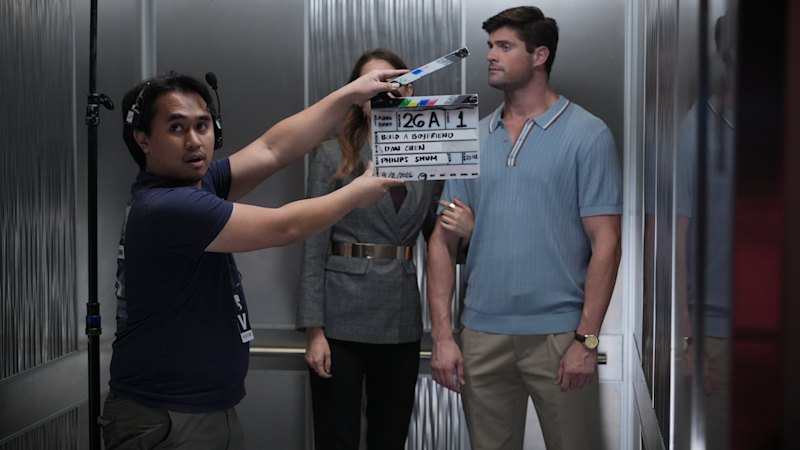
November 14, 2026 — 5:00amWhen Jeffrey Katzenberg’s $US1.75 billion mobile-video experiment Quibi crashed and burned in 2020, it became a cautionary tale for writing big cheques and misreading the market. Six years later, as audience appetite (and impatience) shrinks durations and reframes the picture from 16:9 to 9:16, vertical content is Hollywood’s new gold rush.In case you have not looked at your social feeds in a while, “verticals” initially landed as mobile phone soap operas with outlandish titles such as The Double Life of My Billionaire Husband and Seducing My Hockey Rival. But as the genre has exploded in popularity, studios are branching into unscripted, and other genres. It’s a vertical world, we’re just streaming it.Big studios are moving into the vertical video soap drama market.“It’s undeniable that year over year consumption of video on a phone just continues to increase,” vertical platform, says GammaTime’s chief business officer, Alex Montalvo. “We’re meeting our audience where they are, which is on a mobile device. But we’re not by any means replacing traditional television. We’re all vying for the same 24 hours a day.”Montalvo’s perspective may be unique; he was an executive at Quibi. Barely half a decade later, and in the middle of a vertical streaming gold rush, it’s hard not to wonder if Quibi was not so much a cautionary tale as simply ahead of its time.“A lot of Jeffrey’s intention and mission with Quibi is being proven right with the popularisation of vertical video and micro-drama,” Montalvo says. “We saw those trends [of increasing phone and phone-plus-video usage] early at Quibi. The vertical video industry as a whole is reaping the rewards of those data trends becoming a reality.”And there is simply no denying the content ecosystem is changing, and fast. Scan the Hollywood trades and there are a dozen stories every day. At the world’s largest TV content sales market, MIPCOM, held annually in Cannes, “verticals” are increasingly the opening topic of every conversation.The market leading short-content hub YouTube now faces a major turf war on several fronts as other platforms, notably Netflix and Disney, are shopping for the best vertical content creators with a view to populating their own platforms with 9:16 content. And demand will undoubtedly drive up both the cost of doing business, and the financial return for creators.In the past few weeks alone, US-based VertTV announced a thriller “microseries” starring Beverly Hills 90210 actors Tori Spelling and Brian Austin Green, Canada’s public broadcaster CBC has hired a head of digital originals to develop a slate of vertical series for its streaming platforms, and Endemol Shine North America confirmed it is developing a scripted horror vertical inspired by the unscripted series Fear Factor.And significantly, as major US studios merge and rescale, the digital content producer Dhar Mann Studios is opening a 1 hectare “Creator City” campus in LA in early 2027. The site will have about 175 standing sets – everything from hospitals, police stations and courtrooms to classrooms, homes and aircraft interiors – ready to lease to the makers of low-cost verticals.The attraction, in a business where hours and days equate to dollars, is the economics of speed: a low-cost turn-key studio means productions can be written, shot, cut and launched in a matter of weeks.The market leading platforms include ReelShort, DramaBox, ShortMax and DramaWave, most of which are wholly or partly owned by Beijing or Singapore-based parent companies. LA-based GammaTime is Hollywood’s first home-grown vertical studio; its backers include Serena Williams’ husband, the venture capitalist Alexis Ohanian; reality TV stars Kris Jenner and Kim Kardashian and CSI creator Anthony E. Zuiker.The Ankler’s Manori Ravindran talks with Shekhar Deshpande (Meta), Cathy Boxall (Dentsu) and Kevin Batchelor (Electric Robin) about the rise of verticals at this year’s MIPCOM.MipcomElsewhere, Hollywood players are investing their own capital in vertical studios, including Issa Rae, who has launched Hoorae Media, and Kevin Hart, who has expanded his company, Hartbeat, into vertical content.Speaking at MIPCOM last month, Meta’s head of marketing Shekhar Deshpande said the rise of verticals reflects a larger trend away from the mainstream, into niche.“If you look at the overall context, we are seeing every single age group on our platform engage very heavily in both niche content, niche creators, and in fact, not just watching it, but also forwarding it, interacting with it,” Deshpande said.Actor Cayman Cardiff (right) on the set of the vertical drama Build a Boyfriend.GammaTimeOne of the strengths of the format, particularly when it comes to branded content – for example, a vertical drama with product integration – is that it can be produced in a fairly short window. A production can be filmed, edited and ready for streaming in a matter of weeks, Dentsu’s head of entertainment, Cathy Boxall, said.Alex Montalvo, chief business officer of vertical studio GammaTime.GammaTime“It’s also fantastically hooky for the kind of audience that these kinds of brands are trying to target,” Boxall said. “The whole sort of idea of the format that it’s ending on these cliffhangers, it’s these little short episodes that keep bringing you back and back and back into the story. Even though they’re short, they are incredibly long in terms of dwell time.”And despite the incursion of AI into the Korean and Chinese vertical markets, where studios are now producing wholly-AI vertical dramas, the Western audience “continues to want the live action content,” Montalvo says. “For the foreseeable future, that’s what we’re delivering.”To illustrate how verticals are intersecting with mainstream TV content, Blink49 Studios recently launched a vertical murder mystery Murder at the Mansion, featuring several stars from Real Housewives of New York City , and actor Cayman Cardiff.Cardiff, one of the most popular leading men in vertical dramas, has starred in several GammaTime titles, including My Fake Office Fiance, Build A Boyfriend and How to Lose an F-Boy. Cardiff’s high social media profile – notably Instagram (300k+ followers) and TikTok (120k+ followers) – is central to how vertical talent interact with their audience.“There is definitely a connection between the actors and the audience, and we want to continue to deliver great stories with our audience’s favourite talent incorporated in it,” Montalvo says.Kevin Batchelor, managing director of production company Electric Robin predicts 2027 will see a “premium-isation” of vertical content. Translated, that means larger budgets, stronger storytelling and, significantly, a breakout from the romance and mystery genres that drive the format now, into the action, science fiction and horror genres.“Even from a brand perspective, it’s really appealing to see slightly more premium stories told with that real filmmaker’s eye,” Boxall says, adding she had recently previewed an as-yet unannounced vertical “that literally just looks like it’s been shot like a film. It’s incredible, but just in the format. That’s something we’re going to see a lot more of, and that’s very exciting.”So, vertical micro-dramas will have their Star Trek, their Star Wars and indeed their Game of Thrones? Montalvo says yes.“We’re at the very beginning of what’s possible in this format, and that’s the exciting part,” Montalvo says. “We have a framework now of this chapter-ised, hyper-engaging cliffhanger method of storytelling which, by the way, has been popular in novels for a long time. You look at a Dan Brown novel, it’s effectively a micro-drama.“We’ve learned that this is a very specific way of telling stories in order to maximise the engagement on a phone,” Montalvo added. “So we are continuing to see incredible success with our romance stories, but yes, it is the very beginning of where else can we go with this.”The Market Recap newsletter is a wrap of the day’s trading. Get it each weekday afternoon.From our partners
It’s a vertical world in Hollywood’s new gold rush
Full Article
Original Source
Read the full article at Smh →KhanList aggregates and links to publicly available news content. We do not host full articles from third-party sources. Always verify important information with original sources.