
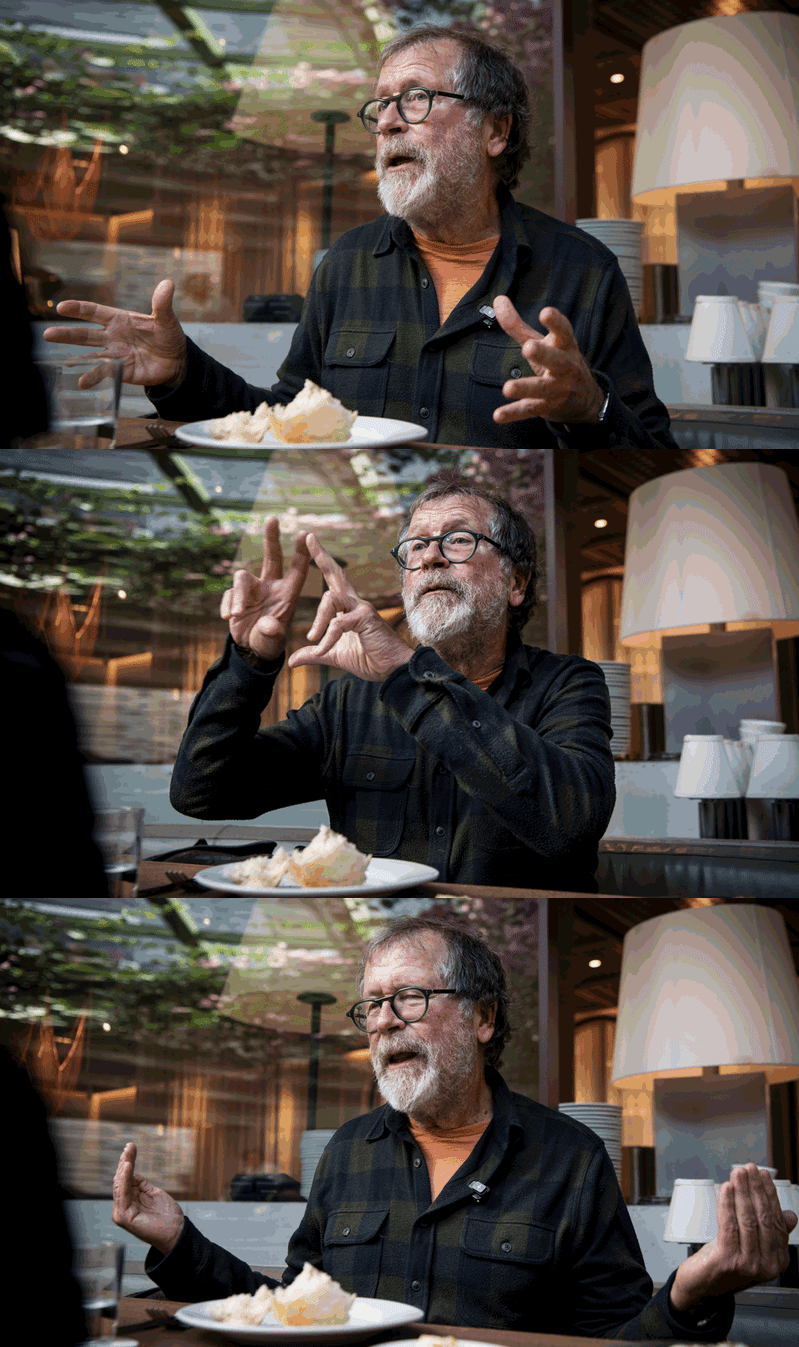
Neil Armfield always brings a cloth napkin to lunch – just in case the restaurant doesn’t provide real linen.The one he produces today (unnecessary as it turns out: Olympus is most definitely a real linen sort of place) has clearly been liberated from Qantas Business Class. (Sitting in front of Alan Joyce at the theatre one evening, Armfield says he once confessed his petty larceny to the former Qantas boss who was apparently unconcerned. “I think he had bigger things to worry about,” says Armfield.)This delightful eccentricity is a small but telling detail. Armfield, one of the best regarded directors of his generation, can’t help but concern himself with how things look and how they might work better. At various stages he is gently directing lunch, the crockery and the Herald’s photographer.Armfield working with Anthony La Paglia on Death of a Salesman: Armfield’s directing is gentle.Eugene HighlandHowever – and this is perhaps the secret to Armfield’s success – being directed by him never feels onerous but more that he is gently leading you towards something you’d probably have chosen yourself anyway, given the time.It’s something I’ve witnessed on several occasions when I’ve sat in on his rehearsals.Away from the rehearsal room, Armfield is a supremely genial and attentive lunch companion, never short of an anecdote or an opinion. He scatters celebrity names like confetti, but without seeming in the least bit pretentious. It’s just Geoffrey (Rush), Cate (Blanchett) or Richard (Roxburgh), whom he worked with in this or that show over the past 50 years.Nailing down a date for lunch has been far from easy. He’s in rehearsals at his beloved Belvoir St Theatre for a revival production of The Book of Everything, the award-winning show he first staged in 2010. The schedule is punishing and at one point we floated the idea of chatting over a sandwich at the theatre before Armfield decided he could get away after all for a proper lunch at nearby Olympus.The restaurant, in trendy new Surry Hills Village (it’ll always be Redfern Mall to me) is light and buzzy, with the centre of the room dominated by a huge, pink bougainvillea. We settle on a collection of small dishes that arrive at regular intervals, leaving my recorded transcript punctuated by frequent exclamations of “Ooh, lovely” and “That looks beautiful”. Half a dozen oysters are followed by taramasalata, dolmades, spanakopita and grilled sardines.It’s just Cate to Armfield who has worked with Blanchett and many other well-known actors over the years.Robert PearceAs we pick our way through the food, Armfield is keen to talk about his current project, and the pleasure he feels to be bringing it back to the Belvoir stage.“There’s something about the show that is so beautiful to return to,” he says. “It was one of my last shows at Belvoir [Armfield was inaugural artistic director there for 17 years, from 1994]. It’s about kindness and courage and how a society gets divided and the power of art in providing fun and beauty and pleasure and dimension. It feels so absolutely a prescription for our times.”In the play, based on a children’s novel by Dutch writer Guus Kuijer, nine-year-old Thomas is growing up in post-war Amsterdam. The youngster inhabits a rich inner world of his imagination, largely as a refuge from his violent, fundamentalist father. Gradually, with the help of an unlikely cast of allies, Thomas overcomes his fear and finds his way to happiness.As is often the case, Armfield is directing from the imagination of the key character in the story.“I’m sort of acting as director for Thomas,” he says. “He’s kind of the controller of the show.”By way of illustrating the redemptive power of stories, Armfield recalls an occasion in New York in 2011 when he was approached by an audience member.The meal starts with half a dozen Sydney rock oysters. Steven SiewertThe grilled sardines. Steven Siewert“I want to thank you for The Book of Everything”, said the man. “I have four children and I thought the right thing to do in disciplining them was to hit them. And all of them have rejected me. I saw that show last year and I made contact with each of my children and I apologised for my parenting. One of them still doesn’t want anything to do with me, but a dialogue has opened up with the others. And that happened because I saw that show.”“[Stories] make you realise there are other possibilities,” says Armfield. “And that there can be other outcomes than the ones you think are determined.”Armfield grew up in Concord in the mid-1950s, the youngest of three boys. His father worked at the Arnott’s Biscuits factory in Homebush and his mother worked for the Commonwealth Bank – until she was forced to give up the job once she was married.Even at a very young age Armfield’s directorial leanings were becoming apparent.“I remember at my eighth birthday party – I think it was my eighth – and all the local boys and girls came. I made everyone take the cellophane and tissue paper, tie it up, pin it to their backs and run around me pretending to be fairies. I did notice that the Jones boys from up the street sort of stood back and all the girls followed.”Neil Armfield in 1987. Doris Thomas/Fairfax MediaPartick White and Armfield.William YangWhen Armfield reached high school, the family was struck by twin tragedies. First, his mother was diagnosed with a tumour on her spine, then his eldest brother, Ian, was diagnosed with lymphosarcoma.“There was this kind of shadow at home and maybe that was the reason I sought to create, or I was drawn to, the theatre world at school,” he says.Whatever the reason, the young Armfield grabbed every opportunity he could to perform. Choir, orchestra, opera, theatre … he was committed practically every night of the week.And even when he wasn’t starring, his ambition was not to be denied. Sitting in the audience on the first night of one show, the gaze of the music teacher’s husband was magnetically drawn to Armfield in the chorus.“[The music teacher] said the person her husband noticed most was Neil Armfield singing in the middle of the chorus and could everyone act as hard as I was acting.”Armfield’s directorial debut came in 1972 with a typically ambitious and well-received production of Toad of Toad Hall, for which he teamed up with composer Alan John, with whom he would later collaborate on the opera The Eighth Wonder.Small dishes that arrive at regular intervals: The stuffed vine leaves.Steven SierwertSpanakopita Steven Siewert“I cast 45 kids in it and I choreographed dance sequences for the Wild Wooders,” recalls Armfield. “The Methodist Ladies’ College did a production of Toad some weeks later. After ours had finished I went along to see it, and it was terrible. It made me so proud.”It was ground-breaking Indigenous actor Brian Syron, who first put into Armfield’s mind the notion that he might make a career of directing after he saw his work in a state drama festival. “He told me, ‘If you want to be a director, you know what you’re doing’. I needed no more encouragement than that.”Armfield began his professional career at the long defunct Nimrod Theatre, established by John Bell, Richard Wherrett and Ken Horler. He worked with Jim Sharman’s Lighthouse Company in Adelaide and then in 1985 became one of the founders of Company B at Belvoir St – “the best stage in the country”.His many notable productions at Belvoir included Cloudstreet with a cast including Daniel Wyllie, John Gaden and Kris McQuade and a 1995 production of Hamlet with Richard Roxburgh.He has worked extensively with Opera Australia and Pinchgut Opera and his film credits include Candy and Holding The Man.Armfield directed Cloudstreet for Belvoir.Matthew BouwmeesterHis movie ventures include Candy, starring Heath Ledger and Abbie Cornish.APIt’s an extraordinary resume in both breadth and depth but, I wonder, does he ever fear the well might run dry? That he might exhaust all that creative energy?There have been moments when he has doubted himself, but then he has to remind himself to “trust the process”.“Actually, it’s nearly always the designers that pull me through,” he continues. “Because they know. My principle of good design is that, if I was in the audience, I should want to go into that space and play in it imaginatively. It’s the key to any design.”He recalls a 1990 Belvoir production of The Tempest with John Bell (Prospero) and Angie Milliken (Miranda). He tried to pull out because he had “no idea” what he was going to do. Ultimately, it was celebrated designer Brian Thomson who unlocked the production for him.John Bell and Angie Milliken in the Tempest that was unlocked for Armfield by the designer Brian Thomson.Branco Gaica“Brian designed it with a sandy floor with all the detritus of the world washed up along one side of the wall,” says Armfield. “There was a gauze curtain that got drawn across and a ring of open festoon bulbs which became Prospero’s magic. It started with a tub of water in the middle and John came out and stirred the water to create the storm that opens the show and put a little toy boat in it. Once you’ve got the vocabulary of the world, you close the doors of the rehearsal room and together everyone plays.”Armfield often returns to the idea of playfulness when creating work. “Actors need the freedom to experiment,” he says. “Sometimes in a rehearsal room, there can be a lot of fear and everyone can be measuring themselves off. It’s about creating an environment which is playful and where there isn’t that fear.”Having the time to allow the process to unfold naturally is also key, as is not trying to force an outcome. “Sometimes, you have a thought that this would be a great idea for the ending, but you have to banish that because then you start doing things that will make that idea happen. Everything has to grow out of what has already been happening so you find this sense of organic growth.”The bill – complete with two Greek coffees. I say I can’t ever imagine this gentle man “losing his cool” in the often pressurised theatre world. Has he? “I truly can’t remember losing my cool,” he says. “When something bad is happening I’ve always had a tendency to look at the reasons why.”As lunch winds to a close I suggest we might finish with one of the tempting looking desserts on the menu. “You don’t think it will look better if we just had two Greek coffees?” says Armfield, with an eye to the picture of the bill that always accompanies these interview pieces.“Oh my God, you’re directing again!” I say.“It’s a common complaint,” he concedes a little ruefully.Read more great conversations over lunchStephen Brook asks Michael Rowland about his future: In the space of 14 months, Michael Rowland upended his ABC life. There’s more upheaval to comeMargot Saville laughs with Kathy Lette: Kathy Lette on ageing fabulously … and giving cheek to the KingLouise Rugendyke lunches with actor Sam Reid aka the vampire Lestat: Sam nearly chucked it all in to become a farmer. Now fans are screaming for his showsDebbie Millgate on knowing when to stop with Caitlin Fitzsimmons: ‘You’re terrible, Muriel’ made Gabby a minor celebrity. Her new career is making her happyStart the day with a summary of the day’s most important and interesting stories, analysis and insights. Sign up for our Morning Edition newsletter.
‘It’s a common complaint’: Even at lunch, Neil Armfield can’t help but direct things
Full Article
Original Source
Read the full article at Smh →KhanList aggregates and links to publicly available news content. We do not host full articles from third-party sources. Always verify important information with original sources.