
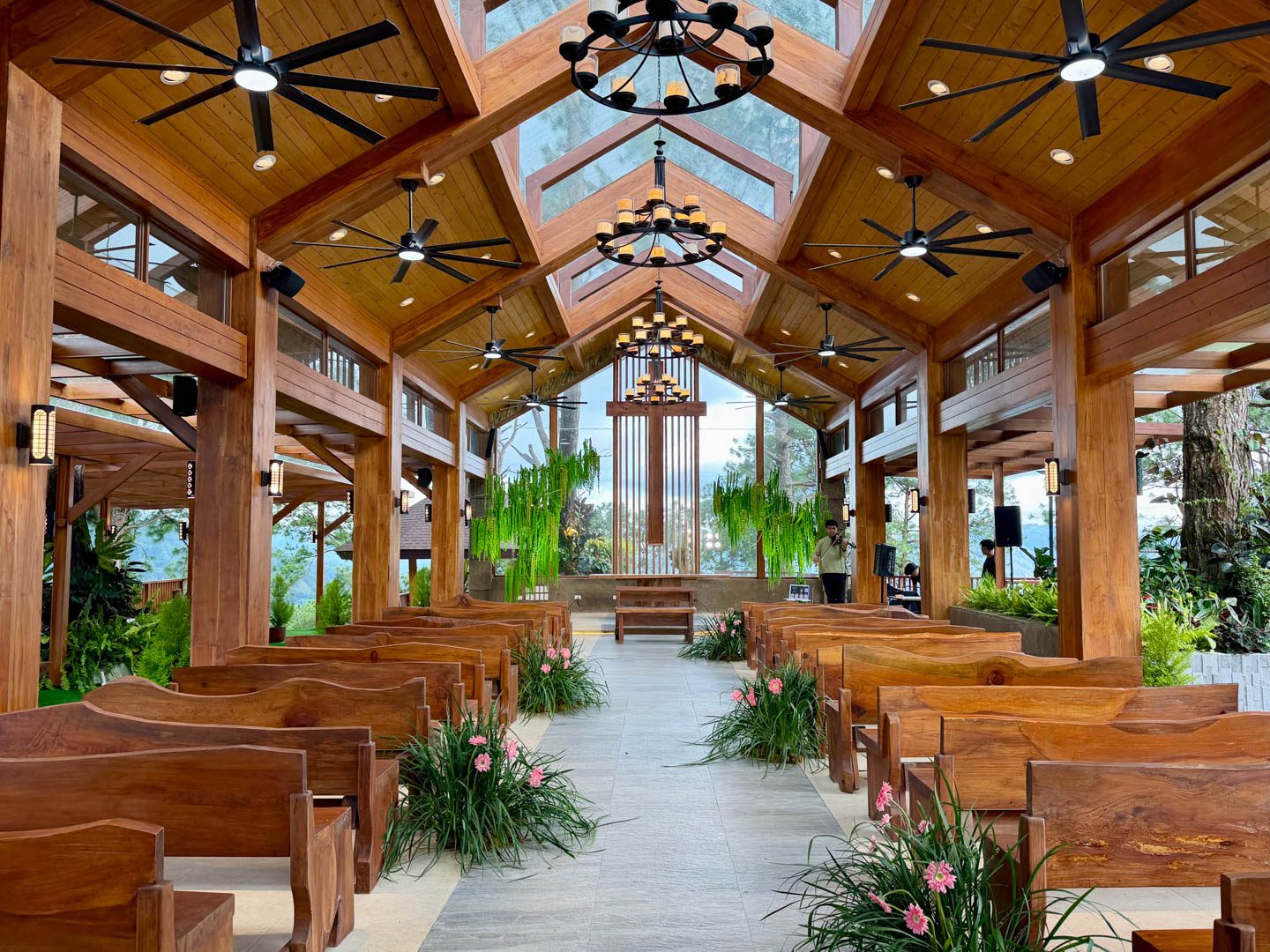
Itogon Mountain Village in Benguet has transformed from a small family café into a popular mountain destination featuring cabins, an events venue, and a nonsectarian chapel, all designed to showcase the stunning Cordillera landscape. The Bernabe family, who initially opened Café Stella, expanded their business in response to customer demand for private events, leading to the creation of additional facilities while preserving the natural environment. The venue emphasizes inclusivity and local culture, hosting various celebrations and working with local suppliers, while promoting environmental sustainability and heritage preservation in the rugged mountainous region. This is AI-generated. Read the article for full context. Report any errors. ITOGON, Benguet – You notice the mountains before almost anything else. They appear through the glass walls, between the pines beside the cabins, and behind the altar of a wooden chapel where nearly every direction opens to another ridge. At Itogon Mountain Village, the view is not decoration. It is the point. The three-hectare property in Barangay Loacan has grown from a small family café into a mountain destination with cabins, an events venue, and a nonsectarian chapel designed around an almost 360-degree view of the Cordillera landscape. On September 19, after weeks of habagat rain, the sun finally returned. The timing coincided with the property’s first wedding open house, Love Above the Clouds, but the experience made clear why people had begun coming here long before the flowers, gowns, and reception tables arrived. The Bernabe family made a simple bet: that people would leave the city for the mountains, and that the mountains themselves were enough. EVENTS. Montesierra Events Place at Itogon Mountain Village is designed for weddings, family celebrations, and other gatherings, with the mountain landscape visible through its wide glass windows. Photo by Mia Magdalena Fokno It started with coffee Itogon Mountain Village did not begin with plans for weddings. It began with Café Stella. “We started off very small,” said lawyer Rish Bernabe, one of the family members behind the property. There were about six employees and only around 15 items on the menu, she recalled. Their father had envisioned a café down the mountain, while the family, which had long spent holidays in Baguio and the surrounding highlands, took on the challenge of running it. Opening outside Baguio was a gamble. The place is almost half an hour away from the city, so “building up a business here was really a risk,” Rish said. Then people came. The café gained attention on social media, and a kitchen designed for a modest number of customers suddenly had to feed far more. So they expanded the kitchen, upgraded to commercial equipment, hired more workers, and opened more of the building. From a handful of employees, the enterprise eventually grew to around 80, according to the family. Customers then began asking to reserve the café for private events. Closing the restaurant for an entire celebration was difficult, so the family expanded again. Cabins followed. Then the Chapel of the Mountains. Then Montesierra, a dedicated events space. What started as somewhere to eat had become somewhere people wanted to stay, gather, and mark important days. VIEW. A guest cabin at Itogon Mountain Village shows how existing pine trees were preserved and incorporated into the design, with the structure built around them rather than cutting them down. Photo by Mia Magdalena Fokno Building around the mountain The growth could easily have changed what drew people there. But the Bernabes say they tried not to let that happen. Glass dominates much of the architecture so that the surrounding mountains remain visible. Buildings and roads were adjusted around existing trees whenever possible, they said. One tree remains standing in the middle of a road because the family refused to cut it. “This is the yamang lupa that made us come here,” Rish said. “So we really have to preserve it and celebrate it.” That approach is most evident at the Chapel of the Mountains. Wooden pews face an altar framed by glass, pines, and distant slopes. Light falls through the roof. Turn to either side, and the landscape remains part of the room. On that sunny September afternoon, after a long stretch of rain, no manufactured backdrop could really compete. The chapel is also deliberately non-sectarian. It is not accredited by the Roman Catholic Church to host Catholic sacramental weddings, management clarified after earlier confusion over a ceremony held there. Rish said the couple involved had already been legally married in Manila and that the ceremony at the chapel was symbolic. “We respect the rules of the diocese,” she said. The space remains open to other ceremonies consistent with legal and religious requirements. Its openness, then, is not only architectural. It gives couples and families from different traditions a place to celebrate in their own way. MOUNTAIN. Wedding bells outside the Chapel of the Mountains at Itogon Mountain Village, framed by pine trees and the steep slopes of Itogon. Photo by Mia Magdalena Fokno Love beyond weddings That idea of inclusion was central to the September 19 gathering. “Today is about love, and not just romantic love,” said Suzy Mejia Bernabe, who handles marketing and sales for the family enterprise. She spoke about weddings, birthdays, anniversaries, reunions, and other milestones, but also about creating a place where people could “slow down and reconnect.” The family says it works with local suppliers, uses local produce when possible, and invites local makers, artists, and cultural performers to take part in events. That puts the property within a broader effort by Itogon to build tourism around its landscape and culture. The municipality has long been associated with gold. Its own historical account traces gold working in the area to Indigenous communities before the colonial period, while large-scale mining later shaped much of the town’s modern history. Today, Itogon’s tourism program also promotes nature and culture, with environmental sustainability, heritage preservation, and local employment among its stated goals. The setting comes with limits. Itogon is rugged mountain country, with 74.6% of its land classified as having slopes steeper than 50%, according to the municipal government. The Bernabes know building here is different from building on flatter ground. The terrain dictates what can be done, where structures can go, and sometimes which trees have to stay exactly where they are. Perhaps that is why the place works. It does not feel as though the mountain was flattened to make room for a destination. In places, the destination appears to have negotiated with the mountain. Looking up For generations, Itogon has been known for what lies beneath its mountains: gold. Itogon Mountain Village asks visitors to look up instead. At the pines growing beside the buildings. At the ridges beyond the glass. At a chapel where mountains remain visible behind the altar. The family started with a small café and the uncertainty that anyone would drive this far from the city. But now, people come not only for coffee, but to stay, celebrate, marry, or simply spend a few hours where the mountains are allowed to remain the biggest thing in the room. Perhaps the distance is not something visitors have to overcome after all. Perhaps it is part of the point. – Rappler.com
Itogon Mountain Village builds a home for love above the clouds
Full Article
Original Source
Read the full article at Rappler →KhanList aggregates and links to publicly available news content. We do not host full articles from third-party sources. Always verify important information with original sources.