
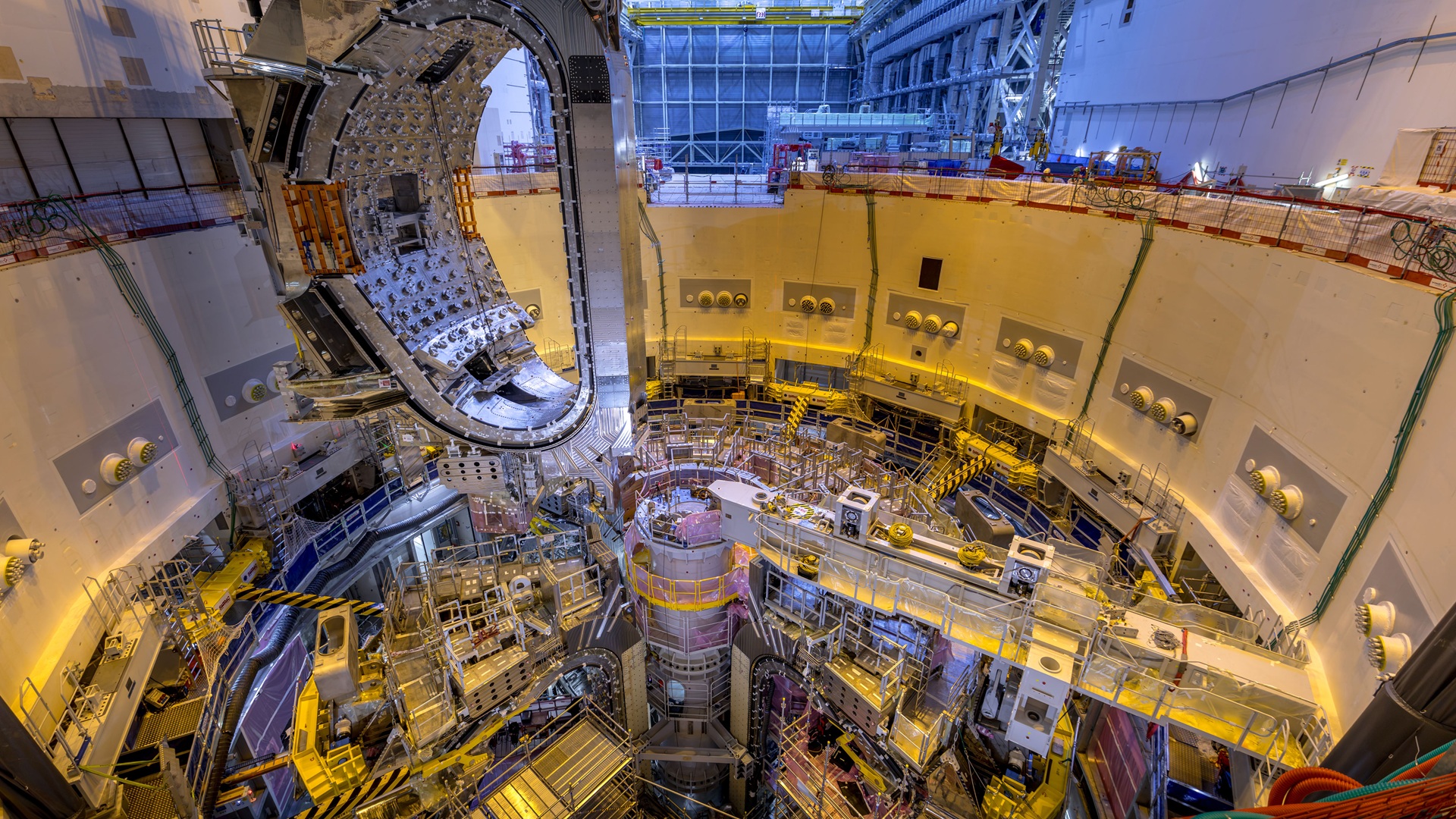
ITER tokamak assembly progresses inside reactor hall.ITERKey TakeawaysITER has installed seven of its nine tokamak sector modules, bringing its experimental fusion reactor closer to core assembly completion.The 1,400-tonne suspended load was manoeuvred between two installed modules with just 5 cm of clearance on either side.The five-storey-tall module was lowered into the tokamak pit during a 24-hour operation completed on November 26. The International Thermonuclear Experimental Reactor (ITER) project in France has installed its seventh tokamak sector module, bringing the experimental fusion reactor closer to completing its massive toroidal core. The five-storey-tall component was lowered into position between two previously installed modules, leaving just 5 centimetres of clearance on either side. The installation, completed over 24 hours on November 25 and 26, involved a suspended load weighing nearly 1,400 tonnes, including the lifting equipment. It marks the first time assembly teams have placed a sector module into a gap between two existing sections. With seven of the nine modules now installed, ITER has completed more than two-thirds of the tokamak’s core assembly. The project is also progressing approximately six months ahead of the schedule established under Baseline 2024. Precision guides massive lift Each of the nine sector modules forms a 40-degree section of the tokamak’s toroidal vacuum vessel. The module itself weighs approximately 1,100 tonnes and includes part of the vacuum vessel, its thermal shield and two superconducting toroidal field coils. Previous installations had unobstructed space on at least one side of the suspended component. The seventh installation presented a more demanding challenge, requiring engineers to manoeuvre the massive structure between two neighbouring modules with extremely limited clearance. The module descended approximately 30 metres into the tokamak assembly pit. Teams programmed pauses during the operation to allow natural oscillations in the suspended load, known as the pendulum effect, to subside. Tilt sensors, strain gauges and cameras monitoring critical clearances provided real-time information about the module’s position and structural behaviour throughout the descent. Crane operators, engineers, metrology specialists and safety teams worked together to guide the component onto temporary supports. “For the first time, we lowered a load of nearly 1,400 tonnes into a gap with about five centimetres to spare on each side, and it went exactly to plan,” ITER Director-General Pietro Barabaschi said. Two modules remain The latest installation builds on several milestones achieved in recent months. ITER received the ninth and final vacuum vessel sector in October, meaning all major components required for the tokamak core are now on site. The project has also completed repair work on its vacuum vessel sectors and thermal shields, reducing technical and scheduling risks associated with machine assembly. ITER plans to install the two remaining sector modules by the second quarter of 2027. Once all nine sections are in place, assembly teams will align and weld the vacuum vessel sectors together to form the toroidal chamber that will contain the fusion plasma. The completed vacuum vessel will measure approximately 19 metres across and 11 metres high, with a weight of around 5,200 tonnes before the addition of internal components. ITER is an international collaboration involving Europe, China, India, Japan, South Korea, Russia and the United States. The experimental reactor is being built in Saint-Paul-lez-Durance in southern France to demonstrate the scientific and technological feasibility of fusion power. Get the latest in engineering, tech, space & science - delivered daily to your inbox.With over a decade-long career in journalism, Neetika Walter has worked with The Economic Times, ANI, and Hindustan Times, covering politics, business, technology, and the clean energy sector. Passionate about contemporary culture, books, poetry, and storytelling, she brings depth and insight to her writing. When she isn’t chasing stories, she’s likely lost in a book or enjoying the company of her dogs.
ITER completes tightest tokamak lift yet, lows 1,400-tonne load with 5 cm to spare
Full Article
Original Source
Read the full article at Interestingengineering →KhanList aggregates and links to publicly available news content. We do not host full articles from third-party sources. Always verify important information with original sources.