
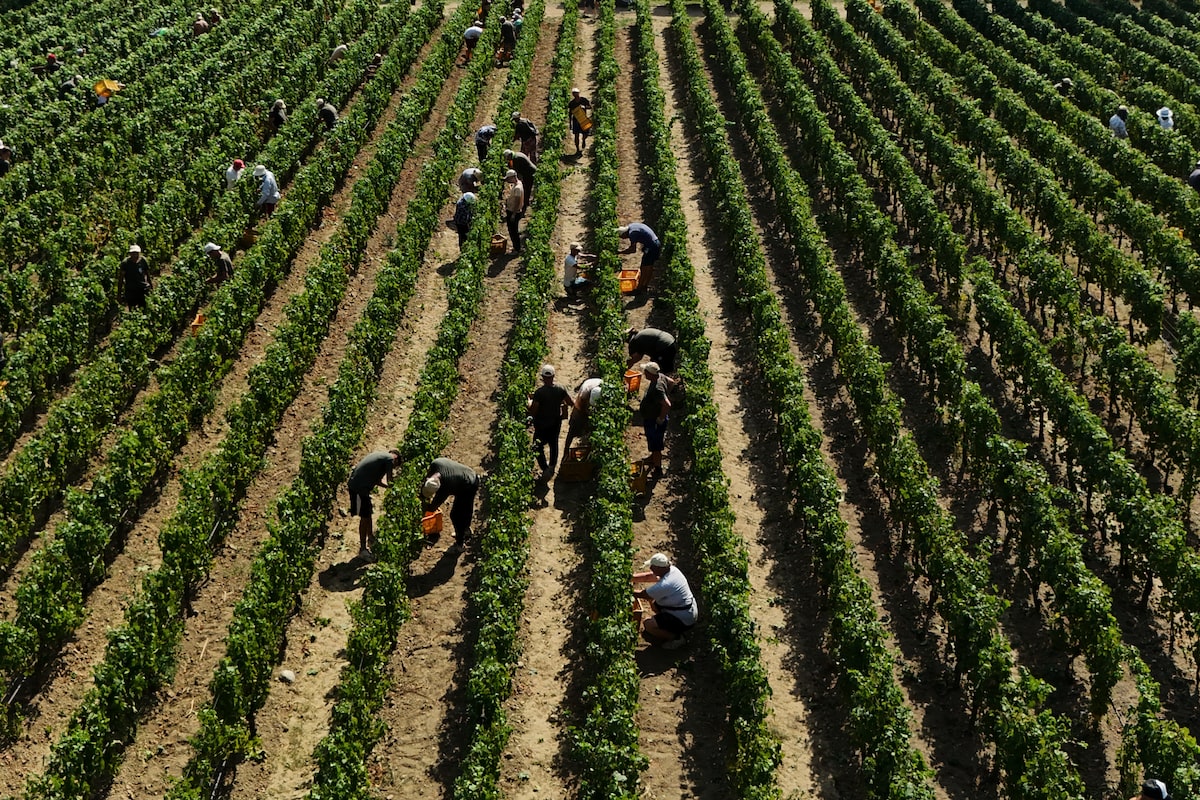
Workers fan out before dawn to clip clusters of grapes destined to be transformed into Italy’s prized Franciacorta sparkling wine a full 10 days earlier than anticipated, as scorching temperatures brought the fruit to maturation earlier than ever.Climate change is narrowing the window for harvesting wine grapes, forcing wine makers to make quick decisions when even a few days can mean the difference between a good vintage and a bad one.“These are delicate, frantic moments, and everything has to work perfectly,” said Berlucchi CEO Arturo Ziliani, whose father, Franco, and estate owner Guido Berlucchi became the first wine makers in the northern Italian region of Franciacorta to produce sparkling wine using the “classic” method famously employed by France’s Champagne makers. “We did not expect such an early harvest or such an acceleration in ripening,” Mr. Ziliani said.Can the wine producers of Franciacorta beat the heat? Learn more about how they're mobilizing for an earlier harvest than expected, thanks to climate change. The Associated PressWeeks of temperatures reaching highs between 37 and 38 degrees, combined with below-average rainfall, have pushed some wine makers in Franciacorta to record the earliest start on record — 10 days earlier than last year and about a month earlier than three decades ago.Berlucchi, the oldest producer of Franciacorta, which is made using the traditional method of secondary fermentation in the bottle, began harvesting Aug. 2 as part of an industrywide effort to preserve grape quality in the face of increasingly extreme weather.Open this photo in gallery:Italians have sweated through heat waves in the high 30s this summer, and Franciacorta is no exception.Experts say several factors combined to push Franciacorta’s harvest so early this year. A relatively mild winter meant the vines produced buds earlier, while hailstorms damaged some of the yield, lightening the fruit and bringing it to earlier maturation.Even in late July, Berlucchi was targeting an Aug. 10 harvest date, but it quickly became clear that Pinot Nero used for sparkling blends and rosé was ready to be picked, signaled by rapidly rising sugar levels. Within two days, workers were mustered and the presses were readied.Open this photo in gallery:A towel gives this worker in Franciacorta some extra protection from the hot sun.The midday heat has been so extreme that workers are forced by regional labour rules to stop between 12:30 p.m. and 4 p.m. But wine makers say it has been too hot for the afternoon shift. To gain time and bring grapes to the presses before they are overheated, Berlucchi last week started the harvest at 4 a.m., with workers picking under the blaze of floodlights.“The grapes are perfectly healthy,” said Ferdinando Dell’aquila, an oenologist who is Berlucchi’s technical director. “We just have to work as quickly as possible, harvest them and preserve their acidity.”Open this photo in gallery:Berlucchi’s wine cellars date back to the 17th century, when Italy was touched by a relatively cold period dubbed the Little Ice Age. Now, Europe is warming up fast, due in part to greenhouse gas emissions.It is not just Franciacorta that is starting early. Sicily began the wine harvest for still wines in late July. Small parts of Tuscany also started picking, as well as most sparkling wine regions. The calculation is most complex for the makers of Champagne-style sparkling wines, which require a delicate balance of much higher fixed acidity, much lower pH and lower sugars than for still reds and whites.“Early-ripening varieties such as Chardonnay require great care, because a delay of just a couple of days can leave you with grapes unsuitable for sparkling wine. Sugar rises too quickly and acidity falls too quickly,” said Attilio Scienza, a professor emeritus at the University of Milan.Open this photo in gallery:These Chardonnay grapes are from the Defilippi I Gessi wine estate near Pavia. Here, as in Franciacorta, harvesters started early to save the crop.Claudia Greco/ReutersHigh outdoor temperatures require the grapes to be cooled before being gently pressed in stainless steel machines to extract the highest quality free-run juice, a crucial step in sparkling wine production that cannot be rushed. Berlucchi operates up to 24 presses a day, often late into the night, to process the unusually early harvest.“Climate change and the African weather systems settling over Europe are bringing extraordinary temperatures and forcing early picking, not only in Italy, but also in France and Germany,” said Paolo Castelletti, secretary general of the Italian Wine Union trade organization.With earlier harvests becoming a trend, wine makers say they will have to begin monitoring the fields even earlier to make sure they don’t miss the best harvesting moment. “A good oenologist can manage situations like this. I can say with confidence that wine quality is not compromised. It simply requires a different organization of work than in past years,” Mr. Castelletti said.In the wine of fire: More from The Globe and MailThe Decibel podcastThis summer’s wildfires in Okanagan wine country are one of many setbacks that have forced Canadian producers to adapt to extreme weather. Three years ago, in another disastrous fire season, wine writer Christopher Waters spoke with The Decibel about how the industry must evolve or run dry. Subscribe for more episodes.In depthIn the vineyards of Chablis, spring is a war against frost waged with fireAs temperatures rise and rainfall declines, this award-winning viticulturalist is embracing changeHow one of Spain’s top wine makers is preparing for wine’s future
Italy’s extreme heat sends sparkling wine makers into overdrive for an early harvest
Full Article
Original Source
Read the full article at Theglobeandmail →KhanList aggregates and links to publicly available news content. We do not host full articles from third-party sources. Always verify important information with original sources.