
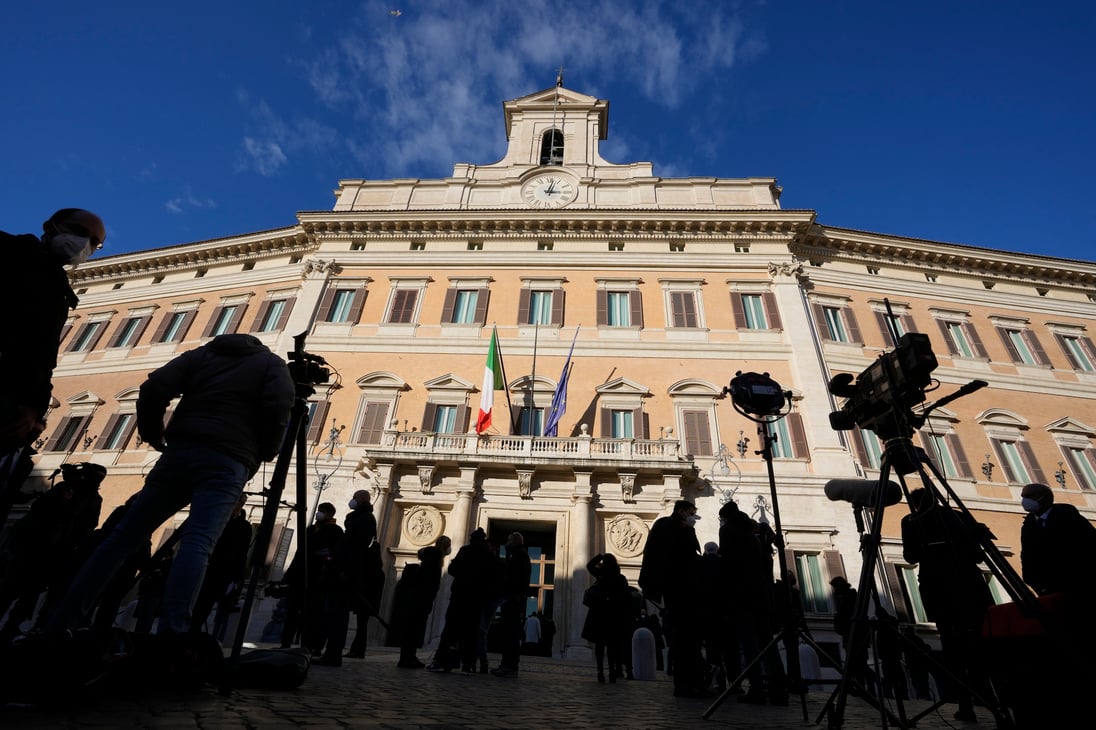
Italy’s right-wing government says a new election law will bring stability to Italy. But critics see it as a power grab by Prime Minister Giorgia Meloni. (CN) — Aiming to end Italy’s history of rickety governments, Italian lawmakers on Thursday passed a controversial law that awards bonus seats in Parliament to election winners, giving far-right Italian Prime Minister Giorgia Meloni a major victory ahead of elections next year.After months of contentious debate about whether it was an anti-democratic power grab by Meloni, the law was approved by the Chamber of Deputies, the lower house, in a 227-164 secret vote.The reform faces challenges at the Constitutional Court with critics and opposition parties warning it unfairly benefits winners and undermines Italy’s democracy. The harshest critiques compare the overhaul to a 1923 law that helped Benito Mussolini’s National Fascist party dominate Parliament.Meloni and her supporters argue the law will end Italy’s era of unstable governments and post-election horse-trading that takes place to form a majority. Italy is infamous for its fractious and short-lived governments, though Meloni’s own term in office has proven that’s not always the case. Italy has had 68 governments since becoming a republic in 1946; Meloni’s center-right coalition is the longest-serving single government. She is in the last year of her five-year mandate after winning elections in September 2022.After the vote, Meloni said the law will “promote the stability and parliamentary coherence of any government, regardless of its political color.”Elly Schlein, the opposition leader of the center-left Democratic Party, accused Meloni of “changing the rules of the game” only months before the next election.She called the law “wrong and unconstitutional.” When the vote count was announced, opposition lawmakers held up signs calling it a “scam law.”The overhaul is designed to make it easier for a victorious party or coalition that obtains at least 42% support in both legislative chambers to secure a majority of 56%. In the lower house, winners will get an extra 70 seats and 35 in the Senate. There are 400 seats in the lower house and 200 seats in the Senate.Once the 42% threshold is reached, the bonus seats go automatically to the winning coalition or party and then the rest of the seats are distributed to all the parties on a proportional basis. However, the winning coalition cannot exceed 220 seats in the Chamber of Deputies or 113 seats in the Senate.If the 42% threshold is not reached, all seats (including the bonus seats) are distributed proportionally.The law also introduces other changes.Candidates for the prime minister’s job will have to be announced ahead of elections. Also, voters will be able to express preferences for candidates in their district, a change that critics say could undo Italy’s gender balance in Parliament because more men might be picked on the mixed-gender lists.Another change makes it much harder for new parties to enter national politics because it will require them to obtain a huge number of supporters before they are eligible to run for office.To compete nationally, a new party will need to gather 6,000 signatures in each voting district, up from the current 1,500 signatures. That amounts to 400,000 signatures across Italy.Critics warn the new system undermines the democratic process by shifting power away from the Parliament to the executive branch. There are concerns election winners will be able to ram through laws, judicial appointments and key decisions without the need to negotiate with opposition lawmakers.Italy’s Constitutional Court is expected to review the law, perhaps as soon as February.Benedetta Lobina, a legal scholar at the Central European University, said the Constitutional Court examined previous proposals to give election winners bonus seats in 2014 and 2017.In 2017, the court ruled that a proposed majority bonus was not unreasonable, Lobina said. But, she added, “this time arguably the bonus is greater.”“Therefore it could be considered a distortion of the principle of democratic representation that unjustifiably reduces the role and voice of the opposition,” she said in an email.The law’s high bar for new political parties may be seen as problematic too, Lobina said.“The disadvantage, in terms of resources and logistics, for new parties is significant,” she said.Lobina noted the reforms were watered down from Meloni’s initial goals of amending the constitution to have voters directly elect a prime minister and awarding an even bigger seat bonus.“Obviously this is a way to strengthen the executive and potentially alienate both existing and new/emerging opposition parties,” she said. “But it’s a milder power grab than what could have been expected.”Paradoxically, political analysts say the law may wind up hurting Meloni at the next election due to the emergence of a new political party even further to Meloni’s right.Roberto Vannacci, a retired Italian general, recently formed the National Future and it is polling above 7%. But Vannacci and Meloni are at odds, making it possible that Meloni’s far-right Brothers of Italy party and its allies might not have enough votes to reach the 42% threshold without Vannacci’s support.There is a chance, then, that left-leaning opposition parties could reach that threshold or that the election could lead to a hung Parliament, the very outcome the electoral reform was meant to prevent.Courthouse News reporter Cain Burdeau is based in the European Union.Subscribe to our free newslettersOur weekly newsletter Closing Arguments offers the latest about ongoing trials, major litigation and rulings in courthouses around the U.S. and the world, while the monthly Under the Lights dishes the legal dirt from Hollywood, sports, Big Tech and the arts.Additional Reads
Italian Parliament approves election law giving seat bonus to winners
Full Article
Original Source
Read the full article at Courthousenews →KhanList aggregates and links to publicly available news content. We do not host full articles from third-party sources. Always verify important information with original sources.