
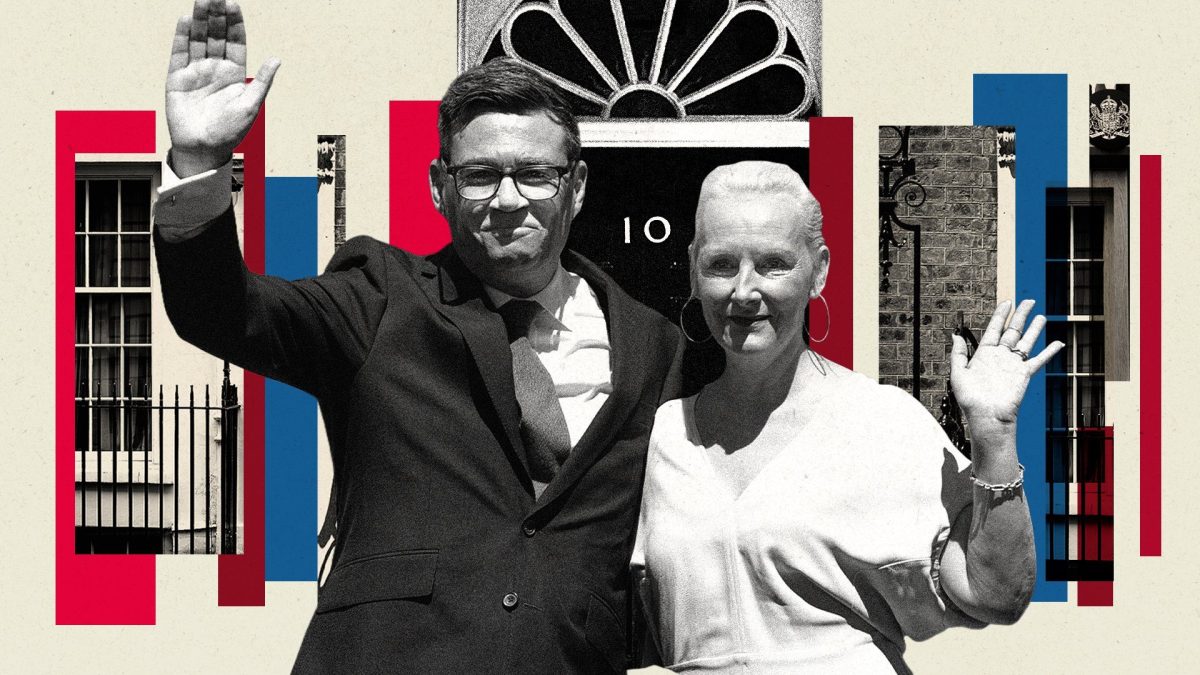
When Andy Burnham became Prime Minister five weeks ago, his wife, Marie-France “Frankie” van Heel, 56, did not quit her job as chief marketing officer of Manchester-based EV-charging infrastructure firm Iduna. She did not pack up the family home in Greater Manchester, abandon the senior marketing career she’s spent three decades building, and decamp to Downing Street. Instead, Van Heel – once “the coolest girl in the college” at Cambridge and famously disinterested in courting the political limelight – appears to have done something altogether more ordinary: carried on with her life. Indications are that she will continue her life in Golborne, near Manchester, while her husband commutes to and from the office in London, making them the first hybrid couple to get the keys to No 10. Although she was by his side on Thursday, as he welcomed the French President Emmanuel Macron and his wife, Brigitte, to Downing Street.Burnham has committed to spending at least one day a week at No 10 North, creating the prospect of a working week divided between Westminster and Manchester – and a wife with her own career, grown-up children, ageing parents and a “support network” rooted 200 miles away. The arrangement marks a shift towards a pattern of working familiar to millions in post-Covid Britain. “It’s a sign of the times,” says Sir Cary Cooper, professor of organisational psychology at the University of Manchester. “Most of us are now working hybridly for flexibility.” While Van Heel has always kept a notably low-profile in Manchester it will be harder for her now to stay out of the spotlight. In the wake of her husband’s arrival in Number 10, faced criticism online over her choice of dress on the big day, with high-profile figures such as Dawn French and Paloma Faith springing to her defence. “The most important thing for Burnham to avoid is turning his partner into a national story,” says communications advisor David Yelland, editor of The Sun from 1998 to 2003 – a period when Cherie Blair was a regular target of media scrutiny and criticism. Labour hardly needs reminding how quickly that can happen: Victoria Starmer endured an extraordinary bout of public criticism when it was revealed Labour donor Lord Waheed Alli had paid for some of her outfits. The outcry caused her to scale back public appearances for most of Sir Keir’s ill-fated premiership. Cherie Blair, a friend of Yelland’s, “went through hell”, he says, and was treated “despicably” by a media that turned her into a proxy target for a husband who proved, at least initially, difficult to attack. The Burnhams now have the opportunity to model a different kind of prime ministerial marriage. Andy Burnham and his wife Marie-France van Heel both greeted French President Emmanuel Macron and First Lady Brigitte Macron at No 10 on Thursday (Photo: Getty Images) ‘Ridiculous for her to up sticks to London’ Downing Street won’t confirm specifics of when or how the new Prime Minister intends to divide his life between the two cities. But Joshi Herrmann, founder of Manchester-based Mill Media, says the police presence around Heron House – the “drab” modern office block now housing No 10 North – has been greatest on Thursdays and Fridays since Burnham began his premiership. Britain has, in other words, acquired its first hybrid-working Prime Minister, albeit one who comes with armed police and audiences with the King. According to Yelland, there is simply no need for his wife to relocate. “It would be ridiculous, would it not, for her to give up her job and her day-to-day life to up sticks down to central London,” he says. “I think we’ve all grown up quite a lot really.” This separation of the Prime Minister’s workplace from his family home is, nevertheless, a striking departure from the traditional domestic theatre of Downing Street. Since 1902, becoming Prime Minister has meant not merely acquiring an office in SW1 but moving family life there too. Tony and Cherie Blair raised their four children behind its gates; Gordon and Sarah Brown moved in with their two young sons; Samantha Cameron gave birth to her fourth child, Florence, three months after moving into Downing Street, and even Liz Truss’s husband and teenage daughters joined her for her famously brief 49-day premiership. Sir Keir Starmer represented a more modern variation: Victoria Starmer continued working for the NHS and the couple fiercely protected their children’s privacy, but Downing Street still became the family’s London base. But for the Burnhams, Manchester remains home; Downing Street is, in effect, somewhere Burnham goes to work – a distinction Yelland thinks may be rather healthier anyway. “It’s not a family home,” he says of the flat above No 10. “It’s a working environment. A working apartment above the office.” Nor, he points out, is there any formal role for the person married to the Prime Minister. “I don’t think we in this country expect our Prime Ministers’ wives to be permanently in situ,” he says. Indeed, the expectation that a woman should become a “servile vessel to stand alongside her husband and give up her career”, he argues, would now strike most people as absurd. Dutch-born Van Heel has built a substantial career of her own in marketing and branding rather than becoming a professional political spouse (Photo: Ryan Jenkinson/Getty) Perhaps nobody should be surprised that the Burnhams agree. The writing was on the wall before they were even married. Early in their relationship, Burnham reportedly issued the woman who would become his wife with a fairly unequivocal warning: “Don’t stay with me if you want to live in London, because I won’t be doing that.” Three decades, three children, a Northern mayoralty and one premiership later, he is testing that promise. Dutch-born Van Heel has built a substantial career of her own in marketing and branding rather than becoming a professional political spouse. She helped launch Sky Digital, headed marketing at MTV Europe and later held senior agency roles including at Heavenly, where her work included brands such as the BBC and England Rugby. The couple raised Jimmy, Rosie and Annie in the North and Burnham has described the five of them as a “tight five-strong family unit” – six if you include Axel, their bichon frisé and regular companion on family walks. Burnham has previously said his wife “takes no interest in my day-to-day job whatsoever”; Van Heel herself has described political family life as “a bit of a balancing act”. Van Heel has hardly disappeared since her husband’s promotion During Burnham’s first Labour leadership campaign in 2015, he was taking questions at an event at Soho House when a woman in the audience raised her hand. It was Frankie. “You’re not allowed to ask a question,” Burnham joked. “I was just going to ask when you’re next home?” she said. “Umm, a week on Thursday,” came the sheepish reply. Eleven years later, the exchange looks prophetic. Yelland is sanguine about the prospect of the Burnhams spending several nights a week apart. “They’ve been married a long time,” he says. “They’re professionals at it.” Van Heel has hardly disappeared since her husband’s promotion. There have been the two high-profile Downing Street appearances, she also joined their three children for his leadership victory, and was beside him in the Everton stands last weekend. Yelland expects her in London for state occasions and visits by foreign leaders and their partners. The model, in other words, may be one of selective visibility: there when it matters, while continuing the job and Manchester life that existed before No 10. That may also be the safest media strategy. Herrmann points to the increasingly vicious social-media treatment of political spouses, from their clothes and careers to entirely unfounded rumours about their private lives. Van Heel, by contrast, has always been notably low-profile in Manchester. “She’s not a politician,” he says. “Anyone I speak to doesn’t know much about her.” His hope is simple: “I hope his decision to become prime minister doesn’t kind of ruin her life.” Yelland’s advice is similarly cautious. “Once you put someone into the public space you can’t go the other way,” he says. “Better to be accused of being too private than anything else.” If maintaining a marriage across two cities is one part of Burnham’s new family jigsaw, there is another considerable advantage to its timing: his children are grown up. Jimmy, 26, Rosie, 24, and Annie, 21, are grown up, meaning there are no school runs or bedtimes to miss – and all three work for organisations with London offices, respectively the Royal College of Nursing, Jägermeister UK and communications agency Riot. Whether they actually work from them regularly isn’t known, but it isn’t hard to imagine Burnham meeting his children for dinner or a gig during the London half of his week. Burnham and Van Heel (pictured in 2015) met at the University of Cambridge (Photo: Justin Tallis/AFP) Back home, family life appears pleasingly ordinary: barbecues; walks with Axel; and music: Burnham says his son introduced him to The Strokes and Big Thief, while at Glastonbury in 2022 the “two-man tent” he packed turned out to be a windbreak, leaving Billy Bragg’s brother to rescue him and Frankie with a spare. But if Burnham has reached the stage of life when his children need less of him, he has also reached the age when his parents may need more. His father Roy has Alzheimer’s and lives in a care home in the North West; his mother Eileen lives nearby. A longtime colleague says getting back matters because “it’s important for him to be back to see his dad with his mum”. Nevertheless, even those who knew how deeply Burnham’s family life was rooted in the North weren’t convinced it would survive contact with the premiership. “I didn’t expect him to retain the link to Manchester so much,” says Herrmann, who has interviewed Burnham several times. “I always thought Burnham would become prime minister, then he would go down to London.” Excitement in Manchester when Burnham returns Instead, Herrmann has noticed genuine excitement around the city whenever Burnham arrives back at No 10 North. “People are definitely excited about the idea that the Prime Minister’s not only from here, but that he is spending time in Manchester. That means quite a lot to people here.” It also plays perfectly into the “man of the people” image Burnham has cultivated for years: a politician who talks about picking up ideas in pubs and Greggs, prefers tea to “posh coffee” and makes a virtue of life outside the Westminster bubble. Herrmann thinks Burnham has a good instinct for gestures that leave voters thinking “this guy’s doing things differently”. Cooper agrees: “He’s saying: I’m a man of the people, I’m a northerner, we have to spread power across the UK.” His determination to remain northern predates No 10. A friend who worked closely with him during his years travelling between Westminster and the North West remembers that he was “always keen to get back on a Thursday”. Weekends combined constituency business with family life, Everton matches and time with friends. There is one logistical snag: Burnham’s two offices are 200 miles apart. Is it as simple as hopping on a West Coast service with a red box and security team, and can he run the country on Avanti Wi-Fi?Quite possibly. Simon Tasker, a former senior Metropolitan Police close-protection officer, says there’s no reason Burnham could not continue using the railway. A 2hr 20min journey provides “a lot of good work time” and fellow passengers often barely notice who is in their carriage. British protection follows a “less is more” principle – “discreet and unobtrusive” – and if Burnham wants to retain his “man of the people” accessibility, “it would not be for us to advise or counsel against that”. A more modern headache security teams have to grapple with is the member of the public seeking a viral moment: an egg, milkshake or embarrassing encounter engineered for social media. Commuters are less convinced. Liz Taylor, a Manchester businesswoman who makes the journey regularly, calls the Wi-Fi “impossible” and the loos “disgusting”, while one X user described the “very specific Avanti train smell” as “sort of like a very warm toilet, if Very Warm Toilet was a smell.” Reliability is another hurdle. Joe, 33, an operations director who made the journey weekly for much of the past year, stopped making plans within an hour of his scheduled arrival and once received more than £100 in Delay Repay in a month. Eventually, “doing London to Manchester every week was enough to make me look for another job”. Not every journey is made by rail. Burnham took a government plane to Manchester earlier this month after travelling via Scotland to meet the leaders of the devolved administrations – an early reminder that a prime ministerial diary will not always bend neatly around train timetables. And therein lies the serious catch: hybrid working is considerably easier when an international crisis cannot summon you back to Whitehall at a moment’s notice. Burnham may intend to spend at least a day a week at No 10 North but ultimately events may dictate his movements. Three decades ago, Burnham warned Frankie not to stay with him if she wanted a life in London. For now, at least, he appears determined to keep his side of the bargain.
‘It would be ridiculous’: Burnham’s wife Frankie isn’t playing by the usual rules
Full Article
Original Source
Read the full article at Inews →KhanList aggregates and links to publicly available news content. We do not host full articles from third-party sources. Always verify important information with original sources.