
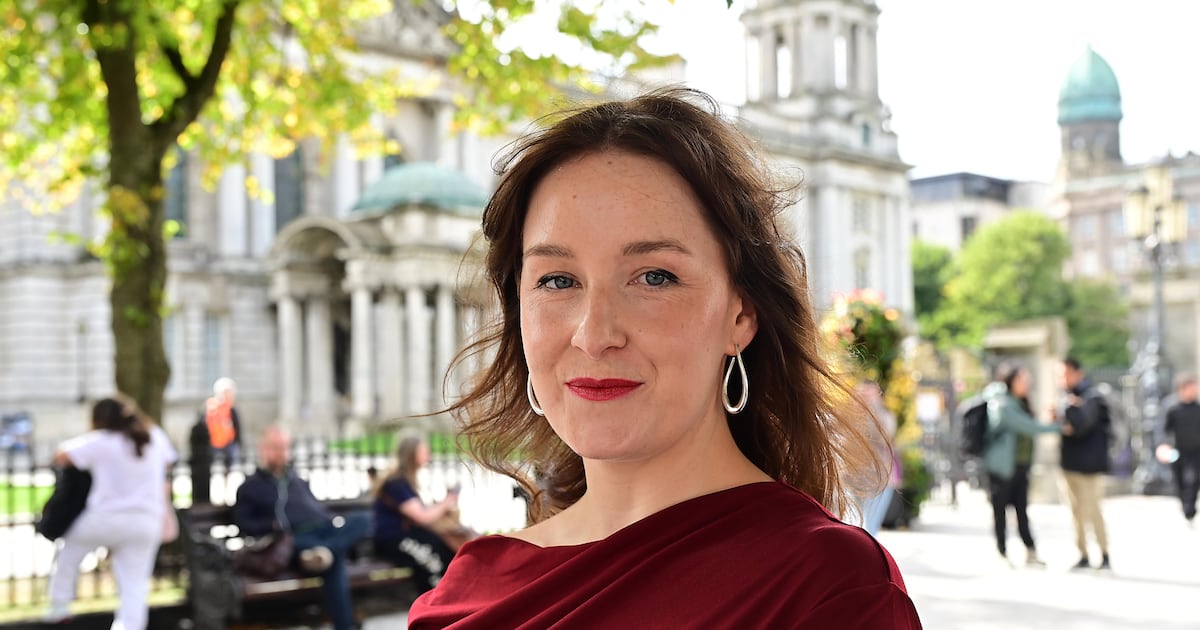
The lowest moment of Siobhán Fenton’s time with Sinn Féin came right at the end. In the run-up to the 2024 general election she discovered – from a report in The Irish Times – that she would not be one of the senior communications staff running the party’s campaign. More humiliatingly, none of her colleagues mentioned it the following day. That is, until an adviser friend pulled her aside late in the afternoon. He asked her if she was okay. When she paused, he specified the subject of his concern, saying: “I meant Mary Lou [McDonald] cutting your balls off and sending them back to the press office in the post.”Worse was to come. Realising she was now surplus to requirements, Fenton handed in her notice. After the election, she went in to clear her desk and bumped into McDonald. In their brief conversation Fenton realised that despite working together cheek by jowl for so long, the party leader was using her “outside voice”, the one she used with strangers.Ourselves Alone, published this month, is Fenton’s absorbing account of her five years working within Sinn Féin, giving a real insight into the inner workings of the most secretive of all Irish political parties. READ MOREWhat makes it all the more intriguing is that, unlike many of her new colleagues, Fenton had no republican background when she took up the role; rather than pursuit of a united Ireland, her motives for becoming involved centred on the party’s progressive agenda and the real prospect of Ireland electing its first woman taoiseach.The attraction for Sinn Féin was the recruitment of a communications professional who could help connect the party to a new constituency that was young, liberal and left leaning, and which would help elect the party to government. Unlike other parties, Sinn Féin has managed to keep its internal business hermetically sealed from the public. There has been a long-standing obsession in the media about what goes on inside Sinn Féin, and who is really pulling the levers, with a presumption that unspecified Northern figures still hold outsize sway. Fenton’s well written account of going from outsider to insider and to outsider again sheds light on what happens within the party in the South, and debunks that myth. While there is a culture of secrecy – Sinn Féin takes pride in the fact that its parliamentary party never leaks – the “secrets” essentially reveal a party as fallible and as dysfunctional as the rest. Personality wise, Fenton was not a typical spokesperson. She is low key, understated and quietly spoken. We meet in the busy cafe of the Linen Hall Library in central Belfast. She apologises for her voice being hoarse from a round of interviews and it’s sometimes hard to fully hear her above the hum of voices and crockery clatter.Siobhán Fenton in the Linen Hall Library: 'It did feel like there was such a huge groundswell of support for Sinn Féin with the possibility that Mary Lou could become the first woman taoiseach. Photograph: Arthur Allison/Pacemaker Nor is she typical, given her political background. Born in 1992, her family, who settled on the shores of Lough Neagh, was a moderate nationalist one. Fenton did an English degree at Oxford University and a master’s in journalism, and has a postgrad degree in gender studies from Cambridge. By 2019 she was building a reputation as a specialist on Brexit and post-conflict Northern Ireland.She was energised by the Repeal referendum in 2018, and the possibilities of Sinn Féin building on the 2020 general election. “It did feel like there was such a huge groundswell of support for Sinn Féin with the possibility that Mary Lou could become the first woman taoiseach.”Against that, she refers to her “antipathy” towards aspects of Sinn Féin’s past and its role in the Troubles. It was a hard decision for her to make and to weigh up, she says, but ultimately she took “a leap into the unknown”.“My focus was around trying to articulate the party’s policies proactively on different issues. So instead of having a kind of a press office that was reactive to what was happening day to day, we were trying to have more strategic communications in place.”[ Newton Emerson: Sinn Féin should forget its absurd timescale for a Border poll and focus on the nowOpens in new window ]And initially, it all went well. “My experience was it was a very inclusive, welcoming organisation,” she says. And were there hidden hands pulling the levers? Not at all, she says. “I would have sat in probably hundreds of meetings with the kind of senior leadership team of Mary Lou McDonald, Pearse Doherty and other senior members. In my experience, it genuinely always was Mary Lou making the decisions.”McDonald’s meticulous preparation for any public appearance involved knowing her lines and positions off by heart, Fenton says. For the first three years after 2020, the party was effectively operating in shadow government form. Spokespeople were treated as if there were ministers getting ready for Government Buildings. “I felt I was part of a project,” recalls Fenton. “We had really good policies in place. I was helping the party to articulate things to the public in a way that the public were interested in, and it was having a positive effect. Everything was going well.”Sinn Féin president Mary Lou McDonald and the party's deputy leader in the Dáil, Pearse Doherty. Photograph: Conor Ó Mearáin/Collins Fenton threw her heart into the party, putting in Stakhanovite shifts and being ultra-conscientious on every imaginable detail to avoid missteps. She spent hours poring over videos of McDonald’s Dáil speeches to capture her speech patterns and phraseology. “I was trying to be constantly very mindful of any misstep. But then, as obviously the book shows, there were so many other bigger missteps that I was completely blindsided by.”What were those big missteps? From polling and focus groups, the party assumed that core working-class supporters would accept its more progressive politics, and that new middle-class followers would accept more “social” policies on housing. But as Fenton’s clear-headed analysis shows, party representatives failed to appreciate the gap between what people said to them, and how they actually acted when the issue was proximate to them. Over a relatively short period in late 2023 what seemed unstoppable momentum began to fizzle out. Some mistakes were of the party’s own making. The first big reverse was around the Dublin riots in November 2023 when McDonald said she had no confidence in the then Garda commissioner and minister for justice, and maintained that stance despite blowback.Then, in a Christmas interview with Pat Leahy for The Irish Times, McDonald stated that she wanted house prices in Dublin to come down to €300,000.“I never heard a figure attached to the policy until she said it. I remember Pat very calmly repeating back the figure a few times,” she says. McDonald stuck with the figure. If that were the price, it would mean a substantial drop in value for many homeowners in Dublin, with some households experiencing negative equity. It went down like a lead balloon and the story dominated the news cycle over Christmas. For Fenton it was a turning point. The book recounts her self-inquisition afterwards on whether or not she could have intervened to mitigate the damage. (In truth, she could not have.) “It was just an absolute clanger of a mistake to let a politician say that and not then immediately realise the severity of it.” Sinn Féin started slipping in the polls. The referendum on care and family was a humbling experience for the party, with many activists refusing to campaign for a Yes vote. A disconnect had grown between its policies and the views of its working-class supporters on immigration. Fenton recalls being hit by coins thrown by anti-immigrant activists while canvassing for the 2024 local elections. After a terrible outing for Sinn Féin in those elections, an urgent review was called. The party announced new policies on Ipas centres, began to focus more on its own core and communities. A new communications head was appointed. [ Is Sinn Féin really any closer to achieving its goals than it was half a decade ago?Opens in new window ]“I think at that point I was very aware I’d been brought into the party to do a very specific role, and that role didn’t seem to be needed any more in terms of trying to pursue that element of the mainstream media or preparing for government. “There was a sense of too much focus on the party strategy at the expense of engaging with the grassroots around bread-and-butter issues.”When she left she took a two-month break before returning to journalism. She knew that after being associated with a political party, it would not be feasible to step into a staff job. Nonetheless she has been busy as a writer and commentator and is seen as a journalist with a deep understanding of Sinn Féin. “I have a particular perspective, hopefully, that can add to the understanding of political strategy and political communications.She approached publishers last summer with the idea for the book and wrote it in an intensive spell between September and January. Now that she is out of Sinn Féin, what is her view of the party? Has it kicked on or regressed? She caveats heavily, pointing out how quickly circumstances can change.“For Sinn Féin, it’s so much harder to maintain momentum as each year passes and the party still doesn’t manage to get into government. Many of the same figures have been in the same positions for a very long time, whereas at the same time other political parties have undergone considerable change,” she says, pointing out that Micheál Martin is an exception to that. She mentions “drift”, never a happy word in the lexicon of politics. Such a contrast to the buoyancy surrounding the Sinn Féin of only five years ago. Ourselves Alone by Siobhán Fenton is published by Sandycove
‘It was an absolute clanger’: Ex-Sinn Féin insider on Mary Lou, missteps and loss of momentum
Full Article
Original Source
Read the full article at Irishtimes →KhanList aggregates and links to publicly available news content. We do not host full articles from third-party sources. Always verify important information with original sources.