
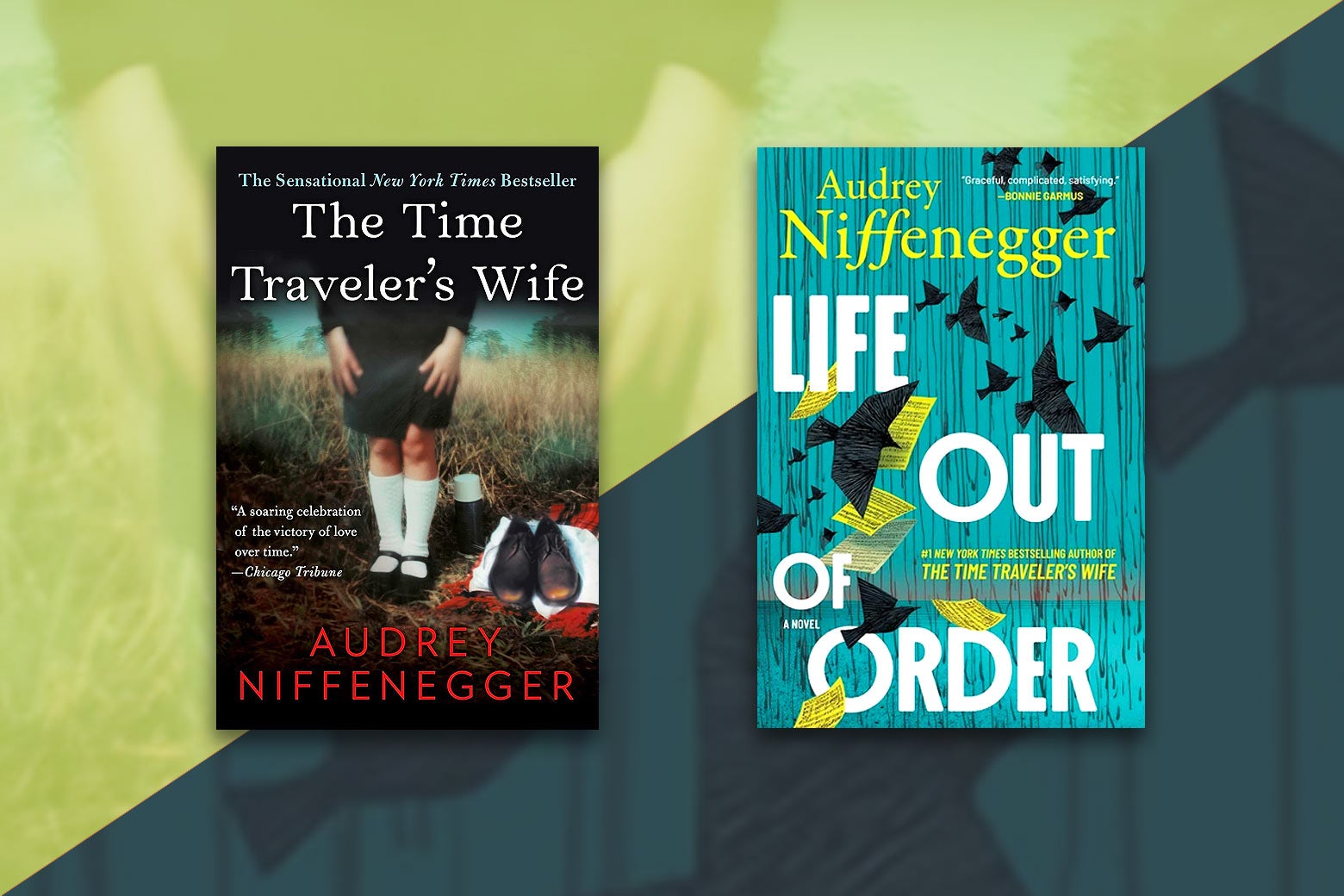
Books After 23 Years, The Time Traveler’s Wife Has a Sequel Audrey Niffenegger’s Life Out of Order is challenging in different ways. By Enter your email to receive alerts for this author. Sign in or create an account to better manage your email preferences. Unsubscribe from email alerts Are you sure you want to unsubscribe from email alerts for Rebecca Onion? Oct 08, 20262:54 PM Photo illustration by Slate. Images via HarperCollins. Sign up for the Slatest to get the most insightful analysis, criticism, and advice out there, delivered to your inbox daily. “I don’t tell that story to many people, it squicks them out,” says Clare DeTamble in Audrey Niffenegger’s new novel, Life Out of Order, after outlining the tale of romance at the heart of its predecessor, Niffenegger’s 2003 blockbuster debut The Time Traveler’s Wife. In that book—a bestseller that eventually became a modest hit of a movie and a much less successful HBO series—Henry, Clare’s future husband, first meets her when she’s 6 and he’s a full-grown man. He has a genetic variation that renders him what Niffenegger dubs “chrono-displaced”: prone to skipping uncontrollably through time, arriving inconveniently naked and barefoot, much like Arnold Schwarzenegger in the first Terminator, sans the robot’s indestructibility. Because Henry knows he will eventually meet and fall in love with Clare when they’re each at more appropriate ages, his mind brings him repeatedly back to a meadow behind her house. She learns to keep clothes there for him, and he meets her over and over again as she’s growing up. Yes, this is a little “squicky,” especially when Clare and Henry have sex when she’s in her late teens (having become close to him and accustomed to the idea that he’ll be her husband, she demands it). The story of The Time Traveler’s Wife prompts intrusive thoughts of the baby Renesmee, from the Twilight universe, squickily destined from birth to become the mate of the werewolf Jacob, who’s of a similar age to her mother. Charitably, you could posit that, in writing that first book, Niffenegger became intrigued with the challenge of developing a love story that takes place between people who encounter one another at all different ages. Would you still like your partner if you met them when you were each 10 years younger, or when one of you was five years older? Is the self stable over time? Are some loves truly predestined? It’s an interesting set of questions, but ones that may make some people bristle when they’re applied to actual human characters who have actual human sex. Niffenegger is evidently aware of this unease—probably more pervasive in today’s age-gap-obsessed era than in 2003—surrounding some aspects of her first book, and you can see it in certain moments in Life Out of Order. This hefty sequel, released 23 long years later, tells the story of Alba, Clare and Henry’s daughter who inherited the chrono-displacement gene, over more than 500 pages, with the addition of many auxiliary characters. Each chapter begins, as it did in the original, with a date and a parenthetical specifying the ages of the characters who will appear in the chapter. As in the original, the chapters are written in alternating chunks of first-person narration, with Alba and a second time traveler, Oliver, skipping around in age, while Alba’s friends and family get progressively older. This can lead to some real brain snarls when reading scenes that feel cuter than they are necessary—in one chapter, four different Albas sit in a booth in a diner, eavesdropping on Clare and Henry on a date—and there’s a lack of differentiation between the language each character uses that makes it hard to stay anchored. Slate receives a commission when you purchase items using the links on this page. Thank you for your support. The story takes place in a circle of Chicago intellectuals, artists, and musicians, and across a span of time from roughly the present day (COVID, ICE, George Floyd, and a president clearly meant to be Trump all appear) through a climate-changed, A.I.-broken near future. Niffenegger clearly wants to play with broadening the stakes of time travel, which in the first book were all about romance. Early on, there are mentions of an antifa network, which various of Alba’s friends belong to, and which always seems to be planning an action or facing down Proud Boy–type antagonists. I wondered if perhaps this would be a book about a resistance movement carried out across history, something like what happens in another time-travel story featuring a romance, a fascist threat, and climate change, 2024’s excellent The Ministry of Time, by Kaliane Bradley. But in this novel, the resistance plot drops away, with characters briefly mentioning a “civil war” that’s never described. This is one problem with a time-travel book in which the main character skips around so much in the future: As soon as you understand what’s happening in one temporal location, you’re pulled backward or forward, out of one setting and into another. It’s a scattered feeling, likely intended to echo the way chrono-displaced people would experience the world, but it worked much better in the first book, which kept to the present and the near past. Clare and Alba are wealthy, because Henry and Alba have pulled occasional “Biff got his hands on an old sports almanac” money moves, and that fact also lowers the stakes of the story. The novel is draped in a kind of upper-class liberal humanism, like an expensive jewel-toned merino shawl hung over the lectern at the front of a Unitarian church. Clare and her partner after Henry’s death, Beck, are an interracial lesbian couple. One of Alba’s early romantic partners later transitions. Clare is a visual artist. Beck is a Quaker. Alba ends up poly. Alba and Oliver are former child prodigies and spend a lot of time practicing and composing music on violin and piano, respectively. (There are a few fun scenes in which each of these kids gets a visit from a future self who proves by demonstration how well they’ll be able to play their instrument if they stick to it and keep practicing. That’s a neat trick, the parent reading this sighs.) I don’t mean this description of the novel’s milieu as critique, necessarily, though I do see one-star Goodreads reviews by Time Traveler’s Wife fans annoyed by the follow-up’s politics. I just mean to illustrate how an “In This House, We Believe” vibe suffuses the story, rendering it almost immediately dated. Here come some spoilers that will likely not reduce the bristling some readers did regarding the love affair in the first book: The way Alba ends up in a polyamorous relationship is by marrying one man, Zach, in the present day, then meeting another, Oliver, in the Yellow House, a place she’s bought for herself as a refuge while time-traveling. Here is where Niffenegger proves herself to have the courage of her convictions, returning again to the sometimes uncomfortable themes she explored in the first book. Alba lies to Zach about this relationship, even after she marries Oliver. (Yes, she two-times these men. Literally.) And then, in the back quarter of the novel, in one encounter at the Yellow House, 25-year-old Alba sleeps with 17-year-old Oliver. The next time they see one another, he’s 17 again, but she’s 74. And they have sex again. Like father, like daughter. This scene is challenging, but what’s more challenging is the way this love triangle springs up at the place in the story where I thought I was going to hear more about the civil war. “Alba is way more fascinating than I am,” Clare says to Beck, but Alba’s sudden fairly serious betrayal of Zach seems to come out of the wild blue yonder. “Fucking time travelers,” mutters Celia, a minor character in this story whose occasional animosity toward Alba comes as a breath of fresh air in a world where everyone else seems to bend around her. “Y’all are manipulative bitches.” People who loved The Time Traveler’s Wife loved it for Henry and Clare. What happens when the woman at the middle of the love story is kind of a jerk? The novel tries for two audiences—readers of contemporary women’s novels, and of science fiction. It may end up landing with neither. Books Slate Book Review
It Was a Controversial Bestseller, a Miniseries, and a Hit Movie. Now, After 23 Years, It Finally Has a Sequel.
Full Article
Original Source
Read the full article at Slate →KhanList aggregates and links to publicly available news content. We do not host full articles from third-party sources. Always verify important information with original sources.