
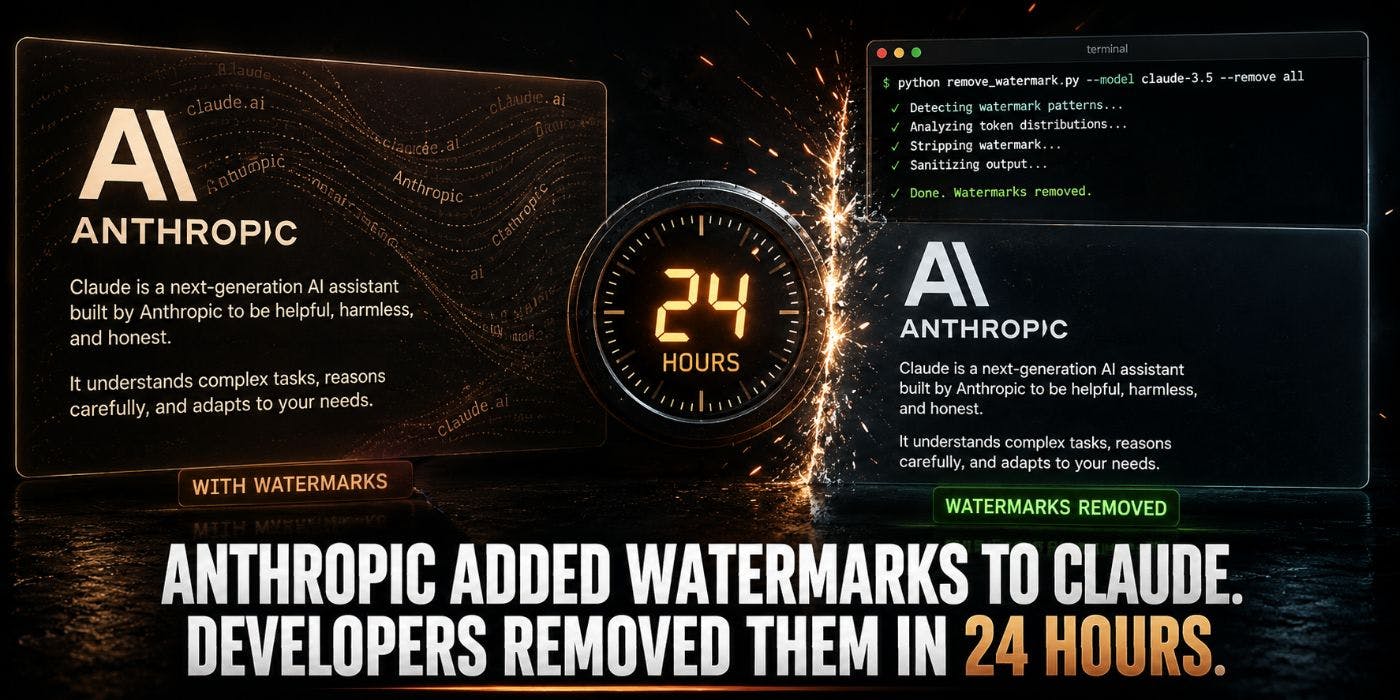
On August 11, 2026, Anthropic announced that all new Claude models now embed invisible watermarks directly into every word they generate, worldwide, forever, following you when you copy and paste. By the same evening, a developer named Guillaume Meyer had published an open-source tool to remove them. It hit 4,500 GitHub stars in 48 hours. This is everything you need to know, what the watermarks actually are, how they technically work, what the remover actually does, and what this arms race tells us about the future of AI transparency. What Just Happened The 48-Hour Timeline August 11, 2026, morning: Anthropic quietly updates a support page. All Claude models released on or after August 2, 2026 now embed invisible watermarks into every piece of text they generate. The watermark travels with the text when you copy and paste it. It may survive some editing. It applies everywhere, Claude.ai, Claude API, Claude Code, Claude Cowork, AWS Bedrock, Google Cloud, Microsoft Foundry. Worldwide. No opt-out. August 11, 2026, 16:32 UTC: Guillaume Meyer creates a new GitHub repository: watermarks-remover. Description: "Strip multi-vendor AI provenance marks: Unicode text hygiene, statistical rewrite hooks, and C2PA/metadata from PNG/JPEG/SVG/PDF/DOCX/HTML/MD." August 11, 2026, evening: Meyer tweets: "watermarks-remover now supports watermarks from OpenAI and Gemini in addition to Claude." August 13, 2026: The repository has 4,500 GitHub stars. Multiple copycat tools appear, claude-watermark-cleaner, remove-ai-watermarks, noai-watermark. Paid services like StealthGPT add "Claude watermark bypass" to their feature lists. Websites spring up overnight: claudewatermark.rip, gptcleanup.com, claudewatermarkremover.app. The internet, being the internet, has spoken. But Wait What Actually Are These Watermarks? Before we get to the arms race, you need to understand what Anthropic actually built. Because most of the coverage, and most of the Twitter discourse, got this wrong. There are two completely different things being called "watermarks" here, and they work completely differently: Layer 1: The Metadata Watermark (Easy to Remove) When Claude generates a file, an image (PNG, JPEG), an SVG, a PDF, a Word document, Anthropic attaches C2PA provenance metadata to it. C2PA stands for Coalition for Content Provenance and Authenticity. It is an open industry standard that embeds a digitally signed certificate into a file saying "this file was created by Claude on this date." Think of it like a digital certificate of origin. It lives in the file's metadata, not in the visible content. This is the easy layer. Metadata can be stripped with standard tools. When you export a JPEG without metadata, the C2PA data disappears. This is what the watermarks-remover tool primarily does and can actually verify it is doing. # What the watermarks-remover actually does to files: # Strips EXIF, XMP, C2PA, IPTC metadata from the file container # Does NOT touch the pixel data # Verifiable — you can check before and after python watermarks_remover.py --input claude_generated.png --output clean.png # Removes: C2PA manifest, XMP provenance, IPTC fields # Result: Clean PNG with identical pixels, no metadata This works. The tool has verified this works. Removing file metadata is a solved problem, photographers have been doing it with exiftool for twenty years. Layer 2: The Statistical Text Watermark (The Hard One) This is the interesting layer. The one nobody fully understands yet, including the developers of the remover tool. When Claude generates text, any text, anywhere, it invisibly biases its word choices according to a secret pattern. The model does not randomly select from equally probable words. It subtly favours certain words over others based on a hidden signal, in a pattern that can be detected statistically if you know what to look for. This is called a sampling watermark or statistical watermark. It is not a hidden character inserted into the text. It is not metadata. It is woven into the words themselves. Here is the key insight that makes this harder than it sounds: The signal is not in any single word. It is distributed across the entire text. It is the cumulative pattern of thousands of tiny word choice biases. Remove or change any individual word and the signal barely moves. To meaningfully weaken the signal, you have to rewrite enough of the text to disrupt the statistical pattern across the whole document. And here is the catch: if you rewrite enough of the text to disrupt the statistical watermark, you have substantially changed the text. The watermark and the content are not separable the way metadata is separable from a JPEG. An Anthropic engineer confirmed this on August 12: "It's not perfect, you can edit it, but it's a first step." What the Remover Actually Does And What It Can't Prove Here is what the watermark remover tool actually does at each layer, and whether it works: What It Can Do (Verified) Strip hidden Unicode characters: Some AI systems embed invisible characters, zero-width spaces, bidirectional controls, tag characters, directly in generated text. These are technically detectable and technically removable. # Layer A: Unicode hygiene — what the remover actually does well import unicodedata import re def strip_invisible_unicode(text: str) -> str: """ Remove invisible Unicode characters that could carry watermark signals. Targets: - Zero-width spaces (U+200B) - Zero-width non-joiners (U+200C) - Zero-width joiners (U+200D) - Bidirectional controls (U+200E, U+200F, U+202A-202E) - Tag characters (U+E0000-U+E007F) — used in some watermarking schemes - Variation selectors """ # Remove zero-width and invisible formatting characters invisible_pattern = re.compile( r'[\u200b-\u200f\u202a-\u202e\u2060-\u2064\ufeff' r'\u00ad\u034f\u115f\u1160\u17b4\u17b5' r'\U000e0000-\U000e007f]' ) cleaned = invisible_pattern.sub('', text) # Normalise Unicode to prevent encoding tricks cleaned = unicodedata.normalize('NFC', cleaned) return cleaned # Before: "Hello\u200b World\u200c" (with invisible characters) # After: "Hello World" (clean) This is real and this works. Some watermarking schemes do use invisible Unicode characters. Removing them is straightforward. Strip file metadata: As covered above, C2PA, XMP, and EXIF metadata in files. Fully removable. Fully verifiable. # Verify C2PA removal worked python -c " from watermarks_remover import check_c2pa result = check_c2pa('output.png') print('C2PA present:', result.has_c2pa) # Output: C2PA present: False " What It Claims But Cannot Prove (The Honest Gap) Statistical watermark removal via rewriting: This is where the tool is honest in a way most of the coverage missed. # Layer B: Statistical watermark disruption — BEST EFFORT # The tool's own documentation says this clearly def rewrite_to_disrupt_watermark(text: str, backend: str = "openai") -> str: """ Attempt to disrupt statistical watermarks by heavy rewriting. HOW IT WORKS: - Sends the text to a DIFFERENT AI model (not Claude) - Asks that model to rephrase while preserving meaning - The rephrased text has different token choice statistics - This DILUTES the Claude watermark signal WHAT IT CANNOT GUARANTEE: - Anthropic has NOT released a public detector - No tool can test against the actual detection system - "Best effort" means statistically likely to help, not certain to defeat - Heavy rewriting may change tone, voice, and precision IMPORTANT: Do NOT rewrite Claude text WITH Claude (you will just re-stamp a new Claude watermark) """ # Use a non-Claude backend to avoid re-stamping prompt = f"""Rephrase this text completely. Use different words, sentence structures, and vocabulary throughout. Preserve the exact meaning and facts. The goal is linguistic diversity — every sentence should sound different: {text}""" # Call non-Claude backend response = call_llm(prompt, model="gpt-5.5-turbo") # Not Claude return response The tool's own README says it clearly: "Until vendors ship public detectors and keys, no tool can honestly certify 'this fails the official check.'" Anthropic has not released a public detector. There is no way to test whether any specific piece of rewritten text would pass or fail Anthropic's actual watermark detection. Every tool claiming to "remove the Claude watermark" from text is making a best-effort claim, not a verified one. The Three Groups of People in This Debate And Who Is Actually Right Reading the GitHub issues and Twitter threads, three distinct groups have emerged with three completely different takes on what this means. Group 1: The Privacy Advocates Their argument: This is surveillance. I pay for Claude. The content I generate is mine. Anthropic has no right to embed a persistent tracking signal in my writing. What if I am a journalist protecting a source? A whistleblower? A lawyer? A patient writing medical notes? The watermark follows every piece of text I ever generate, forever. What they are right about: The watermark does follow everything. You cannot opt out. It applies worldwide, not just in Europe where the regulation requires it. There are legitimate contexts where people reasonably do not want their AI use to be persistently trackable. What they are missing: The watermark only signals that Claude processed the text. Anthropic says explicitly it does not prove Claude authored it, a human could have edited extensively or used Claude to check grammar, and the text would still carry the mark. The detector does not exist publicly yet. The signal is weaker than they fear. Group 2: The Anti-Cheat Advocates Their argument: Finally. Students submitting AI-generated essays as their own work, journalists publishing AI-generated articles without disclosure, job applicants submitting AI-written cover letters- all of this has a technical countermeasure now. Transparency is good. The EU is right to require this. What they are right about: The misinformation and academic integrity cases are real problems. Some technical signal for AI content origin has genuine social value. Google has been watermarking AI images since 2023 with reasonable success. What they are missing: The watermark can be defeated. A committed bad actor who knows about the watermark and uses the rewriter tool will produce text that is harder to detect. The people who most need to be caught are now the most motivated to use the remover. Security through obscurity fails when the obscurity evaporates on day one. Group 3: The Technically Honest Crowd Their argument: Everyone needs to calm down. The metadata removal works but that was always trivially defeatable. The statistical watermark removal is unverifiable because there is no public detector. The tool cannot prove it works against Claude's actual detection system. The internet is celebrating a victory over a lock that nobody has tested against the actual key. What they are right about: Almost everything. This is the honest read of the technical situation. How Text Watermarking Actually Works For those who want to understand the actual computer science: Large language models generate text token by token. At each step, the model produces a probability distribution over its vocabulary; maybe "the" has 35% probability, "a" has 20%, "this" has 15%, and so on. Without watermarking, the model samples from this distribution normally. With statistical watermarking (the approach Claude appears to use, based on Anthropic's description), the model splits its vocabulary into two groups, a "green list" and a "red list", using a secret key. At each generation step, the model slightly boosts the probability of "green" tokens without meaningfully affecting the quality or meaning of the output. Over a long piece of text, statistically more "green" tokens appear than would in non-watermarked text. A detector with the secret key can check: is the ratio of green to red tokens significantly higher than chance? If yes, the text was likely generated with this model. The detection is statistical, not cryptographic. You cannot prove any individual sentence is watermarked. You can show, with high confidence over enough text, that the pattern is present. This is why the remover's rewriting approach makes theoretical sense: if you rephrase enough of the text using a different model, the "green token" distribution gets disrupted, and the statistical signal weakens. But here is the critical limitation: you need enough text for the statistics to work in both directions, detection and removal. Short texts are harder to detect reliably. Short rewrites may not sufficiently disrupt the signal. The mathematics of this are well understood in the research literature. The practical question, how much rewriting is enough?, depends entirely on Anthropic's specific implementation, which is not public. The Broader Arms Race This Represents What happened in 48 hours this week is not surprising to anyone who has watched technology history. It is a pattern as old as DRM. DVD copy protection: broken within months of launch. The CSS encryption algorithm, once cracked, led to the creation of DeCSS, which spread globally within days. E-book DRM: Adobe's protection was routinely defeated. Calibre, with the DeDRM plugin, has millions of users. Music DRM: Apple's FairPlay was defeated, eventually abandoned. The industry moved to watermarking and licensing instead. AI image watermarks: Google's SynthID for images has faced repeated research papers demonstrating weakening attacks. The pattern is always the same: a technical protection ships, the open-source community studies it, a bypass appears, the bypass spreads faster than the protection was adopted. What is different this time: The regulation requires the protection regardless. Under the EU AI Act, Anthropic must embed watermarks or face fines up to €15 million or 3% of global revenue. The legal requirement does not disappear because the technical protection is imperfect. Anthropic will keep improving the watermark whether or not the bypass tools work. The protection is at the model level, not the application level. Every Claude model ships with watermarking. There is no patch to install, no server to update, no API endpoint to bypass. The protection is baked in. That makes it architecturally harder to eliminate. The detector does not exist publicly yet. Anthropic has said it is coming. When it ships, the actual effectiveness of the bypass tools will become measurable for the first time. The current state- tools claiming to remove something that cannot be verified as removed- will not last. What This Means for You If You Use Claude for Personal Work Nothing changes in the short term. You cannot see the watermark. Your text reads identically. The detector does not exist publicly yet so nobody can check your content right now. Be aware that once the detector ships, any text generated by Claude models after August 2, 2026 may be identifiable as Claude-processed. If this matters for your use case, you should know about it. If You Use Claude for Professional Work Understand what the watermark does and does not mean. It signals Claude processed the text. It does not prove Claude wrote it. If you used Claude to check grammar, expand notes you wrote, or help structure an argument, and you edited substantially, the text carries a mark but was genuinely your work. The professional risk is not "will this text be detected as AI-generated" in a meaningful accuracy sense. The risk is "will a detector flag this text and create an awkward conversation" even when the work was substantially yours. If You Build Products on Claude Your outputs now carry watermarks. Your users' content now carries watermarks. You should understand this and decide whether it affects your product's value proposition or your users' privacy expectations. You cannot opt out at the API level. Anthropic applies the watermark at the model level before the text ever reaches you. If You Are Building AI Detection Systems The landscape just got more complex. Claude watermarks give you a new signal to check. But watermark stripping tools are already circulating. A clean watermark check tells you something. A failed watermark check tells you less than it used to. The Question Worth Actually Asking The 48-hour watermark-to-removal timeline generated a lot of "developers are savages" energy on social media. That framing misses the more interesting question. The question is not "can the watermark be removed?" It obviously can, at least partially. Every technical protection can be partially defeated. The question is "what is the watermark actually for?" Anthropic's answer, based on their announcement, is honest about the scope: the watermark is a signal, not a proof. It indicates Claude processed content. It travels with that content so researchers, platforms, and regulators can understand the AI content landscape statistically. It is not designed to be a perfect anti-fraud system. It is designed to be a transparency layer that, across billions of pieces of content, gives meaningful signal about how AI-generated content flows through the internet, even if no individual piece is definitively attributable. That goal is not defeated by the watermark-remover tool. If 95% of Claude-generated content carries the watermark and 5% is stripped by people who specifically sought out a bypass tool, the population-level transparency signal remains meaningful. The people stripping watermarks are telling you something about their intentions in the act of doing so. And the developers who built the removal tool in 24 hours are doing something that developers have always done: pushing back on what they see as surveillance infrastructure, building in public, moving faster than any corporate or regulatory body can respond. Whether that is heroic or reckless depends entirely on what you think AI transparency is actually for. Both sides of this debate are going to keep making their case. The arms race is not over. It just started. References [1] Anthropic. How Claude’s Text Watermark Works. August 14, 2026. https://www.anthropic.com/news/claude-text-watermark [2] Gizmodo. Anthropic's Claude Will Start Adding Invisible Watermarks to AI-Generated Text. August 12, 2026. https://gizmodo.com/anthropics-claude-will-start-adding-invisible-watermarks-to-ai-generated-text-2000797759 [3] TechCrunch. Anthropic says it will watermark text generated by its AI models. August 11, 2026. https://techcrunch.com/2026/08/11/anthropic-says-it-will-watermark-text-generated-by-its-ai-models/ [4] BleepingComputer. AI watermark removers flood the web. Almost none can prove they work. August 14, 2026. https://www.bleepingcomputer.com/news/security/ai-watermark-removers-flood-the-web-almost-none-can-prove-they-work/ [5] Implicator.ai. GitHub Tool Targets Claude Watermarks Without a Public Detector. August 13, 2026. https://www.implicator.ai/github-tool-targets-claude-watermarks/ [6] ExplainX.ai. Claude Invisible Watermarks — What They Detect (And Miss). August 12, 2026. https://explainx.ai/blog/anthropic-claude-invisible-watermarks-c2pa-august-2026 [7] GitHub. guillaumemeyer/watermarks-remover. https://github.com/guillaumemeyer/watermarks-remover
It Took Developers 24 Hours to Build Around Claude's Invisible Watermark
Full Article
Original Source
Read the full article at Hackernoon →KhanList aggregates and links to publicly available news content. We do not host full articles from third-party sources. Always verify important information with original sources.