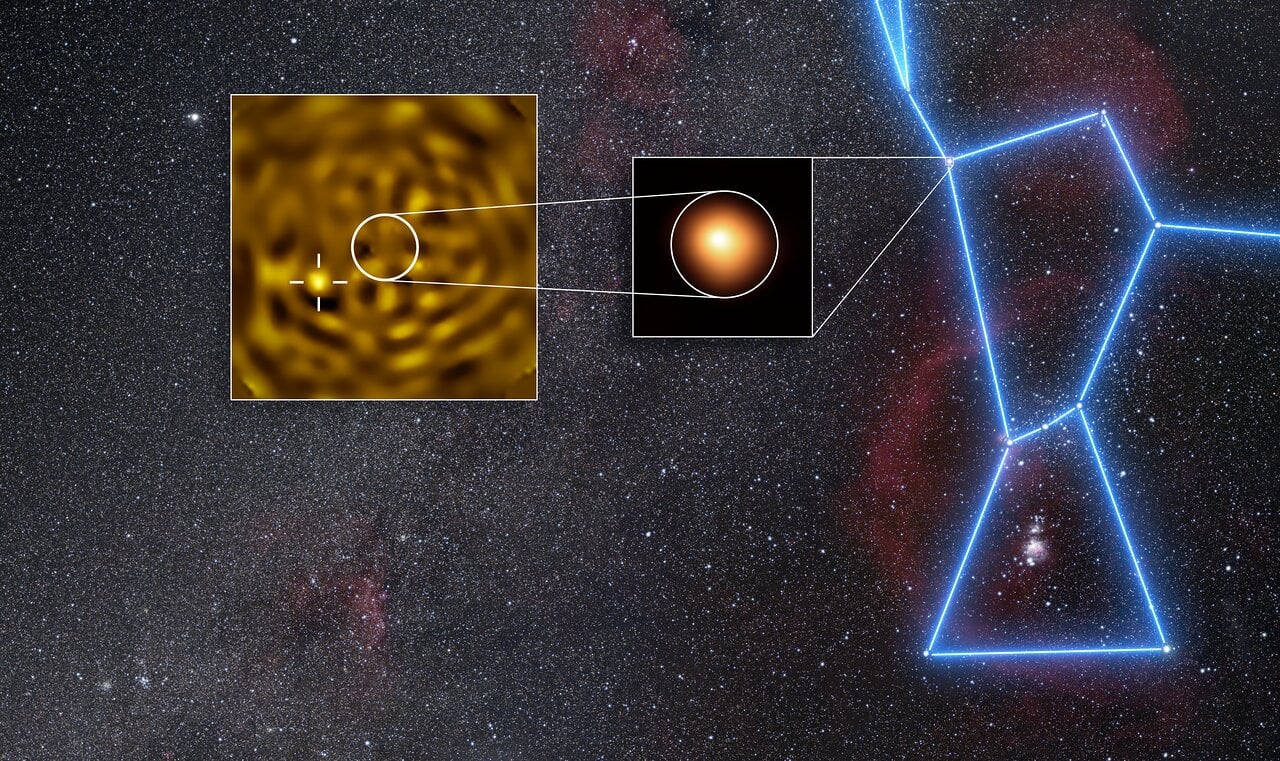
Most of us are familiar with Betelgeuse (also known as alpha Orionis), the bright shoulder star in the constellation Orion. It's a red supergiant star that lies somewhere between 400 and 550 light-years away from us and is quite bright. Betelgeuse contains about 14 times the mass of the Sun and is a fairly young star compared to ours. It appears to be no more than 10 million years old, which means that it evolved rapidly from a protostar to the red giant we see today. That lifecycle means Betelgeuse will explode as a supernova sometime in the relatively near future — say within the next 100,000 years. For all these reasons (and more), astronomers are quite interested in this star and have observed it for decades using multiwavelength detectors from Earth and space. The star's brightness and pulsations make it difficult to determine its exact diameter over time. The fact that Betelgeuse is so bright hides any possible companion(s) that it could outshine, but astronomers have suspected for years that the brightness (and variations) hid a secret companion. Other telescopes and techniques have found hints of it, but until recently, there's been little positive proof that such a star was actually there. This image is a color composite made from exposures from the Digitized Sky Survey 2 (DSS2). The field of view is approximately 2.0 x 1.5 degrees. Courtesy ESO/Digitized Sky Survey 2. Acknowledgment: Davide De Martin. Now, for the first time, astronomers using the Very Large Telescope in Chile have announced the clearest image of what looks to be that companion star from images and data taken in 2024. It's called Betelgeuse B, with the nickname of Siwarha, and it appears to be about 2 or 3 times the mass of the Sun, according to astronomer Miguel Montargès, who led the observation team. “This is the conclusion of a century-long quest," Montargès said. Honestly, I thought we did not have the sensitivity to detect Betelgeuse B as it was predicted. Because it is more massive than predicted, we see it!” Originally thought to be about as massive as the Sun, the new observations reveal that Betelgeuse B has around two to three times the mass of the Sun. “The fact that we can still discover a nearby companion, more massive and brighter than the Sun, around such a well-studied star is remarkable,” says Montargès. “These are among the best moments in science: seeing something new, unexpected.” This image, taken with ESO’s Very Large Telescope (VLT), shows the clearest image ever of what likely is Betelgeuse B (nicknamed Siwarha), a star orbiting Betelgeuse. The image was taken with the SPHERE instrument in December 2024, when the companion was predicted to be furthest apart from Betelgeuse as seen from Earth. The circle indicates the size of Betelgeuse, which has been removed. The bright source to the left, marked with a crosshair, is consistent with being Betelgeuse B. Credit: ESO/M. Montargès et al. The Search for Betelgeuse's Companion Astronomers have long suspected Betelgeuse had a companion, and found tantalizing evidence of it. But it's always been tough to spot, due to Betelgeuse's brightness and its variations in luminosity. Betelgeuse itself appears to be embedded in a lopsided envelope of material that it has ejected as it aged. That's pretty normal as a supergiant like this evolves. It happens because the star has moved into a period in its evolution where it has stopped hydrogen fusion in its core. That change has led to mass-loss ejections of material now seen around the star. An infrared view of Betelgeuse taken using the VISIR camera on the Very Large Telescope in Chile. It shows the extent of material being thrown off into space as Betelgeuse ages. This mass loss is a critical part of its stellar evolution. The small red circle in the middle has a diameter about four and a half times that of the Earth’s orbit and represents the location of Betelgeuse’s visible surface. The black disc corresponds to a very bright part of the image that was masked to allow the fainter nebula to be seen. Courtesy ESO/P. Kervella Betelgeuse is a pulsating variable, which causes its brightness to vary over time as its size and temperature change. In 2019, observers began noticing that Betelgeuse was going through an unexpected dimming phase. Hubble Space Telescope images and data showed evidence of dense material moving through Betelgeuse's atmosphere before being ejected to space. Observers concluded that as the hot material cooled, it formed a dust cloud that temporarily blocked light from the star. Astronomers also suggested that starspots might be dimming the star. Such variations in brightness very likely made it more difficult to find the companion star. More recent Hubble observations of Betelgeuse seemed to find strong evidence of a trail of dense gas swirling through the star's atmosphere. The trail is caused by Betelgeuse B/Siwarha as it orbits around a common center of gravity with Betelgeuse itself. Betelgeuse B was directly imaged despite Betelgeuse's brightness when astronomers used the SPHERE instrument on ESO’s VLT. The team used extreme adaptive optics and then performed image processing on the data. While there's definitely a companion there, astronomers have not yet determined if it's gravitationally bound. Betelgeuse B appears to be a 2.6 to 3.1 solar-mass B-type young main-sequence star. Watching the Betelgeuse System VLT was the first telescope to directly image the star, but other telescopes have tried to see the companion, too, including the Gemini North Telescope in Hawai'i. According to study co-author Anthony Boccaletti, more observations will help solidify the find. “It is remarkable to see how SPHERE and advanced post-processing techniques, originally developed to find exoplanets, also excel at detecting a companion around a massive, evolved star like Betelgeuse," said Boccaletti. “To be certain that the companion is really there, we still need to observe it in one year on the other side of the star, but there is very little space left for doubt,” adds Montargès. Betelgeuse's recent dimming episode raised a lot of questions about its lifetime. Astronomers speculated that the star might be on the precipice of a supernova explosion. The discovery of the dust clouds mitigated some of that speculation, and it appears that the star won't be blasting itself to pieces any time soon. The presence of the companion has prompted astronomers to investigate how it might affect Betelgeuse's anticipated supernova explosion. “The question is truly open whether this companion is going to have an impact on the evolution of the red supergiant,” said Montargès. If Betelgeuse's evolution goes as expected, sometime in the next 100,000 years, it will go through a catastrophic mass-loss phase and what's left will collapse down onto the core of the star. That will compress the core into a remnant — possibly a neutron star or even a black hole. The light from the explosion will brighten our night skies for several months before dimming down. The companion could be completely destroyed by the explosion, or perhaps a remnant of it, too, will survive. For now, however, astronomers will continue to observe Betelgeuse and its companion to finally verify Siwarha's existence, characteristics, and effects on its larger companion as Betelgeuse slowly moves through old age. For More Information Astronomers Find Strongest Evidence Yet that Betelgeuse Has a Companion VLT/SPHERE Images of the Candidate Companion of Betelgeuse NASA Hubble Helps Detect ‘Wake’ of Betelgeuse’s Elusive Companion Star What is Betelgeuse? Inside the Strange, Volatile Star
It Took a Century, but Astronomers Imaged Betelgeuse's Companion
Full Article
Original Source
Read the full article at Universetoday →KhanList aggregates and links to publicly available news content. We do not host full articles from third-party sources. Always verify important information with original sources.