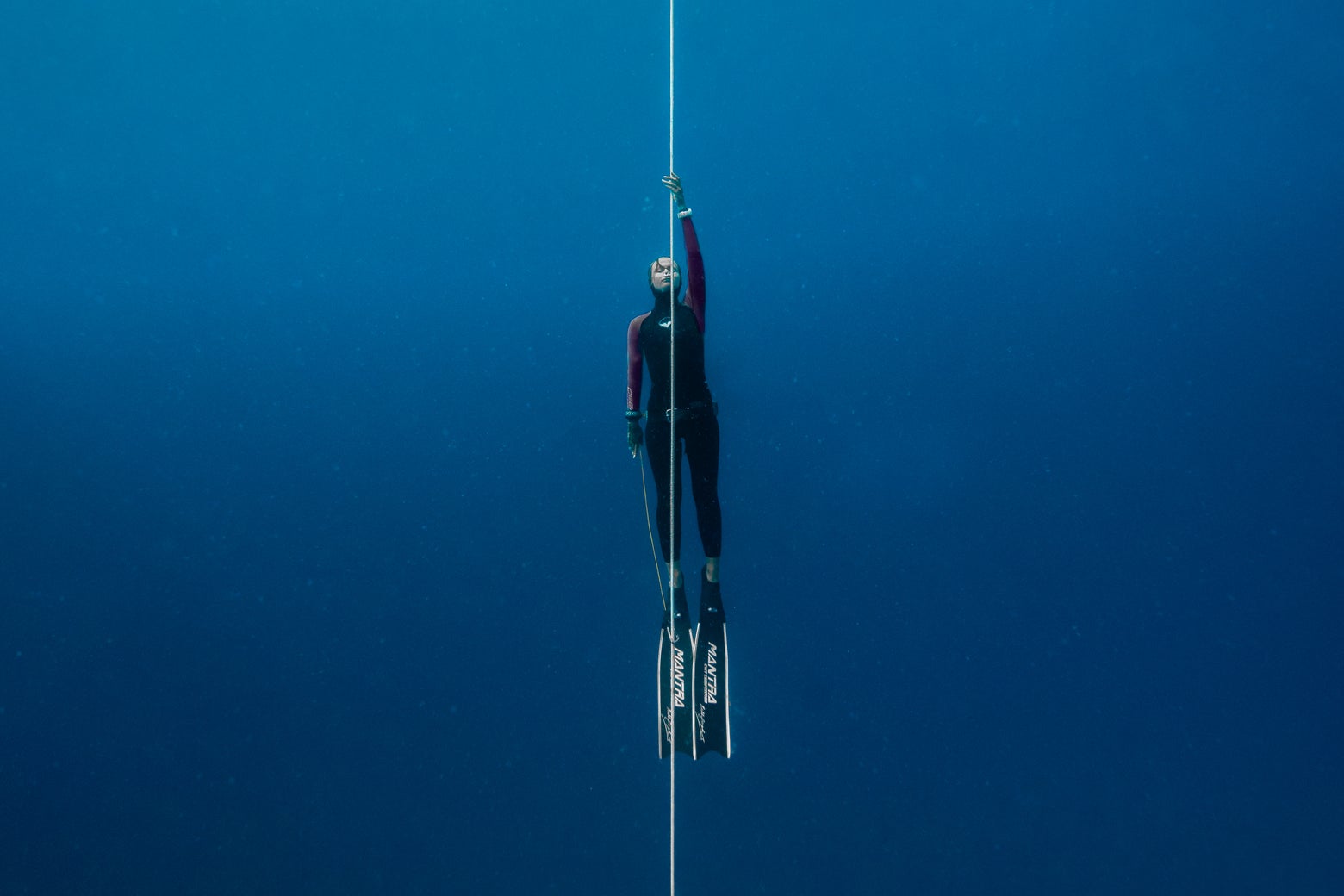
Life Three … Two … One … After a few days of training, I learned how to hold my breath for longer than I ever thought possible. The doors it opened changed my life. DAHAB, Egypt—I’m floating on the water’s surface, gentle waves lapping at my wetsuit. Thoughts enter and then leave my head rhythmically as I focus on slowing my mind, my heart rate, and my nerves. Around me are the sandy ridges of Egypt’s Red Sea coastline. “Two minutes!” my buddy booms, starting a countdown on a dive watch as I prepare for my solo descent. I am about to dive underwater while holding my breath, in what some consider the “extreme” sport of freediving. I’m not wearing a mask or an oxygen tank. My tools are my lungs and my mind. I grew up far away from the sea, and for many, many years, remained on dry land. But then, in my mid-20s, I was roped into a three-day crash course in freediving by my water-loving partner, a filmmaker who sold me on it with spectacular imagery of ethereal-looking freedivers in deep-blue seascapes. I’d never really been underwater, so I had nothing to lose and no idea of what to expect. It turns out that what is happening beneath the ocean’s surface is otherworldly. My life changed forever in that course, which requires only that participants are older than 18 and can swim 200 meters—four laps in an Olympic-sized pool—without fins. When I first held my breath for two minutes, I felt immense accomplishment and awe, as if my lungs had used their full potential for the very first time. And when I descended 12 meters into the blue on Day 3, a modest entry-level dive, I could hear whales singing in the distance. I instantly had a hunger for depth and what else I could discover. Slowly, my life started to revolve around the trips I was taking to freedive. Eventually, I took myself to the “mecca of freediving,” in Egypt, and never left. The setup for a dive is simple: An inflated buoy floats on the surface, and an adjustable rope descends into the water, anchored to a weight. Every day along the rustic coastline of Dahab, dozens of freediving buoys float in the water just off the colorful reef, where people learn, train in, and explore the spectacular turquoise waters. Here, freediving became a religious four-times-a-week morning ritual for me. We wake up just after sunrise, and it’s a short swim out from the shore before we reach depths of 40 to 50 meters. Similar to how some jog in the morning (which was also once considered somewhat unusual), these freediving sessions set me up for the day ahead: It’s not competitive training, but more about maintaining a routine. The combination of breathwork, being in the water, and being away from digital screens leaves me invigorated and with a mental clarity that I carry through the rest of the day. I’m not surprised that the sport is now growing in popularity as more people discover this. Recently, freediving has been gaining momentum, rapidly transitioning from being an astonishing test of the human body undertaken by a select few to being a visible practice open to anyone curious enough to try. In 2023, Netflix introduced viewers to the world of freediving in the Dahab-based documentary The Deepest Breath. Earlier this year, Vogue published a travel package declaring freediving the “ultimate wellness reset,” offering readers a handful of plush resorts at which they could try it out for themselves. But today, I’m trying something deeper than my usual morning dive: My goal is to make it to 70 meters, or 230 feet. If I succeed, it will be a personal best—and will take me past the point that scientists, as recently as the 1960s, believed would mean a crushed chest cavity, and certain death, for someone diving without oxygen. “Five, four, three, two, one, official top!” my buddy calls out. He’ll be serving as the safety for this dive—but I’ll be down there alone. I submerge my face into the cool blue water; my buddy releases the weight that will pull me to the abyss. What I’m about to attempt goes against every survival instinct. The Blue Hole in Dahab, Egypt, is widely considered the mecca of freediving. The 92-meter-deep sinkhole boasts calm conditions year-round, making it a perfect place for training. Tamara Davison Freediving has always sat somewhere between sport, hobby, experiment, and even means of survival. For communities like the Bajau Tribe of Southeast Asia, freediving served as a source of food and a way of life for millennia. Yet it was the 1960s that loosely marked the beginning of modern competitive freediving as we know it, with the first realizations that the practice defies our scientific assumptions about how the human body behaves underwater. Since then, freedivers have served as guinea pigs in this sport’s evolution, revealing exactly what the human body is capable of, and beyond. In 1961, Italian underwater pioneer Enzo Maiorca challenged doctors’ warnings that he would “be crushed” by pressure when attempting what was at the time a record-setting freedive of 50 meters (164 feet). Maiorca proved everyone wrong, returning to the surface unscathed, to the surprise of scientists at the time. With that, the race for records had unofficially begun. In the years that followed, scientists relied on freedivers to study the human body’s ability to withstand underwater pressure; an era when pioneers Teteke Williams, Robert Croft, and Jacques Mayol, alongside Maiorca, enjoyed a healthy rivalry while venturing deeper and deeper. First they made it 59 meters, then 60, then 62—eventually working up to the first 100-meter (328-foot) dive achieved by Mayol in 1976. The hardware for freediving is thought to be present in all humans. The physiological triggers that help us survive when we’re submerged in water are broadly known as the mammalian dive reflex, or MDR, and are also observed in marine mammals such as whales and seals. Early freediving pioneers helped scientists understand how these adaptations function in humans, explains Erika Schagatay, a professor at Mid Sweden University and heavyweight in freediving physiology research who has been studying freediving for more than 40 years. There’s bradycardia, a phenomenon in which the heart rate automatically slows to conserve oxygen underwater. There’s also blood shift, with a 1968 study referencing Mayol showing that blood moves into the chest cavity, preventing it from imploding under pressure, as early scientists once warned would happen if a diver went too deep. When MDR kicks in, blood is redirected to where it’s really needed—the brain, the heart, the lungs. “Your heart rate can drop because when you close some of the vessels, your circulatory system becomes much smaller,” Schagatay explains. “It’s like your body shrinks.” MDR feels subtle to me: The first 20, 40, 60 feet of my dive pass by in the blink of an eye. These are standard depths beginners aim for in early freediving courses like the one I took, and pretty attainable for most after a few days’ training. To counter the pressure, which compresses airspaces found in our ears, lungs, and sinuses, divers gently push air from their mouths into their ears with a simple tongue movement to equalize the pressure, while the rest of the body’s adjustments happen automatically. But things become more challenging as I near 30 meters (100 feet), sometimes considered the cutoff at which recreational diving becomes more technical. Before my lungs become too compressed, I switch to a pressure equalization method known as a “mouthfill,” where divers literally fill their mouths with air from their lungs and hold it there. This keeps the ears “open” and equalized. Then, I continue to sink to the bottom of the Blue Hole, feeling the sensations of the water getting colder as it flows against my skin. I focus on the muffled watery sounds, submitting my body into total relaxation. I’m completely alone: The surrounding pressure embraces me as the weighted rope I grip pulls me down, down, down. (I’m doing a discipline known as Variable Weight, where the weight does most of the work.) I don’t know yet what will happen at the bottom—my mind is elsewhere; nowhere. Before going underwater, freedivers need to “breathe up.” During this process we attempt to relax our bodies as much as possible, lowering the heart rate, so that the one breath we use for a dive lasts us as long as possible. Here I am doing a breathe-up—it takes several minutes. Tamara Davison It gets harder to understand what happens to the body as it moves beyond about 60 meters (200 feet), which is where instruments like underwater oximeters get trickier to use due to pressure and signal quality. (There are innovative ways to get around that, though: In one recent research project, a freediver had a blood sample drawn underwater at 80 meters that was analyzed back at the surface.) And a major open question is what actually happens to the human mind. “We don’t really know how the brain behaves under pressure and hypoxia,” says Margot Camus, the founder of the academic association Alteryss, who is currently studying human physiology in extreme environments. Hypoxia: That’s when the body’s oxygen levels drop below what’s needed to function properly. One of the challenges in understanding freediving’s effects lies in heavy reliance on experience rather than measurements. Problematically, Camus told me, “we don’t have enough old freedivers to know what the long-term effects are.” “The only instrument that can go to these limits of the world is the freediver themselves,” says Inès Leferme, a researcher in the phenomenology of depth in freediving. “So we have to use the consciousness of the freediver like an instrument, because we can’t always put instruments at that depth.” It’s these mysteries that are so compelling. As Italian freediver Tito Zappalà told me: “We know more about the moon than about freediving.” Despite challenges, research is slowly gathering pace. For example, one hypothesis Leferme is exploring is a state of “pre-consciousness.” Freedivers may enter this during dives; it’s “when you are completely in the feeling. We think that is the state most connected with the body, because what you are feeling is pure and present.” It forms part of Leferme’s broader research into phenomenology, exploring how freediving may affect the perceptions of extreme environments. Though still in an exploratory phase, Leferme combines interviews with real-time physiological data, such as heart rate and oxygen saturation. She’s trying to understand how the body and the mind relate to one another in these extreme conditions, through whatever means possible. As for the state of consciousness I’m currently feeling, it’s hard to define. Although my eyes are closed, common practice for those diving without a mask, I feel my surroundings become darker than I’m accustomed to, now almost a minute into my dive. I’m deep, relying solely on a beeping signal from my watch to sporadically signal certain depths. But down here, humans largely have to rely on the signals their own bodies are sending. “It’s not about the numbers,” you often hear freedivers say, but the current depth records are truly remarkable. Records are observed across each separate discipline, defined by how freedivers descend and ascend. For example, among a handful of recognized depth disciplines, there is Constant Weight, where you kick with a monofin (like a mermaid), or Free Immersion, where you pull the rope with your hands. Across the common competitive freediving disciplines where divers use their own energy to descend and ascend, the current maximum depth stands at 137 meters (442 feet) for men—achieved by Petar Klovar in Free Immersion—and 123 meters (400 feet) for women—held by Alessia Zecchini and Alenka Artnik in Constant Weight—equivalent to about as deep as a 40-story skyscraper is tall. My favorite discipline is Free Immersion, as I find deep satisfaction in rhythmically pulling the rope and gliding through the water. However, athletes often train in multiple disciplines throughout their careers, due to personal preference, to avoid overtraining certain muscles, and to earn more points in competitions. There are also pool records, where the challenge is swimming horizontally on a breath hold, and static breath-hold competitions, too. (It’s not that different to what kids do in a pool to see who can stay underwater the longest.) Each involve incredible records in their own right—most observing huge jumps in the past few decades as the sport takes off. In fact, German legend Heike Schwerdtner just recently broke her own world record, holding her breath for an incredible 9 minutes, 39 seconds. While pool freedivers don’t have to deal with the physiological challenges of pressure, the mental game is often much harder. You only need to lift your head from the water to end the breath hold, as opposed to at depth, where you must get to the surface. Sitting through the discomfort of the urge to breathe and going against your body’s survival instincts, then, is much more of a mental game in the pool—and it’s hugely respected in the freediving community. Then there are the legendary and controversial “No Limits” records, feats in which divers use a mechanical weighted sled to shuttle them down, then open an oxygen cylinder at the bottom, filling a bag with air that lifts them to the surface. It’s controversial because there’s a high risk of injury, and divers rely primarily on artificial machines rather than their own abilities. Austrian diver Herbert Nitsch reached 253 meters (830 feet) with this method in 2012, but suffered serious decompression sickness and several strokes shortly after. Mainstream freediving circles have shunned No Limits record attempts as being too dangerous, even “unbiological,” and to this day Nitsch’s record remains unchallenged. But divers are increasingly adding to the records in more conventional disciplines, with little sign of slowing down. Tunisian freediver Walid Boudhiaf was the first diver to reach 150 meters (492 feet) in 2021 in Variable Weight, descending on a weight and finning back up to the surface in what he described to me as “a free ride to the abyss, basically.” At those depths, the pressure is 15 times that at the surface; the ocean is dark. Boudhiaf’s lungs would have compressed to the size of a fist, and negative buoyancy pulled him to the bottom of the ocean at a pace of 1 meter per second, which feels as fast as it sounds. “I wouldn’t say it’s an adrenaline rush, but it’s very pleasant,” Boudhiaf says. “It’s hard to describe that sensation of complete peace and abandon.” Gus Kreivenas, a Lithuanian record holder and founder of Touchdown, where I trained, is one of many athletes who say freediving changed their lives. “I was unable to control my emotions,” he explains about his former life, struggling with anger and lack of direction until he came across freediving. Mental discipline, breathwork, and becoming more attuned to bodily sensations can reduce stress or anxiety out of the water, too. For me, freediving is the only outlet where I can fully still my mind and remove myself from a constantly switched-on world. Before a dive, during a breathe-up, I visualize thoughts dissolving into the water around me, leaving just an empty space behind in my head. It feels something like a mix between lying in Shavasana at the end of a yoga class and being in a sensory deprivation tank—I am existing, but not thinking. I near 180 feet on my dive. Then 190 feet. Then 200 feet. Down here, I’m suddenly overcome with bliss and awe; excitement pulses through my body. I can feel that I’m deeper than I’ve ever gone before, as the water feels cooler than usual. But there really isn’t any room for analysis at this depth. I’m just overwhelmingly present in a feeling of discovery instead, of being, becoming, of truly surrendering my mind and body. Everything is quiet. But if I had to associate the experience with a sound, it’d be a spontaneous, childlike “wheee” as I glide further and further. In Aqaba, Jordan, a decommissioned military jet, a C-130 Hercules, lies just below the surface. It was sunk here on purpose. Freedivers can visit the site in what we refer to as a “fun dive”—no competitions or records are at play here, just the opportunity to explore this underwater wonder, which also serves as an artificial reef. Tamara Davison As the sport of freediving pushes people deeper and its growing popularity brings in more and more novices, the freediving community is increasingly reckoning with the sport’s dangers. Every certified freediver is trained to rescue their buddy if something goes wrong, forming one of the very basic rules of freediving: Never dive alone. The buddy essentially breathes up and dives slightly later, meeting the diver on the ascent when they’re most at risk of blacking out, while also holding their own breath. At recreational depths, the risk of blacking out is low, and buddies typically meet a diver at one-third of the total depth (so 33 feet for a 100-foot dive). It’s the ethos of the sport that everyone has to be both a diver and a buddy: In entry-level courses, divers can only be certified after demonstrating that they can both dive and perform a rescue. For many deep dives, and certainly in competitions and record attempts, safety requirements are much more advanced. Multiple trained safety divers meet the deep-diver (while also holding their breath and freediving), and a backup system called a counter-ballast can quickly pull the rope up in emergencies, bringing the attached diver back up as well. But of course, no matter the safeguards, more depth leads to more risk. “Today, to be on the podium in competition, you have to be doing 120, 125 meters—big numbers,” Zappalà explains. Trained rescue divers are on hand to assist diving attempts, but a broader medical infrastructure of oxygen tanks, evacuation plans, and a nearby hyperbaric chamber is vital to truly ensure that divers are safe. Recent fatalities, such as the tragic loss of Russian athlete Andrey Matveenko in September following a medical emergency at the World Underwater Federation’s CMAS World Championships, have raised questions about the effectiveness of existing safety procedures. As an experienced safety diver, Zappalà has seen the dangers of freediving firsthand. On one particular occasion, he rescued a freediver who couldn’t feel half her body following a deep dive—a sign of decompression sickness caused by nitrogen bubbles forming in the body. There are usually signs that a diver requires a rescue; for example, they stop moving underwater or report strange sensations after surfacing. Once thought to be an issue only for scuba divers, such cases are increasing among freedivers as people push deeper. Zappalà luckily knows the signs and what to do: He rushed the diver to a nearby decompression chamber, a capsule more commonly used by scuba divers and in some medical situations that helps get rid of dangerous nitrogen bubbles in the body. It does so by increasing pressure, forcing the nitrogen to dissolve back into the blood (kind of like putting the cap back on a soda bottle to stop the bubbles). He completed the rescue and got her to a chamber in 12 minutes, which potentially saved her life (and, luckily, sensation in her body came back). Freedivers insist the sport is less “extreme” than it appears, as long as dives stay within planned limits and safety protocols. But things do go wrong. Blackouts occur, and pressure-related injuries like lung squeeze can take months to recover from. Diving is just different from doing anything on land. Even small problems like a cramp or a moment of panic—problems that, say, a jogger could push through—are good reasons to abort. Acting on the instinct to bail becomes ingrained when you start freediving. There are now various certifications and training programs worldwide that beginners can enroll in as they build skills and dive deeper with confidence. In addition to becoming attuned to your body’s sensations, there are several theory classes where you learn about the science behind what’s happening. They counsel that a dive should always feel easy—discomfort is a signal to put your ego (and goals) aside. Freediving is a humbling experience. The deeper you go, the more important it is to act on discomfort. And while, yes, freediving is about transcending theoretical limits safely, at the end of the day, the human body is still bound by the limits of biology, physiology, and physics. “Deep diving is not only going down,” Zappalà says. It’s also about knowing when to come back up. And back in Blue Hole, I was about to find my own limit. When freedivers line dive, as I am doing here, a weighted rope helps guide their descent and ascent. I’m clipped to it, and markings on the rope will help me keep track of precisely how deep I am. Tamara Davison My personal experiment, the goal of 70 meters, 230 feet, is almost in reach. Achieving this would be the clearest bodily signal that my month of training had paid off, and that my mental focus was exactly where it needed to be. Hours and hours of dry training, equalization practices, morning yoga, mindfulness, meditation, early bedtimes, gym sessions, and repetition have boiled down to this moment. There is also a competition coming up, and I’m thinking about making my debut as a professional athlete. But at around 60 meters (200 feet) deep, my calm mental state is suddenly pierced by a single, yet significant bodily awareness. It’s not good. The air in my mouth disappears, and with it the ability to equalize the ever-increasing pressure on my ears. If I go much further, I could burst my eardrum and potentially leave lasting damage that will totally scupper any progress and render me to dry land. But I’m not thinking about that. I’m just feeling. And at this point, there is no room for error. Instinctively, I let go of the rope, not knowing that at that point I was just a few feet shy of my target. There’s no time for disappointment. What goes down must come up—and it’s a long way back to the surface. I tug the rope. “One.” I reach up and start to pull the rope, glide, pull again. “Two.” Then another “three, four,” counting each tug on the rope to keep my mind focused on the task at hand, to keep myself from freaking out. The water begins to warm and lighten; the vibrant reef’s colors become more striking as I rise through it. My buddy, the one tasked with ensuring my safety, meets me on my ascent while also holding his breath, and together we glide to the fresh air above. I breach the surface roughly two minutes after the dive started, and instantly I’m overcome by an immense high. “I’m OK,” I tell my buddy, following the standard safety protocols that end all successful dives. Only then do I check the depth on my dive computer and realize just how close I’d come—67 meters. Just 3 meters shy of my goal. It’s still a personal best, even though I didn’t reach my target. And I feel that: The ecstatic sensations that come with breaching a new depth are immense. Fellow divers on neighboring buoys, many of whom are friends from this tight community, briefly cheer with me as I splash about on the surface with excitement. It feels great to breathe air again, but it’s not relief: It’s energy. Research Science Sports Travel Hobbies Ocean
It Seems Impossible. It Can Kill You. Come Along With Me as I Try It—Because You Should, Too.
Full Article
Original Source
Read the full article at Slate →KhanList aggregates and links to publicly available news content. We do not host full articles from third-party sources. Always verify important information with original sources.