
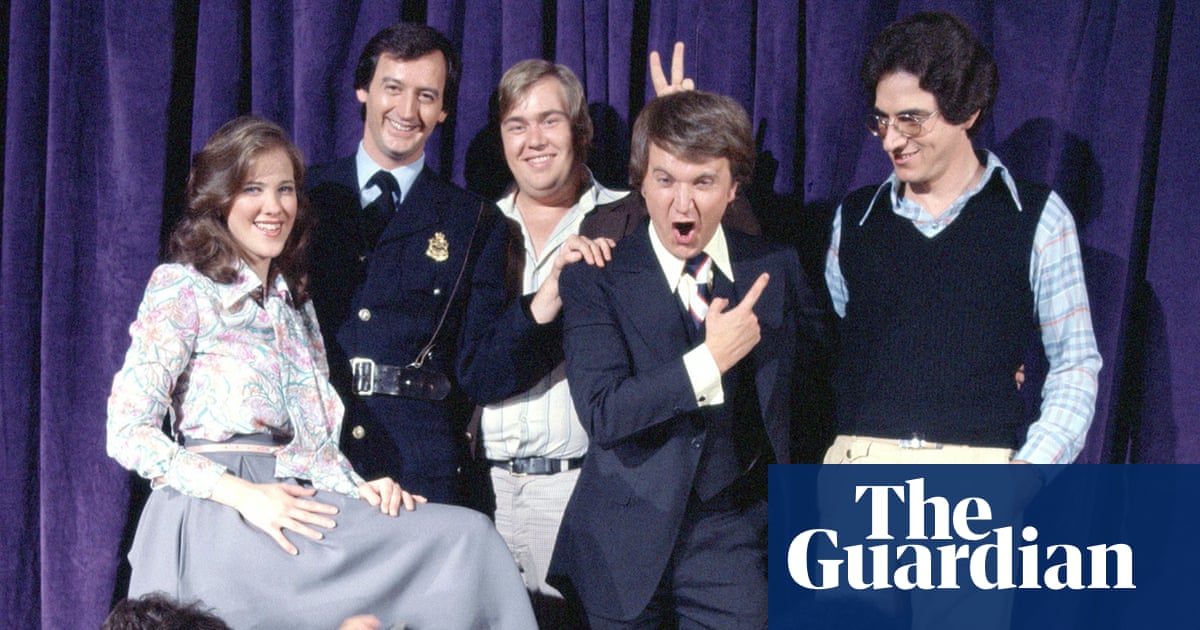
SCTV – short for Second City Television – is one of most influential comedy shows ever created. In the 1970s and 80s, while North American comedy fans worshipped at the altar of Saturday Night Live, the comedy nerds loved SCTV. The Canadian sketch show was weird. It was dark. It was multilayered and years ahead of its time.Dave Thomas, head writer and an original cast member, was there from the start. “Conan O’Brien said that he used to watch and he thought, ‘This show is being written specifically for me,’” Thomas tells me. “There were references in it that he was absolutely sure only he got. We wrote at the top of our reference level. And the idea was to see if the audience would meet us there.”Thomas was part of an astonishingly talented cast that included John Candy, Eugene Levy, Catherine O’Hara, Rick Moranis, Joe Flaherty, Martin Short, Harold Ramis and Andrea Martin. They wrote and starred in the series, which ran intermittently in Canada from 1976 to 1984. At a time when American shows dominated the airwaves, and homegrown content tended to be earnest factual programmes along the lines of Hinterland Who’s Who, Canadian audiences were delighted to see a show that reflected their culture while being – to everyone’s surprise – actually funny. It even went on to find a late-night audience in the US.Former cast members Catherine O’Hara (left) and Andrea Martin in SCTV: The Greatest Show You’ve Never Heard Of. Photograph: NetflixTo celebrate its legacy, Netflix has just added 134 episodes of SCTV to coincide with its release of a new documentary – SCTV: The Greatest Show You’ve Never Heard Of. Like many of the show’s fans, Thomas isn’t exactly enamoured with the title.“Yeah, the title is kind of insulting in a way,” he says.That’s not the only problem. While it’s a decent primer for revisiting the show, featuring new interviews with the surviving cast members, including Thomas, the documentary could have been so much more. Many things are skipped over, such as the musical acts, including bands like the Boomtown Rats and the Plasmatics, who didn’t just perform but also appeared in sketches. And while the cast took care of the writing in the show’s early days, they were later joined by talented staff. These omissions rankle with Thomas.“Tom Hanks and Bob Odenkirk doing the narrative on how it was written? I thought, what the fuck? Why don’t you ask some of the people who wrote it? We had some really good writers on that show.”SCTV’s Leave It to Beaver parodyThere is a cracking story to be told. For the uninitiated: the cast of Chicago’s legendary Second City improv theatre had already been plundered by producer Lorne Michaels to create Saturday Night Live in 1975. It seemed to make perfect sense to use Second City’s Toronto outpost to create a Canadian version of SNL. Gilda Radner and Dan Aykroyd had already been poached by Michaels, so the remaining cast members were asked to make a television sketch show without knowing the first thing about it.“For the first two seasons, SCTV was a failure,” Thomas remembers. “It was the poor brother of SNL. Our greatest weakness was that our show looked cheap as shit. So we made it about a small television station, and that’s why it looks so cheap.”Each episode of SCTV covered one broadcast day for a run-down TV station in the fictional rural Canadian town of Melonville. As well as parodying the film and TV of the time, the backstage dramas of the station also played a part.“We were learning,” Thomas tells me. “We were being paid to learn how to produce television while doing it. It really was the idiots running the asylum for the first two years. There are a lot of things we got credit for that were just horrible mistakes.”John Candy, who would later go on to star in Planes, Trains and Automobiles with Steve Martin. Photograph: NetflixThe naivety of the cast and the low budget, paradoxically, freed up the sketch-writers: without shiny sets and special effects, they focused on characters. There was the overbearing station manager Guy Caballero, the cheapskate’s cheapskate; the garrulous variety star Johnny LaRue, who was an extension of John Candy’s party-loving nature; Catherine O’Hara’s showgirl Lola Heatherton; Eugene Levy’s appalling standup, Bobby Bittman; and Harry, the Guy With a Snake on his Face. Sketches were smart, sharp and featured startlingly accurate impressions (Thomas’s Bob Hope was a standout).As time went on, the show found its feet, started gaining an audience, increased its budget and grew more sophisticated.“I was particularly proud of the evolution of the comedy,” Thomas remembers. “Like the parody of the television show Fantasy Island, which was also a parody of Casablanca, and also a parody of Road to Morocco, and also a parody of The Wizard of Oz, all weaved in and out. A lot of the Simpsons writers said that’s what they loved about SCTV, that it brought in a kind of a multilayered writing. And they said: that’s the way we write The Simpsons.”But as the money came in, the creators’ freedom dwindled. Used to having everything their own way, the cast and writers baulked when threatened with any outside interference.“I remember one of the producers that NBC had sent up was in the cafeteria one morning, crying,” recalls Thomas. “I said, ‘What’s the matter?’ He goes, ‘The goddamn cast, they shut me out. They stonewall me. I’ve got a good mind to quit.’ And I said, ‘Well, you probably should quit because you’re here in the cafeteria, crying. Is that what you had in mind when you got into showbiz?’”‘We thought, screw this press conference, let’s go to Studio 54!’ … Dave Thomas. Photograph: NetflixBeing produced in isolation gave SCTV a distinct personality and a legion of devoted fans. But the team were still very much on the outside.“We went to New York for a press conference,” Thomas says. “There were only three people there and two of them were student journalists. But we thought, well, screw this press conference, let’s go to Studio 54. We’re on television. We should be able to get in. They wouldn’t let us in.”Thomas and Rick Moranis (later to star in Ghostbusters, with Harold Ramis, and Honey, I Shrunk the Kids) were part of SCTV’s most surprising breakout success. Asked to include more specifically Canadian content in the series, they improvised two-minute pieces to camera featuring two dim-witted, beer-swilling, hockey-watching Canucks, Bob and Doug McKenzie. The characters caught on: Canadians, so used to watching American stereotypes played for laughs on TV, loved seeing two of their own get the same treatment. The documentary shows Beatles-like levels of hysteria at McKenzie brother appearances. They went on to record albums and make a film.Not everyone in the cast was delighted by all this, as Thomas admits. “There’s no question that the success of the McKenzie brothers was a divisive factor and played a role in Rick and I leaving. There were little things like that which definitely sowed some seeds of division, but we were still family.”The show shifted networks, time slots and cast members until it eventually fizzled out in 1984. But the SCTV family went on to greater heights. John Candy became a Hollywood star. Eugene Levy and Catherine O’Hara featured in many of Christopher Guest’s comedies (including Best in Show and A Mighty Wind), as well as starring in Schitt’s Creek together. Martin Short is, well, Martin Short.And Thomas has a wildly varied career: he starred in the sitcom Grace Under Fire, wrote Spies Like Us with Dan Aykroyd, started an animation company and is now developing an Amazon show with his son. But Thomas will always be fiercely proud of his SCTV achievements.“I loved that show because, I thought, nobody’s doing this. Nobody is doing a show like this. There was a network tendency to dumb everything down to the stupidest person in the room. And we didn’t do that.”
‘It really was the idiots in charge’: inside the TV sketch show that launched a generation of stars
Full Article
Original Source
Read the full article at Theguardian →KhanList aggregates and links to publicly available news content. We do not host full articles from third-party sources. Always verify important information with original sources.