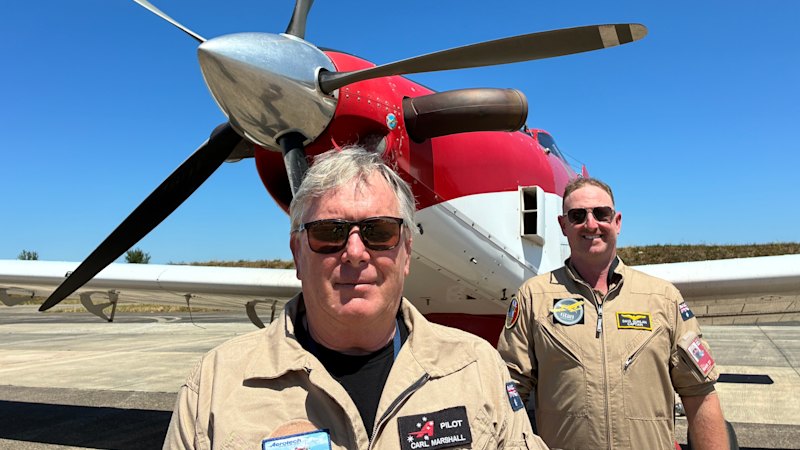
Bordeaux: Flying over the forests of south-western France last week, Carl Marshall saw a cloud in the distance that reminded him of one of the most dangerous sights for emergency crews during a raging Australian bushfire. The cloud erupted from a wildfire that was racing through pine plantations near Bordeaux, sending thick, brown smoke high into the air.“It looked like an atomic bomb,” says Marshall, 64, a pilot who has come from Adelaide to help fight the fires in this blistering European summer. As he flew his single-engine water bomber away from the firestorm, he knew he was witnessing a pyrocumulonimbus cloud (pyroCb) – an extraordinary event that creates its own weather system.The intense heat from the fire was forcing air and smoke upwards, where moisture condensed in the cooler air above. Marshall did not see lightning or rain, which are known to occur with some “pyroCb” formations.Pilots Carl Marshall (left) and Dave Quinlan (right) in front of an Air Tractor aircraft from Australian company Aerotech. They are part of a multinational group fighting fires for French authorities from a military base near Bordeaux.David Crowe“It’s like a big vacuum cleaner,” he says. “We have to remain clear of that. We have to find targets that are away from that intensity.”The wildfire is still burning near Bordeaux more than a week after it began, as French authorities deploy more than 2200 firefighters to save communities between the city and the Atlantic coast. As the nation faces its worst fire season in living memory, the government has sent military aircraft to help douse the flames. “We will win this fight,” French President Emmanuel Macron declares.But this northern summer is a horrifying awakening for Europe and the world. The sheer intensity of the fire, after a series of heatwaves, has left people stunned at the speed of the flames racing through forests and farmland in the hot and dry conditions.Temperatures in Bordeaux this summer have soared to 40 degrees Celsius or above. On Wednesday afternoon, the temperature was 39 degrees, 12 degrees above the average daily high. Many residents put on face masks as smoke spread through the city.France prepared for this season, having seen major fires just four years ago. But this fire, which began near the holiday homes of Arcachon Bay, has eclipsed the others. And it has highlighted the need for France to seek help from pilots and aircraft from other countries.The Australian pilots, having seen bushfires at home over many years, rate the Bordeaux blaze as one of the most dangerous.“I’ve never seen anything quite like this fire before,” says Dave Quinlan, 41, who is based in Darwin and is also in Bordeaux for the northern summer. “This is by far the biggest fire that I’ve been involved in. It’s a significant fire.”The two pilots are among six deployed by Adelaide company Aerotech Group to this fire season in France, flying four Air Tractor AT-802 aircraft that are each capable of carrying 3000 tonnes of water. They are joined by two engineers and a base manager, Cherie Marshall, who is also a pilot. Their nerve centre is a demountable office on the edge of a military airfield near Bordeaux.The Air Tractors from Australia share the airfield with similar aircraft from other countries working for Titan, a Spanish company that has a contract with France to prepare for each summer.The workload is intense, and the airfield is busy with larger water bombers, including modified versions of the De Havilland Canada Dash 8, commonly seen in Australia as a passenger aircraft.Marshall was raised on the South Island of New Zealand but has worked for decades in Australia, starting as a pilot on tourist flights before moving to agriculture. When not putting out fires, he flies the Air Tractors for Aerotech to drop fertiliser or pesticides on farms – the common training ground for pilots who need the skill and experience to fly at low heights over flames.Quinlan was raised in the NSW town of Armidale and worked as a builder before deciding to put some of his savings towards flight school. That took him into aerial work in agriculture, and then fires. He and Marshall both admire the Air Tractor, made by a Texas company for decades, for its reliability and flexibility. They can move at short notice to put out a fire.Base manager Cherie Marshall is also a pilot with the Australian contingent.David Crowe “I love it. I can’t really explain what it’s like when you’re in the air in those types of planes,” Quinlan says. “It is next level. The fires are very challenging and dynamic, and you are ultimately trying to help put your skill set to good use.”This is only possible because the planes have made long journeys from Adelaide.Ferry pilots flew each Air Tractor from Adelaide to Port Hedland, then to the Cocos Islands and Colombo in Sri Lanka, before heading across to Duqm in Oman. From there, they flew to Egypt and Malta before reaching Bordeaux. Each trip in the single-seater aircraft took six days.This puts people like Marshall and Quinlan in the rare position of being able to observe fire seasons in two very different countries. Are European summers becoming more like Australian ones? “One hundred per cent, they are,” Quinlan says.Marshall says the changes to the climate are having an impact.“Worldwide, generally, fire conditions are becoming more interesting,” he says. “The climate is definitely changing, there’s no doubt about that. The reasons for that might be debatable, but I think worldwide it’s a phenomenon. And it needs to be thought about very, very carefully in terms of how we deal with it.”Without doubt, the Bordeaux fire is one of the country’s worst. Records show that a fire near the city in 1949 burned through 50,000 hectares.This year’s fire, so far, has burned 42,000 hectares. One key difference is the upheaval to communities this time, given that resort towns have grown along the coast over many decades and were packed with holidaymakers at the height of summer. Macron described the disaster and the evacuations as the biggest of their kind since the Second World War.In Spain, the nation’s largest fire in modern history continues to burn near Avila, west of Madrid, where 50,000 hectares have been scorched. Greek authorities reported three firefighters dead from a wildfire in Crete last Wednesday. Germany has a fire in the Chiemgau Alps, near the Austrian border, and England is battling a blaze near Dunwich Heath on its eastern coast. More than half of England is officially in drought.The Bordeaux fire is one of the country’s worst on record.AP Photo/Emma Da SilvaIt has so far burnt more than 42,000 hectares.Baz Ratner/Pool AP via APClimate scientists forecast greater and more frequent dangers.“What we’re seeing in France and Spain isn’t just bad luck; it is a clear sign of the escalating impacts of anthropogenic warming,” says Clair Barnes, research associate in climate change at the Centre for Environmental Policy at Imperial College London.“We’ve seen repeatedly how climate change increases hot, dry, flammable conditions that are extremely conducive to wildfires.”At the same time, other factors are at work. The pine plantations west of Bordeaux, on ground converted from wetlands in the 19th century under Napoleon III, provided fuel for the fire. The undergrowth was thick and dry. As in Australia, a debate has begun in Europe about rules that govern how land can be cleared of dry vegetation.Arson also appears to be on the rise. Authorities arrested two suspected arsonists near Bordeaux on Thursday. Even before that, Prime Minister Sébastien Lecornu said there had been 162 arrests of people believed to have started fires deliberately across the country since July 6.Aerial firefighting key as dangers growThe dangers are growing, and so is the need for support to fight fires. France prepared for this summer by assembling a squadron of aircraft including single-engine air tankers (SEATs) such as the Air Tractors and large air tankers (LATs) such as its converted Airbus A400M Atlases.A firefighting aircraft releases fire retardant in Lanton, south-west of Bordeaux.Getty ImagesThe French government signed up commercial operators to assist. One of them, Spanish company Titan, has an agreement to provide Air Tractors to France every summer over four years.Aircraft are in short supply. France, like other countries, has been forced to wait for new Canadair water-bombers – the twin-engine, two-pilot amphibious aircraft that can skim across a lake and fill up with 6000 litres of water. Crucially, the Canadair does not need to return to an airfield to reload. Production, unfortunately, is behind schedule.Titan turned to Australia to find more Air Tractors and pilots for its French contract. Aerotech has been operating out of Bordeaux with Titan for several years and expects to return next northern summer. Founded in 1968 by Pam and Bob McCabe, it is still owned by the McCabe family and has 10 former military Black Hawk helicopters and 17 Air Tractors, as well as other aircraft.‘What we’re seeing in France and Spain isn’t just bad luck; it is a clear sign of the escalating impacts of anthropogenic warming.’Clair Barnes, research associate in climate change at the Centre for Environmental Policy at Imperial College London.While the Air Tractor is smaller than other aircraft, carrying 3000 litres, it can also reload by skimming across water. And it costs less to run than a Canadair.The lesson in Europe is that summers are changing and aerial firefighting will be more important. Australia learned this in 2020, when critics warned the aerial fleet was too small; federal and state governments have made big investments in new aircraft since then.“Aircraft are not cheap to either procure or to run,” Aerotech chief executive Chris Boyd says. “In fact, I would say the running side of things, and the crew and the training, far outweigh the capital costs. But when you add up the cost of economic recovery from a fire, the cost of being prepared is insignificant by comparison.”Aviation Trade Europe sales manager Hugo Arceo Campoy helped arrange the contracts with Titan that brought the Australian crews to Bordeaux. The key factor in changing minds in Europe, he says, was the experience of Portugal in 2017, when horrific forest fires killed 100 people over four months. That led the European Union to set up a new way to mobilise in emergencies.Aviation Trade Europe sales manager Hugo Arceo Campoy was key to bringing Australian pilots to France. David CroweThe result was a system called rescEU, an EU disaster management program that funds shared resources ranging from aircraft to medical teams and field hospitals. This helps France and other countries to buy firefighting assets or sign companies to provide firefighting services.“It’s absolutely critical and game-changing to have shared resources,” Arceo says. “In this way, it helps northern countries that are not usually having fires, or bigger countries that need more aircraft.”Titan has 50 Air Tractors deployed across Europe for several governments this northern summer.While the firefighting fleets are growing, there are real questions about whether countries can get all the resources they need. It is practical right now for Europe to hire Australian crews during the southern winter, but this may change if the fire seasons grow longer in each region.One day, perhaps, Australian governments may want to keep more water bombers at home under contract when companies might have to weigh up offers to send them to Europe. So far, says Boyd at Aerotech, that has not been an issue.Fire retardant is released over a pine forest.Getty Images‘An orchestrated ballet’The urgent need for help is apparent on the airfield near Bordeaux when Marshall and Quinlan talk to this reporter beside one of the Air Tractors. The impact of the fire is visible in the distance as a large smoke cloud rises – a sign that the flames have suddenly reached an area of tinder-dry forest.An official approaches the group to ask if the Air Tractors can take off quickly to put out this new part of the blaze. The answer, unfortunately, is they cannot. Every flight is co-ordinated by a regional headquarters, and the air is busy with water bombers. Nobody can freelance.In Australia, aircraft are often co-ordinated by leaders in a helicopter who survey a fire and tell the pilots where to drop their loads. In France, the co-ordination is often done from the ground. The Australian pilots follow a French colleague in an Air Tractor who acts as leader and translator, relaying the orders on what to target so they follow in formation.A plane prepares to dump its load of water.Baz Ratner/Pool AP via APThe pine plantations west of Bordeaux are on ground converted from wetlands in the 19th century under Napoleon III.AP Photo/Emma Da SilvaIn the southern winter, the pilots might be helping farmers with their crops. Here in the European summer, they have an opportunity to counter a major disaster. They admit there is an adrenaline rush from the sheer challenge of the task.“I enjoy the fact that I can help when there’s a disaster,” Marshall says. “I think I enjoy it more now than I ever have because I feel like I’m able to pass on some of my knowledge to people that are coming through.”“It’s like an orchestrated ballet,” Quinlan says.“Everybody knows the task, and then they decide how we do it. When we go in, another aircraft like a Dash-8 might come in, and they’ve got a bigger run than us, and we’ve got to move out of the way. We all know our job, and we all have a little piece to play in the bigger puzzle.”Read more of our European wildfire coverageGeorge and Amal Clooney flee luxury French home as wildfires rageDavid Crowe in Bordeaux: As south-west France burns, it’s not just the flames that have residents worriedDavid Crowe in Bordeaux: ‘Doing their best to survive’: Inside Bordeaux’s wildfire refugee centre‘Deliberately set’: Arson warnings as Europe battles blazes ahead of new heat surgeFire ‘at the gates’ of Bordeaux as Europe battles blazesTens of thousands forced to flee French, Spanish holiday spots as fires spread across EuropeGet a note directly from our foreign correspondents on what’s making headlines around the world. Sign up for our weekly What in the World newsletter.
‘It looked like an atomic bomb’: The Aussie pilots flying into a French firestorm
Full Article
Original Source
Read the full article at Smh →KhanList aggregates and links to publicly available news content. We do not host full articles from third-party sources. Always verify important information with original sources.