
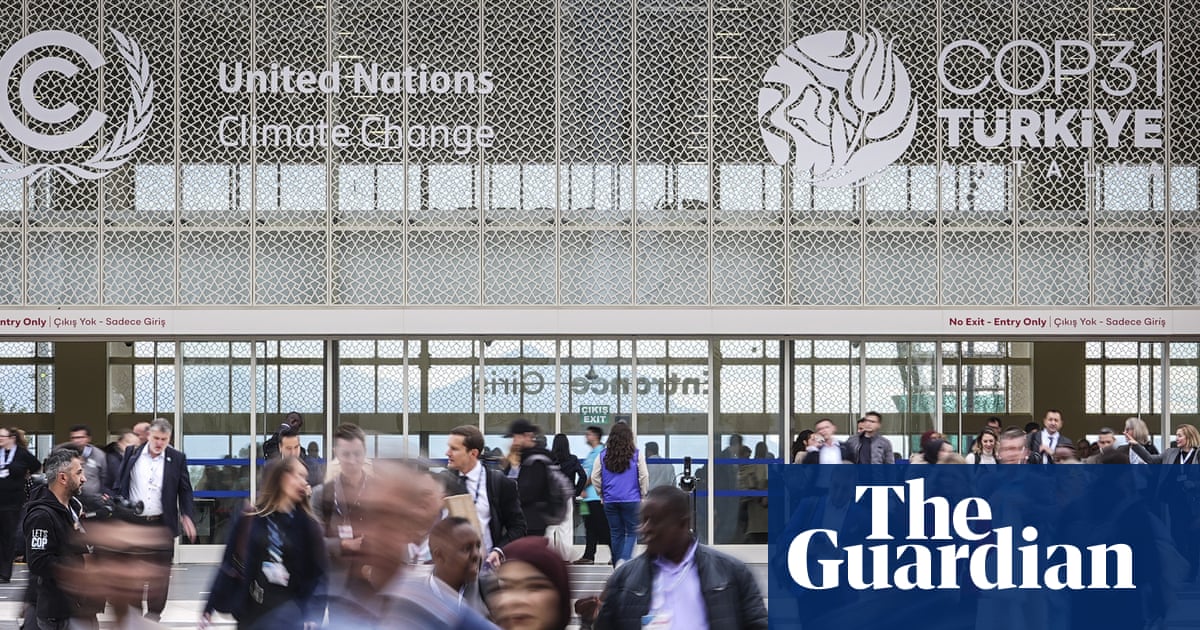
They are counting on you not to read our coverage of the Cop31 climate talks. Fossil fuel companies, climate science deniers, petrostates, far right populists … They want you to think the negotiations are too intractable, the progress too halting, the issues too complex, too tortuous, too pointless, TL;DR.But as the UN’s 31st annual climate conference got underway in Antalya, Turkey this week, our journalists have been going to great lengths to help you understand why the talks remain urgent, crucial and – hopefully – consequential. As well as helping you follow the agreements reached and progress made during the two week summit, they have also been highlighting what’s at stake.Covering a Cop is gruelling work. The negotiations are by definition difficult: representatives from almost every country in the world attempt to thrash out consensus agreements and roadmaps for confronting humanity’s greatest threat. There are also practical hurdles, with 70,000 registered delegates at this year’s summit, packed venues and tangled schedules. On Tuesday morning, the Guardian’s live blog from the conference also chronicled the odyssey of our journalist Graham Readfearn as he struggled for three and a half hours just to get to the venue on one of the special Cop31 buses that got caught in the Antalya traffic.Graham’s quest wasn’t a metaphor – it was just one of many practical challenges reporters face when covering a Cop (which stands for Conference of the Parties to the United Nations Framework Convention on Climate Change). These challenges are that much harder for smaller media organisations from poorer nations that are particularly vulnerable to the impacts of the climate emergency.I asked some of our journalists why it’s such an important conference to cover and the challenges they face reporting from it.Ajit Niranjan European environment correspondent“The hardest thing about covering Cop is satisfying the many different audiences who turn to our coverage during this chaotic fortnight. For the tens of thousands of people attending the summit, we offer a close-up view of the diplomatic spats (and rare breakthroughs) that have sweeping consequences for humanity and the other species with which we share this planet. And for the average Guardian reader, who cares about the climate but may not need the minutiae of UN diplomacy, we mix key takeaways from the negotiations with the most riveting, heartbreaking, terrifying and encouraging stories about the climate crisis. It’s a rare moment during the year when climate change is in the spotlight, and we want to serve as many readers as we can.”Adam Morton Executive editor, news, politics and sport, Guardian Australia, and previously climate and environment editor“Getting across a summit that can draw 100,000 people to attend countless events and backroom meetings is challenging enough, but perhaps the hardest thing about covering Cop is working through the exhaustion that hits after two weeks of long days chasing ministers and bureaucrats across a vast convention centre as they haggle over acronyms that are impenetrable to normal people. By the end of the final weekend it is not unusual to have gone 48 hours with little to no sleep, as delegates work through the night, well past the scheduled deadline, to try to reach an agreement. Power naps on any available surface can become a necessity. Covering a Cop is a great reporting assignment - sometimes deeply frustrating, sometimes exhilarating - but the exercise of being present and alert to translate what the end result means in tangible terms for readers across the globe is an endurance test.”Fiona Harvey Environment editor“The annual Cop summits might seem futile, and they certainly have long stretches of tedium. Logistically, they’re a nightmare, as tens of thousands of delegates descend on a new location each year to spend a fortnight in white air-conditioned conference halls and cramped negotiating rooms. Oh, and the food is always terrible.Every day at a Cop is a flurry of text messages, emails, calls, sprints down corridors desperately trying to doorstep world leaders, and forlorn attempts to update yourself on which press conferences have been cancelled, which meetings rearranged, what rumours have been scotched and which of those flying about might still be true.Journalists at work in the media centre at Cop31 in Antalya, Turkey Photograph: Metin Aktas/Anadolu/Getty ImagesOn the futility side, it’s true that after three decades of Cops the climate crisis has not gone away, and global greenhouse gas emissions have continued to rise. But that’s not the whole story. The world is moving away from fossil fuels, albeit far too slowly, and those impeding that progress need to be held to account. In many countries, voters can do that, but a huge slice of the world’s emissions and fossil fuel production come from autocratic states where elections are not free and fair. Cop is one of the few places where those countries can be questioned and exposed on their failings and attempts at obstruction. Cops are also, at their best, engines for progress - countries encourage each other to do the right thing. As John Kerry [the former US secretary of state] told me, just ahead of Cop31, when I asked him whether Cops were worth it: ‘I’d rather have it [Cop] taking place, and having people listen to each other and exchange information and views, than live in a completely dark, motionless pit where nothing happens.’”Graham Readfearn Environment and climate correspondent, Guardian Australia“I can’t pick the one thing that’s hardest. They are sprawling in scale, cut across geopolitics, science, diplomacy, social affairs and so many other big issues. I’m based in Australia, so there’s always a long flight to take and some jet lag to deal with while at the same time trying to be on top of your game from day one. It’s exhausting, relentless and exhilarating. If none of my colleagues have mentioned the acronyms, then TBH they should have. You need to know your LDCs from your NDCs and your HACs from your WEOGs. The big challenge is to know enough to then be able to translate what’s happening into a language the reader understands, and to be able to tell the difference between a development that’s genuinely going to be consequential and something that’s just part of the Cop noise. And I never eat or sleep properly.”Damien Gayle Environment correspondent“The most challenging thing about covering Cop is cutting through the forests of jargon to find your way to the story that actually means something to the outside world. It’s all too easy to get caught up with the excitement of Cop. For two weeks it is like a world in itself – part summit, part trade fair, part festival. Those participating believe it is the most important place anywhere, and that the fate of the world hangs on every intricacy. And it is important. But it still needs to be kept in perspective.”
‘It is not unusual to go 48 hours with little sleep’: what it’s like to cover a Cop climate summit
Full Article
Original Source
Read the full article at Theguardian →KhanList aggregates and links to publicly available news content. We do not host full articles from third-party sources. Always verify important information with original sources.