
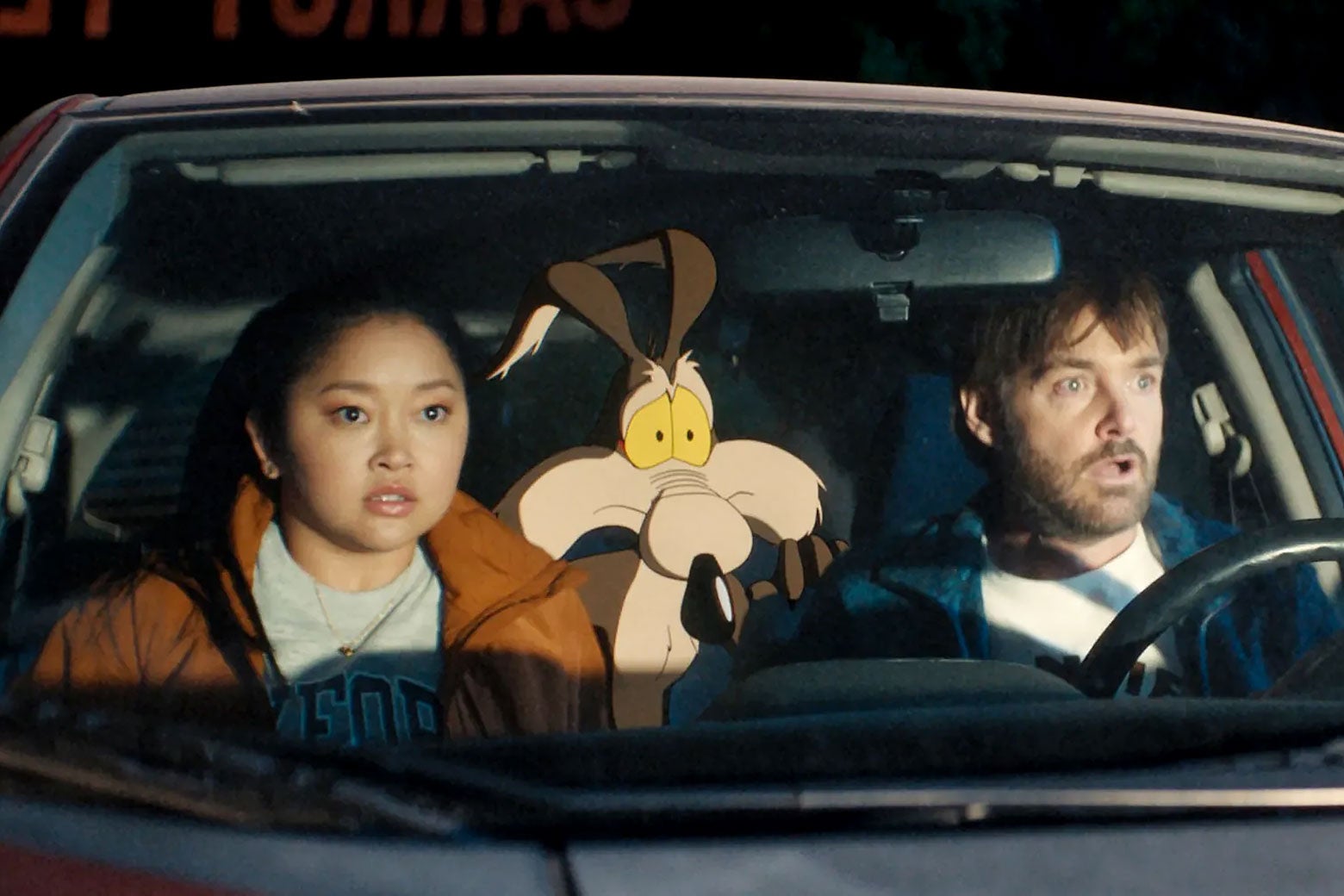
Movies Its Corporate Ownership Tried to Bury It Forever, but Like Wile E. Coyote, It Just Kept Bouncing Back Coyote vs. Acme is finally here, and it’s a delight. By Enter your email to receive alerts for this author. Sign in or create an account to better manage your email preferences. Unsubscribe from email alerts Are you sure you want to unsubscribe from email alerts for Sam Adams? Aug 27, 20262:38 PM Ketchup Entertainment Sign up for the Slatest to get the most insightful analysis, criticism, and advice out there, delivered to your inbox daily. Outside Albert Camus, there’s no better depiction of the drive to devote oneself to an impossible pursuit than the tale of Wile E. Coyote and the Road Runner. The coyote wants to catch the bird; the bird wants merely to escape. In the natural world, that might be the end of the story: Predator eats prey, the end. But the coyote doesn’t want just any prey. He wants this bird, who seems to be the only other living thing in the barren landscape they alone inhabit. The coyote has skills: He’s an inventor of sorts, as well as an enthusiastic customer of the Acme corporation, which supplies him with all the materials an aspiring bird-trapper could want (anvils, rocket skates, and so on). And yet the bird outwits him time and time again, a defeat that stings especially hard because the bird sometimes seems to have no wits at all. In Coyote vs. Acme, Wile E. sets his sights on the company whose malfunctioning products have done him unspeakable bodily harm. In the live-action world inhabited by Kevin Avery (Will Forte), the small-time lawyer who agrees to take the coyote’s case, Acme’s wares seem to work well, or at least well enough that no one questions why their cellphone and their car are the same brand. But the cartoons who live alongside the humans don’t fare so well. The coyote’s detonator explodes in his face rather than setting off the dynamite meant to reduce the roadrunner to ash; his backpack releases a fistful of silverware rather than the parachute meant to slow his descent to earth. Not even less risk-taking toons are safe. Poor old Porky Pig is just walking down the street—in Albuquerque, naturally—when he’s smashed into a wall by a wrecking ball with the Acme logo. Perhaps Wile E. has never connected the dots and realized that the Acme corporation was the author of all his pain, or perhaps it simply never occurred to him that he could do anything about it. When Chuck Jones and Michael Maltese’s cartoons first started appearing in the late 1940s, Acme was a satire of low-rent brands, the kind of generic knockoffs you might order from a small-print ad in the back of a magazine. But by the 2020s, Acme isn’t the bargain choice; it’s the only choice. Kevin, who is named after the legendary Looney Tunes animator Tex Avery (his law-firm partners share the surnames of the coyote and roadrunner’s creators), makes a viable if unglamorous living settling small-claims suits against Acme on behalf of injured cartoon clients. When he first meets Wile E., he pegs his injury as “a run-of-the-mill $300 rocket-skate case.” But Kevin’s settlements come with a boilerplate clause stipulating that none of this is Acme’s fault, and they’ve apparently got deep enough pockets that they can keep hurting cartoons and paying out penny-ante claims for eternity. The coyote cleverly manipulates him into filing a massive lawsuit all the same—they don’t call him Wile E. for nothing—and Kevin is eventually won over to the cause. But they’re going up against the biggest company there is, one that seems to unofficially own the few things, like judges or the U.S. Congress, that don’t already bear its logo. The feeling of being powerless to slow the depredation of a massive megacorp is, of course, not just the story of Coyote vs. Acme but the story behind it. In 2023, producer Christopher DeFaria was informed that Warner Bros. had no plans to release the completed $70 million film—not in theaters, not on demand, not to its own streaming platform—and that because the company’s CEO, David Zaslav, had decided to write the film off as a complete loss for tax purposes, it might never be seen at all. It was, Zaslav modestly concluded, a decision that took “real courage.” (Even more courageous was the nearly $50 million in compensation Zaslav took home that same year.) It wasn’t the only film Zaslav boldly decided to erase from existence; a fully shot, if not entirely complete, movie starring Leslie Grace as Batgirl was canceled after poor test screenings. But unlike Batgirl, which DC Studios co-head Peter Safran called “not releasable,” Coyote vs. Acme was said to be good, certainly good enough to be seen—test audiences ate it up—and its value to the studio as a whole would have extended beyond its viewership, reminding HBO Max subscribers that unrestricted access to the Looney Tunes catalog was only a few clicks away. It turned out, however, that Zaslav didn’t value the original cartoons either; as with Sesame Street, he viewed “children’s programming” as a distraction from the streaming platform’s strengths, and so they let the icons of animation history go in March 2025. (You can now watch them on Tubi.) But unlike Batgirl, Coyote vs. Acme became a cause célèbre, and Warner eventually agreed to sell the movie to the little-known indie distributor Ketchup Entertainment, which has finally put it into theaters this week. The original Looney Tunes were born out of a particular creative ferment, a combination of wild talent and executive disinterest, and re-creating the golden years of Termite Terrace on an ad hoc basis has never entirely worked, in part because the original cartoons were the products of numerous teams working in their own distinct, if not quite incompatible, styles. So it’s wise that while Coyote vs. Acme features oodles of brief appearances by familiar toons, Samy Burch’s script (based on a legendary 1990 Shouts & Murmurs column by the New Yorker’s Ian Frazier) hews largely to its title character, although it does feature a substantial supporting role for a certain carrot-smacking leporid. (Eric Bauza, who voiced Daffy Duck, Foghorn Leghorn, and others in Space Jam: A New Legacy, takes on many of the animated characters here, although the Road Runner’s beep-beeps are mostly recycled from the original cartoon shorts.) Since the coyote and roadrunner’s struggles are entirely nonverbal (the former does brandish the occasional handwritten sign), that leaves most of the talking to Forte and John Cena, who plays Acme’s intimidating chief counsel, along with a supporting cast that includes Lana Condor (To All the Boys), P.J. Byrne (The Wolf of Wall Street), and Luis Guzmán. Forte feels a little constrained by having to play the straight man, but Cena has a ball as Acme’s Buddy Crane, a ruthless corporate shill who loves doing Acme’s dirty work and has been cleaning Kevin’s clock since they went to law school together. Cena plays it relatively straight as well—it’s a bad move to go for antic when you’re acting opposite cartoons—but it’s more of a supercharged deadpan, as if he’s too full of himself to acknowledge the fundamentally ridiculous world in which he’s triumphed. When he presses Tweety Bird, who’s been compelled into spying against his own kind, for information about what he’s seen, he fumes, “I don’t pay you to tink. I pay you to taw.” I wish Coyote vs. Acme were as good a movie as it is a cause. Zaslav’s attempt to junk a finished film for the sake of a tax break was appalling behavior for the head of a studio, and its release is a triumph over the corporate indifference to art—a story that now has extra resonance because of how it parallels its characters’ battle to make a faceless behemoth take note of their existence. But for all its commendable zeal, the movie doesn’t have the anything-goes spirit of the best Looney Tunes, or even Who Framed Roger Rabbit. Burch’s script, written before her Oscar-nominated May December went into production, is sentimental and moralistic, qualities that simply don’t belong in this universe, and while the animators do a solid job of emulating the original cartoons’ style, they can’t possibly match their inventiveness. That’s an absurdly high bar to clear, especially compared to the lifeless cynicism of the average Hollywood IP grab, and the movie does manage to connect the coyote’s Möbius-strip pursuit of his eternal adversary to the equally hopeless battle against corporate consolidation. I just found myself longing for a little more anarchy, and little less third-act resolution. Screenwriting dogma insists that characters have to progress, but what makes the cartoons so eternally satisfying is that nothing ever changes. The coyote takes a million routes but always ends up back at square one, and though he is endlessly frustrated, his determination never flags. One must imagine Wile E. Coyote happy. Comedy HBO Movies Animation
It Got Exploded, Pummeled, Anviled, and Left for Dead. But Now It’s Back to Life, and It’s a Delight.
Full Article
Original Source
Read the full article at Slate →KhanList aggregates and links to publicly available news content. We do not host full articles from third-party sources. Always verify important information with original sources.