
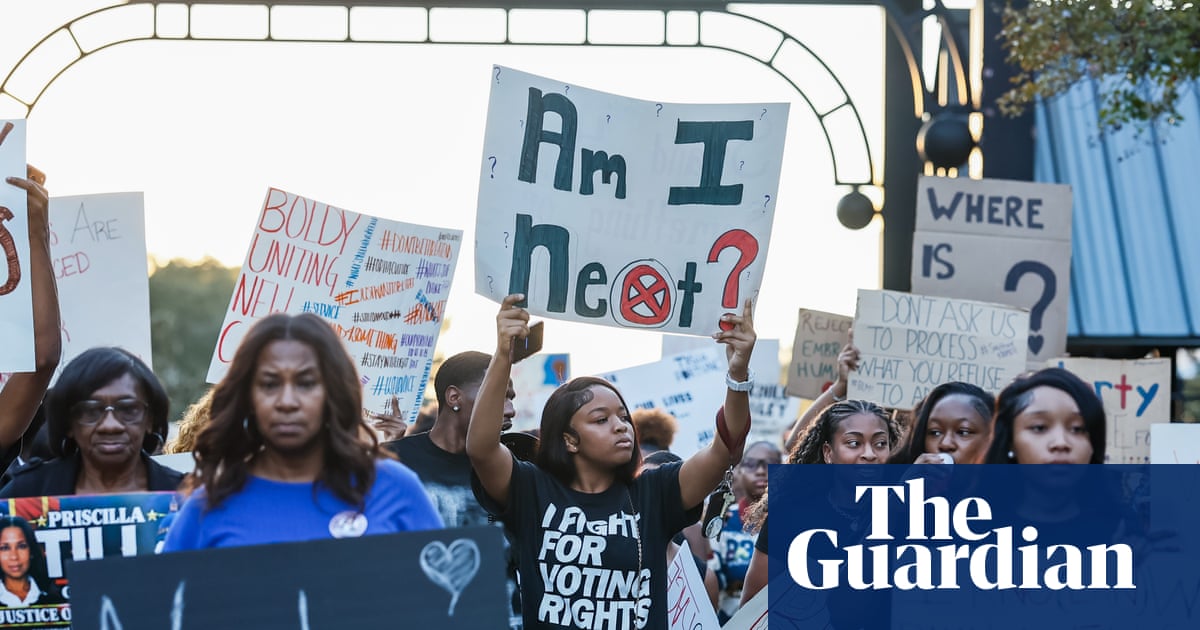
On Wednesday afternoon, hundreds of students gathered on the Jackson State University (JSU) campus for a rally to call for transparency in the mysterious death of young Black people and to encourage student engagement in politics and the fight for voting rights.As the sun began to set, the students, many of whom wore black, marched through the historically Black university’s plaza chanting: “Nolan Wells, Trey Reed, Tasia Fortune, Kohen Wiley, Jaylen Lewis – Black Lives Matter!” All five were young Black Mississippians – the youngest, Wiley, was one-year-old while the eldest, Fortune, was 29 – who either died under suspicious circumstances or were killed by police.The students wound through the campus, with school police and others looking on, continuing their chants until they made it to the Cofo Civil Rights Education Center. The building was significant: it was the organizational home for the Mississippi Freedom Summer of 1964, a largely student-organized movement that aimed to increase Black voter participation during the Jim Crow era, and the statewide headquarters for the Council of Federated Organizations, a coalition of the Mississippi branches of the NAACP, the Student Nonviolent Coordinating Committee, the Congress for Racial Equality and the Southern Christian Leadership Conference.“This is the first step of advocacy,” Camrynn Wimberly, a JSU student and one of the organizers of the march, said. “This is the first step of collective action and political power. The more this spreads, the more we continuously advocate for the same thing and let them know that we will not stand idly by as rights are stripped from us, as parents grieve, as we wonder whether or not we will be next – that is the first step to something greater.”Demonstrators at the Blackout rally at Jackson State University on 7 October 2026 in Jackson, Mississippi. Photograph: Aron Smith/Jackson State University/Getty ImagesThe students at JSU are part of a larger movement of students at historically Black colleges and universities (HBCUs) who are calling for justice and transparency in the cases of Nolan Wells, an 18-year-old Black student whose disappearance and death have received national scrutiny, and other young Black people who died in mysterious or suspicious circumstances.Also this week, students in the Atlanta University Center Consortium (AUC), which includes Spelman College, Clark Atlanta University (CAU) and Morehouse College, as well as Langston University, Prairie View A&M University and other schools, marched to demand answers about the cause and manner of Wells’ death, which remain undetermined, and other suspicious deaths of young Black people.‘They look like me’On 1 October, students in the AUC held a march in solidarity with Nolan Wells and his family. Thousands of students participated.“We’ve seen time and time again the mistreatment of cases involving young Black Americans,” Barhn Gadson, president of CAU’s chapter of the NAACP, said. “There’s not so much of an attention towards it until we do things like having to march and having to riot. We’ve gotten to a point where we are tired of having to fight for young Black males or young Black females or any Black individual for our lives to mean something.”A’Nija Hughley, president of Spelman’s NAACP chapter, said that it was important for all students, but specifically those at HBCUs, to speak up.“As HBCU students, we’re in a unique position where we are allowed to learn how to be critically conscious, and we learn how structures are built to work against us,” she said. “As students who are legacies of those who started the civil rights movement and the Atlanta student movement, it’s kind of our job to speak up and then also show our support for [Wells’] family.”Hughley said that the idea for a solidarity march came from a student in her chapter who wanted to know what they could do for Wells. Though the students are in Atlanta, they said that they marched in solidarity with Wells and other young Black people who have died in suspicious circumstances.“To us, it’s we either speak out or we just shut up,” Gadson said. “Just because we may not be in the same city or the same state doesn’t mean that we can’t speak out on it. And just because there is a one ruling here doesn’t mean that we aren’t going to protest, doesn’t mean that we are not going to advocate for our community. I mean, we are the NAACP. This is what we’ve been doing for years.”Hughley said that, instead of a larger protest where they marched to the capitol building or otherwise engaged the larger community, she wanted to keep the march AUC-wide. “We cannot sit and look at injustice and not say anything about it,” she said. “It honestly could have been any one of us. This one hits close because he’s around our age. He looks like us.”Students protesters during a Blackout rally at Jackson State University on 7 October 2026 in Jackson, Mississippi. Photograph: Aron Smith/Jackson State University/Getty ImagesWells’ similarities to the students in age and appearance were also noted by the JSU students who rallied on Wednesday afternoon. As they made their way across the campus, they chanted: “Our lives matter. That could’ve been me. They look like me. Say their names!”Jakari Holland, an organizer of the rally and founder of the Mississippi Access Project, said that the school’s location in central Mississippi made it particularly important for students to speak out. “Multiple people have passed away inside Mississippi under suspicious circumstances,” Holland said. “Jackson State University, being a public institution and bringing in public funding, but also at the centerpiece inside the capital in Mississippi, we have to take a stance. We have to bring awareness and transparency in light of what’s happening. This could be any one of us. We’re young people inside Mississippi, and we’re seeing what’s going on in the backyard of our home.Like the students in Atlanta, Holland was keenly aware of the historical significance, not only of JSU, but of Jackson and Mississippi, in general. “Our HBCUs have a long history of people being advocates and standing against things,” he said. “The Greensboro Four, when they were at North Carolina A&T and sat down in Woolworth’s lunch counter. The Student Nonviolent Coordinating Committee. The students at South Carolina State that were shot. The people that our Gibson-Green plaza is named for. It’s crazy to see that people love talking about and celebrating Black history, but when you’re living through it, that’s when the issue comes about because you don’t like people that challenge the societal norms.”
‘It could have been any one of us’: Black college students march for Nolan Wells
Full Article
Original Source
Read the full article at Theguardian →KhanList aggregates and links to publicly available news content. We do not host full articles from third-party sources. Always verify important information with original sources.