
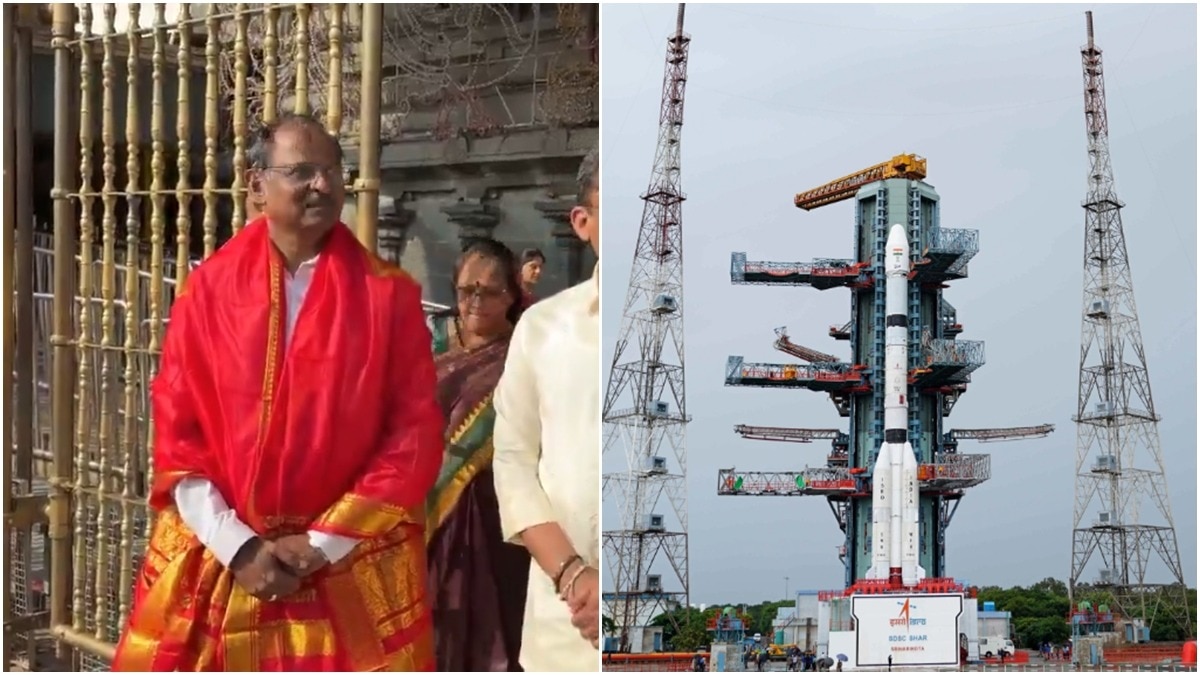
Indian Space Research Organisation (Isro) Chairman Dr V Narayanan visited the Sri Venkateswara Swamy Temple in Tirumala, Tirupati, on Thursday, October 29, ahead of a crucial satellite launch that could help restore India's independent satellite navigation capabilities.The visit follows a longstanding practice among Isro teams of seeking blessings before major missions from Sriharikota.Speaking after the prayers, Narayanan confirmed that Isro would launch its NVS-03 navigation satellite aboard the GSLV-F18 rocket at 11:51 pm IST on Friday, October 30."This is the fifth mission we have accomplished this year, including a private launch," he said. "With this launch, we will have four operational navigation satellites in orbit, including one equipped with an indigenous atomic clock, providing precise position, navigation, and timing services for India." #WATCH | Tirupati, Andhra Pradesh: ISRO Chairman Dr. V. Narayanan visits the Sri Venkateswara Swamy Temple in Tirumala ahead of the GSLV-F18 navigation satellite mission scheduled for October 30. https://t.co/ext8mHHS0L— ANI (@ANI) October 29, 2026 WHY IS NVS-03 MISSION IMPORTANT?The satellite will be launched from the Satish Dhawan Space Centre in Sriharikota, Andhra Pradesh.It is the third satellite in Isro's second-generation navigation series, designed to strengthen India's home-grown navigation system, Navigation with Indian Constellation (NavIC). Much like the US-operated GPS, NavIC provides location, navigation and precise timing information. It is, however, designed primarily for India and the region extending around 1,500 km beyond its borders. NavIC currently has only three operational satellites providing navigation services. (Photo: Gen AI by India Today) NavIC currently has only three operational satellites providing navigation services, fewer than the four needed for standalone regional positioning services.Once NVS-03 is placed in orbit and becomes operational, it is expected to bring the number to four, helping restore this capability.HOW WILL NVS-03 REVIVE NAVIC?As Narayanan mentioned, NVS-03 carries an Indian-made atomic clock alongside other atomic clocks. Such clocks measure time with extreme precision, which is essential for calculating a user's location from signals received from navigation satellites.The satellite will also introduce the L1 frequency band alongside the existing L5 and S-band signals, an addition that is intended to expand NavIC's usefulness for civilian users.#WATCH | Tirupati, Andhra Pradesh: ISRO Chairman Dr. V. Narayanan says, "On October 30th at 11:51 PM, under the guidance of the Prime Minister of India, we are going to launch NVS-03, a navigation satellite, using our GSLV-F18 launch vehicle. This is the fifth mission we have accomplished this year, including a private launch. With this launch, we will have four operational navigation satellites in orbit—including one equipped with an indigenous atomic clock—providing precise position, navigation, and timing services for India. These services serve multiple purposes, including strategic applications, supporting the Airports Authority of India, real-time train tracking, vehicle monitoring, and vessel navigation for boats and ships..."— ANI (@ANI) October 29, 2026The system supports several applications, including real-time train tracking, vehicle monitoring, ship and boat navigation, airport operations and strategic defence requirements.The mission follows setbacks affecting the NavIC constellation, including the failure of NVS-02 to complete its orbit-raising manoeuvre in January 2025.A successful NVS-03 mission would therefore be an important step towards rebuilding India's navigational network.- Ends
Isro chief offers prayers at Tirupati ahead of critical GSLV-F18 launch
Full Article
Original Source
Read the full article at Indiatoday →KhanList aggregates and links to publicly available news content. We do not host full articles from third-party sources. Always verify important information with original sources.