
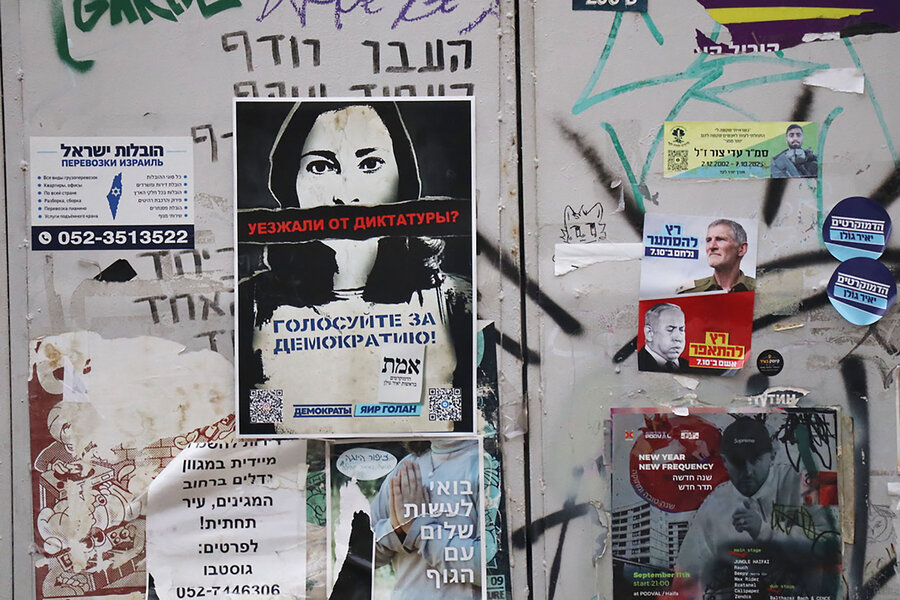
Ramat Gan, Israel | Oct. 26, 2026, 4:02 p.m. ET | 4 min read Yona Roizman has never voted in a free election. Born soon after Vladimir Putin rose to power in Russia in 1999, democratic competition existed in name only for her generation. After Mr. Putin’s decision to unleash a full-scale invasion of Ukraine in early 2022, she left Moscow for Tel Aviv.Now an Israeli citizen, Ms. Roizman says she feels as if she is voting for the first time, hoping to stop what she sees as “democratic backsliding” in her new home under the far-right government of Prime Minister Benjamin Netanyahu.“I moved to Israel because I don’t want to live in a dictatorship, and I would like to live in a country that is at peace,” she says. “And we are moving further from there.” She’s one of nearly a quarter-million Russians and Ukrainians – according to Israeli government statistics – who immigrated to the Jewish state since 2014, when Russia seized Crimea. About half that group arrived in the aftermath of Russia’s attack against Ukraine in February 2022.It’s difficult to say exactly how many of those new arrivals have since left Israel. But those who remain constitute a politically distinct community, and many have never voted in Israeli elections. Ilan Ben ZionYona Roizman, center, speaks on a Russian-language election panel in Ramat Gan, Israel, Oct. 18, 2026. They join a more established population of immigrants from the former Soviet Union. More than 900,000 arrived in Israel between 1989 and 2001 and tended to be a reliable voting bloc for right-wing parties. Polling indicates that newer immigrants who emigrated under Mr. Putin are markedly more liberal – and politically active – than the old guard.A survey published in 2024 by the Israel Democracy Institute found that, among immigrants to Israel from the former Soviet Union who arrived between 2014 and 2023, one-third of them self-defined as left-leaning, another one-third as centrist, and just under 20% as right-wing. Among Russian-speaking immigrants who arrived before 2013, half of the respondents described themselves as right-wing, and only 10% considered themselves leftist. “There are definitely more politically active people, and people who oppose an anti-democratic regime,” says Inna Orly Sapozhnikova, a researcher at the institute, a Jerusalem-based think tank.Zeev Khanin, a professor of political studies at Bar-Ilan University, says his latest research indicates a “substantial difference” between these two generations of immigrants.The earlier wave of Russian-speaking immigrants is known as the “Sausage Aliyah” – incorporating the Hebrew term for Jewish immigration to Israel – because of the economic hardship they fled. A different nickname for the more recent wave was inadvertently created when a new immigrant who arrived in Israel in 2022 inquired on a Russian-language chat group about where she might find a pumpkin spice latte in Israel. Sausage Aliyah folks responded with derision and started referring to this latest group of Russian immigrants as the “Pumpkin Aliyah.”Most of the Pumpkin Aliyah arrived as middle class, Dr. Khanin says, whereas people from the Sausage Aliyah “started their career in Israel from zero.”“I believe that more than half or two-thirds of [the Pumpkin Aliyah] – or even more – would probably vote for one of the oppositional parties,” he says, and most would vote for the right-leaning, anti-Netanyahu party Yisrael Beytenu, headed by Avigdor Liberman, who emigrated from Soviet Moldova in the late 1970s. The “Pumpkin” label might have been meant as a dig, but many recent immigrants have leaned into it. Sergei Zhurkovskii moved to Israel in November 2022 to distance himself from “the crimes being committed by that [Russian] regime every single day.” He started an ad firm based out of the northern Israeli city of Carmiel and named it Pumpkin People Marketing.“I want Israel to remain a democratic country, and I’m deeply concerned about the future of its democracy,” Mr. Zhurkovskii says. He says he intends to vote for Gadi Eisenkot, a former army general leading the opposition to Prime Minister Netanyahu, whom Mr. Zhurkovskii fears is “leading the country down the wrong path” toward a more authoritarian future.“I always participated in elections in Russia,” he says. But they never felt free or fair, Mr. Zhurkovskii says. “So, for me, these will truly be my first real elections.”“Of course, this is a significant election for me, also because it’s the first one,” says Ms. Roizman, who has been campaigning for The Democrats, a center-left opposition party headed by another former general, Yair Golan. She says she felt she “didn’t do enough when I was in Russia, and it was very scary.” Deepen your worldviewwith Monitor Highlights.Politics with respectGet political stories with respectful analysis.There‘s a world of new ideas in everyBooks newsletter.There‘s more to life, enrich yours withCulture & Learning weekly.Follow humanity‘s discoveries withScience & Nature stories in your inbox.Gain a spiritual perspectivefrom the stories in your inbox.Want to understand the deeper impact of critical events? Learn the Monitor‘s insight.Already a subscriber? Log in to hide ads. In the run-up to the Oct. 27 elections, she took part in a panel discussion organized by a nongovernmental group called Israel Shelanu – or “Our Israel” in Hebrew – that promotes democratic involvement among new Russian-speaking immigrants. The event was held in Ramat Gan, in central Israel, and included representatives from five different political parties fielding questions from a group of several dozen Russian speakers about issues of religion and state, about the possibility of aligning with Mr. Netanyahu’s Likud party, and the conflict with the Palestinians.“I already had one home. Now, I have my second home,” Ms. Roizman says. “I don’t really know if I have it in me to have a third home.” ALREADY A SUBSCRIBER? LoginReal news can be honest, hopeful, credible, constructive.The Christian Science Monitor was founded in 1908 to lift the standard of journalism and uplift humanity. We aim to “speak the truth in love.” Our goal is not to tell you what to think, but to give you the essential knowledge and understanding to come to your own intelligent conclusions. Join us in this mission by subscribing.
Israel’s newest Russian-speaking voters see elections as an opportunity
Full Article
Original Source
Read the full article at Csmonitor →KhanList aggregates and links to publicly available news content. We do not host full articles from third-party sources. Always verify important information with original sources.