
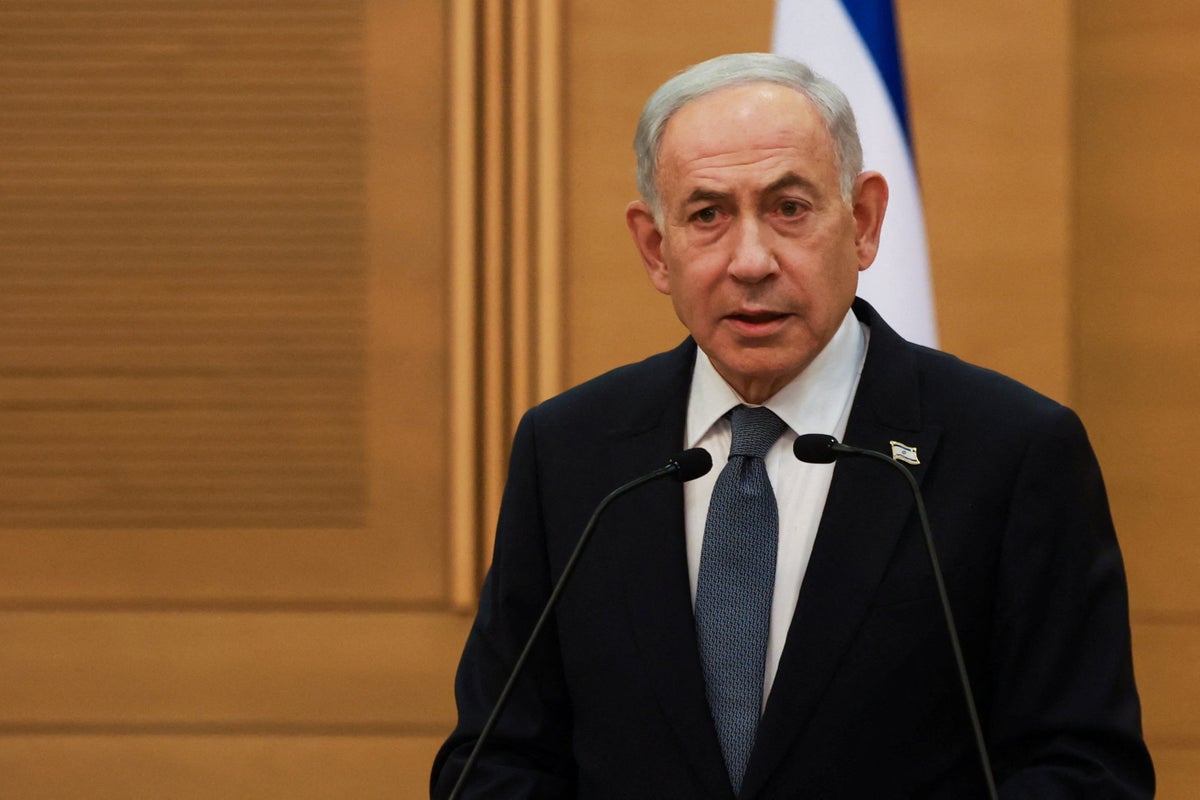
Benjamin Netanyahu offered to form a national unity government with rotating premiership to break the political deadlock created by last month’s election that produced no clear majority.He is scheduled to meet opposition leader Gadi Eisenkot on Sunday to discuss a way out of the impasse.Offering a significant concession, the caretaker premier said he would agree to Mr Eisenkot becoming prime minister first before handing the job back to him. Mr Netanyahu’s right-wing Likud and its allies, including far-right and ultra-Orthodox parties, won 53 seats in the general election, while the opposition bloc led by Mr Eisenkot's centrist Yashar party took 48 seats. The two Arab-led coalitions won 19. No side reached the 61 seats needed for a parliamentary majority despite a voter turnout of nearly 78 per cent.The unprecedentedly strong showing in the election by the two Arab-led alliances, the United Arab List and the Joint List, made them potential kingmakers. However, all but one of the Jewish parties pledged not to work with them to form a government.“My responsibility as a leader requires me to set everything aside,” Mr Netanyahu declared, “and agree that Gadi Eisenkot will serve first as prime minister, while I will serve as alternate prime minister at the beginning of the term.”Protesters hold up placards during a demonstration calling for the formation of a Jewish-Arab coalition government on 7 November 2026 (AFP/Getty)He was ready for such an arrangement, Mr Netanyahu said, because of “the gravity of the existential danger and the possibility that a government will be formed that lacks the ability to confront it”.“I expect that, in light of this agreement on my part, we will immediately begin genuine, sincere, and accelerated negotiations in which the other side will also be willing to make similar compromises and concessions, to establish a national unity government that’ll repel these dangers and ensure Israel’s security and future,” he said.Mr Eisenkot, a former army chief, responded by inviting Mr Netanyahu to "genuine and accelerated negotiations".“If Likud is ready for genuine unity, I am ready to assess the seriousness of its intentions over the next 24 hours, and I invite Netanyahu and his team, tonight, to the Dan Accadia Hotel in Herzliya, where I’m staying with my negotiating team, to conduct genuine and accelerated negotiations on basic guidelines and policy issues, based on the detailed proposal to which Netanyahu has yet to respond,” he wrote on social media. “I am committed to the citizens of Israel, including those who did not vote for me and my partners, to continue working to bring about the formation of a good government for all the citizens in the coming days.”Mr Eisenkot earlier signed coalition deals with two partners whose support could bring him closer to a majority without Mr Netanyahu’s party.Gadi Eisenkot attends a meeting at the Knesset in Jerusalem (AFP/Getty)Some in Mr Eisenkot’s camp dismissed Mr Netanyahu’s offer as performative or a stalling tactic.“Enough with the stunts and tricks,” Yair Golan, head of the Democrats, said on X. “Netanyahu lost. It is our duty to respect the will of the voters and form a government of change and salvation.”Former prime minister Yair Lapid dismissed Mr Netanyahu’s proposal as “yet another transparent con by a serial fraudster who has cheated every partner and broken every agreement”. He proposed swearing in an Eisenkot government without Mr Netanyahu and only then starting negotiations for a unity government.Naftali Bennett, another former prime minister, welcomed Mr Netanyahu’s statement, but urged cautious negotiations. He said it was the “right decision” and that it was now “forbidden” to continue discussions about a government without Mr Netanyahu. Supporters of political change hold Israeli flags during a demonstration on a pedestrian bridge overlooking in Tel Aviv on 10 November 2026 (AFP/Getty)Sticking points in negotiations over the formation of the next government include the conscription of ultra-Orthodox Jews into the military, differences about national security policy and judicial reforms, and whether Arab parties may be included in or allowed to support a governing coalition, an issue on which Mr Eisenkot’s bloc remains cautious. Possible outcomes include a unity government with rotating premiership or an Eisenkot-led coalition relying on outside support. A failure to reach a deal could pave the way for another election, with Mr Netanyahu remaining in office as caretaker prime minister.
Israel’s Netanyahu offers rival rotating premiership to break election deadlock
Full Article
Original Source
Read the full article at Independent →KhanList aggregates and links to publicly available news content. We do not host full articles from third-party sources. Always verify important information with original sources.