
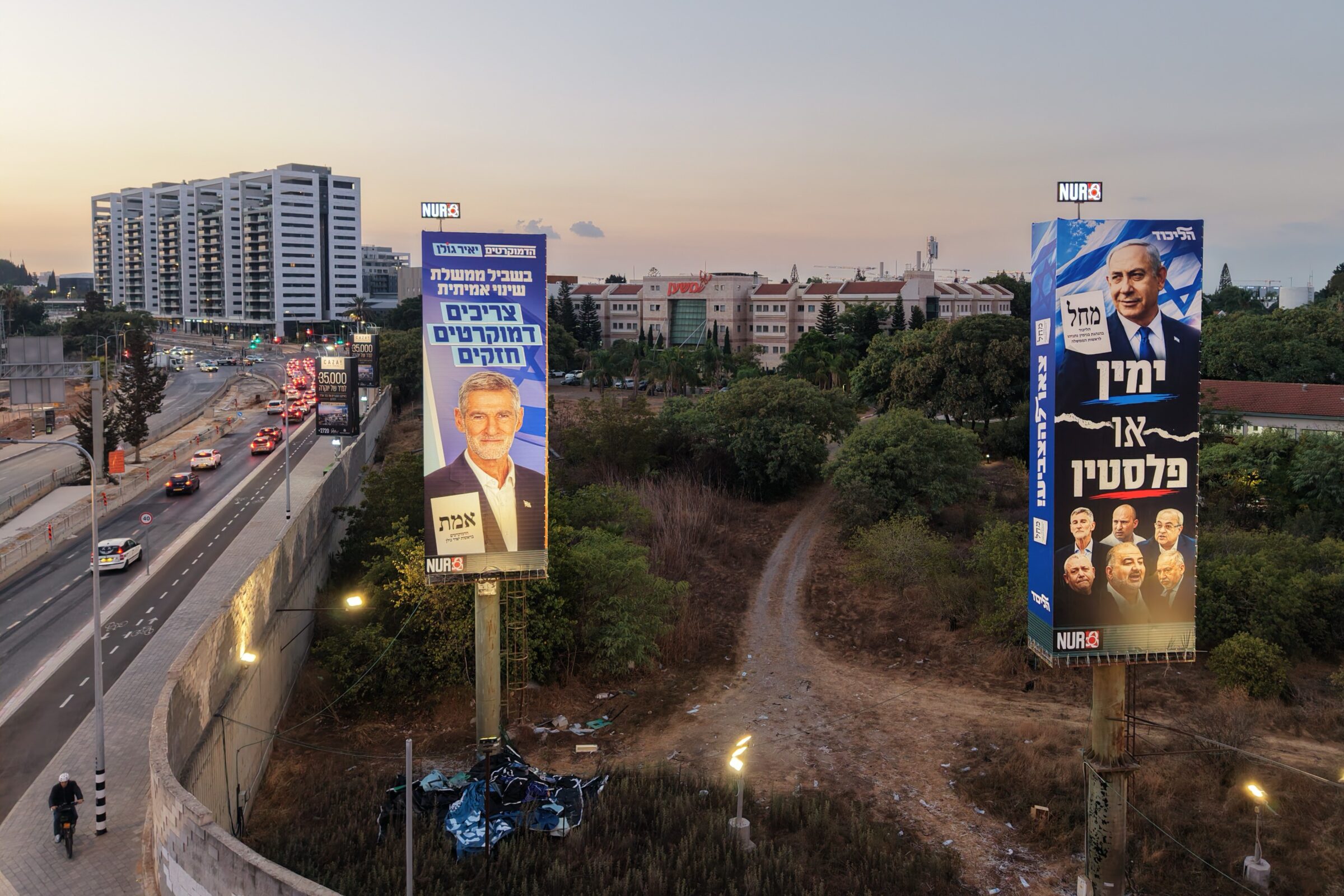
Israel’s 27 October election might disappoint everyone. To start, there may be no next-day resolution. Polls show the Netanyahu-allied and opposition blocs nearly tied, both short of a majority. If that holds, expect weeks of furtive factional negotiations that diminish the reputations of all involved. If those fail, back to the ballot box. If a new government forms quickly, it will likely be led by Benjamin Netanyahu or the opposition’s Gadi Eisenkot. Most observers outside Israel are hoping for Gadi. In truth, either result will confront Brussels and Washington with tough choices that both have put off too long. Last week’s grudging and partial White House endorsement notwithstanding, Netanyahu is near-friendless on the international scene. If he grinds out another win, many European leaders and US presidential contenders will find themselves managing bilateral relationships of mutual contempt. Unwilling to face hard facts at home, Bibi seemed to think he could gamble them away with Gulf money and American missile interceptors. He marketed himself as the founding entrepreneur of a new-model Middle East powered by Saudi normalisation and Iranian regime change. Instead, Houthi drones and Saudi budget deficits are vaporising the mirage of glass cities and data centres in the desert. Trump’s war now Iran is Trump’s war now, not Israel’s: he will fight or end it as he pleases. What’s left on the IDF’s regional briefing map are small places with complicated pasts and unclear futures, lands that Israel wishes the rest of the world would forget but is itself unwilling to leave. The old Middle East is back. In truth, it never left. It has been the beggar at the door of every air-conditioned Gulf investment conference. But the poor relations — Gaza, the West Bank, Lebanon, Syria, Yemen — have refused to go quietly. Israel’s old politics are back, too. The median Israeli is 29-years old. Netanyahu, whose hair and makeup bills are the subject of a considerable body of investigative journalism, just turned 77. His leading rival Eisenkot, who lost a son and two nephews in Gaza, launched his career as a platoon commander in Israel’s 1982 invasion of Lebanon. Israel, like America, is due generational change. Instead, Israelis (or at least undecided centre-right voters) got a choice of character: the embarrassing but reassuringly indestructible Bibi, or the earnest but untested Eisenkot. It’s not just the faces that are familiar. The candidates are still fighting Israel’s culture wars. The debates that dominated the election — ultra-orthodox military enlistment, judicial reform, and the role of religion in the state — are serious. But they’re also stalemated. Despite deafening recriminations about who is to blame for exposing Israel to Hamas’s 7 October attacks, the debate about security in Gaza and Israel’s north is equally stuck. Indiscriminate destruction and deliberate destabilisation Netanyahu promised “total victory”; that turned out to mean indiscriminate destruction and deliberate destabilisation. His opponents claim Netanyahu has squandered the IDF’s achievements. They promise to do what Netanyahu could not, by using the same crude tools to achieve the same poorly defined objectives — but this time, with greater skill. The question of what that means for ordinary Palestinian civilians, and what future they can expect for their children, has barely been discussed. Many Israeli voters, desensitised to the situation of Palestinians who are routinely dehumanised by Israel’s domestic press, don’t ask. Most Israeli candidates carefully avoid answering. Both blocs pledge they’ll refuse to partner with the Arab-Israeli parties that could hold the key to a Knesset majority — even as prominent Arab candidates downplay their support for Palestinian statehood and campaign on more palatable topics like under-policing in Arab communities. It’s comforting to imagine an Israeli government formed by anyone left of Netanyahu will steer instinctively towards international expectations. But a more centrist Israeli government, like any elected government anywhere, will operate within the political space created by the policy priorities and the empathetic capacity of its voters. There isn’t much room for Palestinians. If an opposition-bloc government forms, it will surely ask for time, assuring foreign capitals that the appearance of pressure makes meaningful change harder back home. European leaders and US Democrats poised to win at least one house of Congress in November may be tempted to pause efforts to compel Israel towards rapid implementation of the international road map in Gaza, an end to ethnic cleansing in the West Bank, and full IDF withdrawal from Lebanon and Syria. That would be a mistake. There will be no place in Israeli politics for a realistic discussion of Gaza, the West Bank, Lebanon, and Syria until the foreign partners necessary to Israel’s security and economy insist, soberly and relentlessly, on creating one. That will require tough new sanctions, not just wordplay. The things that have to be admitted are too hard, and the promises that must be broken are too many, for any Israeli leader to act alone.
Israel’s election may disappoint everyone, as Brussels and Washington face a hard reckoning with a more ‘centrist’ leader
Full Article
Original Source
Read the full article at Euobserver →KhanList aggregates and links to publicly available news content. We do not host full articles from third-party sources. Always verify important information with original sources.