
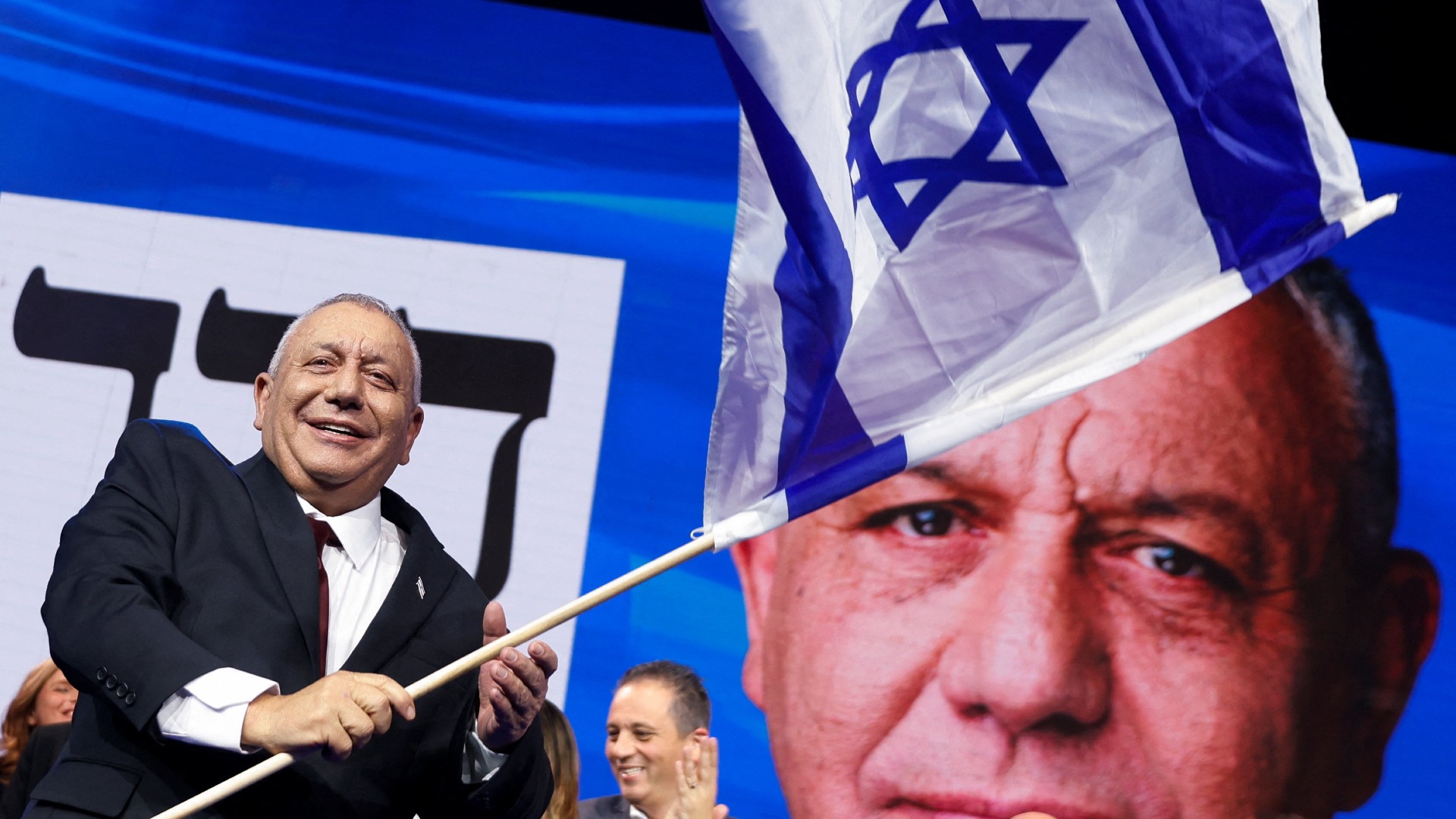
More Israelis voted in Tuesday’s election than in any poll since 2001, yet neither Israeli Prime Minister Benjamin Netanyahu nor his challengers have a straightforward path to power. Complicating matters are the stunning gains made by the Joint List and Ra’am, two slates representing Palestinian citizens of Israel that almost all Israeli political leaders have promised to exclude from any future governing coalition. With 85 percent of votes counted on Wednesday, Netanyahu and his allies stood on 53 seats, while former army chief Gadi Eisenkot’s bloc had 48. The Palestinian parties together sat on 19. A minimum of 61 of Israel’s 120-seat parliament, the Knesset, is needed to form a majority government, and no one is close to that magic number. Middle East Eye explores the possibilities as coalition-building negotiations set to begin. New MEE newsletter: Jerusalem Dispatch Sign up to get the latest insights and analysis on Israel-Palestine, alongside Turkey Unpacked and other MEE newsletters Netanyahu stays in power When the exit polls were released at 10pm on Tuesday night, showing Netanyahu’s bloc trailing Eisenkot’s, many were prematurely writing the prime minister’s political obituary. Eisenkot or Netanyahu: No matter who forms government, democracy is dead Read More » Over the following hours, it became clear that not only was Netanyahu’s Likud party the largest in parliament with an expected 26 seats, but his coalition was also set to gain five MPs more than the Zionist Jewish opposition trying to replace him. As sitting prime minister, Netanyahu will remain in office until a viable government can be formed to replace him. It’s likely that President Isaac Herzog will give Netanyahu the opportunity to try and form a government first, as he has the largest party. There are two ways Netanyahu could do this. The first is by convincing MPs from some of the opposition parties to abandon their bloc and join his government. Several of the opposition parties are very right wing and contain Israeli settlers and former settlers who Netanyahu might think could be tempted over. However, this would need a significant number of defections. The alternative is that Netanyahu forms a unity government alongside some of the key parties in the opposition, such as Eisenkot’s Yashar and Naftali Bennett’s MPs in the Together slate. This would be the preference of US President Donald Trump, who endorsed Netanyahu ahead of the election, and Herzog. It would likely mean that at least one of Finance Minister Belzalel Smotrich and National Security Minister Itamar Ben Gvir’s far-right parties would be excluded from government. Ultra-Orthodox parties Shas and United Torah Judaism, longstanding allies of Netanyahu, would be at risk of missing out, too, as the opposition have campaigned fiercely on the principle that Haredi youth should be conscripted into the army. However, Netanyahu’s personal brand is toxic to the opposition leaders, and especially their voters. Another former army chief, Benny Gantz, destroyed his political career by joining a unity government with Netanyahu in 2020. Assaf David, an analyst at Israel’s Vanleer Institute think tank, told Middle East Eye: “If the final results show Netanyahu’s bloc in the lead, then some of the opposition parties might decide that it's better to have a government of Netanyahu without Smotrich and Ben Gvir than to go for a second round of elections in which the right-wing bloc will be much more organised and the opposition bloc less organised.” Eisenkot forms a minority government The maths for Eisenkot doesn't look good. Yashar and his natural allies trail Likud and Netanyahu’s bloc significantly. Overall, however, voters have elected nearly 70 anti-Netanyahu MPs, including the Palestinian parties. That means the retired general could try to form some sort of government with the help of the Joint List and Ra’am. It’s unlikely that both the Palestinian slates would formally join a coalition. Bennett, Avigdor Lieberman and other opposition leaders have ruled out cooperating with the Arab parties. However, Eisenkot could seek to form a minority government with the support of the Palestinians from the outside. This, David warns, could come with significant risks, as Netanyahu would likely present the move as Arabs stealing the election alongside a minority of Jewish MPs. “If there is no Jewish majority against Netanyahu, relying on the Arab vote to tip the scale against Netanyahu will be very dangerous, not just politically, but even security-wise,” he said. “Netanyahu will be able to incite his supporters to use political violence, and I don't even rule out the possibility of people trying to assassinate Eisenkot.” Another election In 2019, Israel held two elections with results not dissimilar to today's. In both cases, neither Netanyahu nor his former army chief rival, this time Benny Gantz, was able to form a government. Israel’s president gives candidates 28 days to form a government before offering the opportunity to someone else. That window can be extended by 14 days upon request. As things stand, sliding towards another election would suit Netanyahu. He would remain prime minister until those fresh polls are held in a few months’ time. 'I believe that everybody in the opposition bloc knows that they have to seize this opportunity and rely on the Arab vote' - Assaf David, analyst And it is likely, David says, that the conditions would favour Netanyahu and his allies rather than the opposition. Around 67,000 Israelis are estimated to have returned from abroad to vote on Tuesday, and most are believed to have supported Netanyahu’s opponents. It’s unlikely they will all make the effort again. Similarly with the Palestinian vote. An astonishing 80 percent of Palestinian citizens of Israel voted this year, up from 54 percent in 2022. Many were voting for the first time and breaking a longstanding boycott in the face of rising discrimination, insecurity and horror in Gaza and the occupied West Bank. Returning similar numbers in a re-run with a right-wing base energised to stop the Arab vote will be a serious challenge. “The bloc that resists Netanyahu understands that it has a one-shot opportunity right now, because they had the tens of thousands of voters that came to vote from abroad and a huge majority of Arab Palestinian citizens voting,” David said. “These two facts that are in favour of the opposition bloc will not repeat themselves next time. So, I believe that everybody in the opposition bloc knows that they have to seize this opportunity and rely on the Arab vote.”
Israel’s election deadlock: What could happen next?
Full Article
Original Source
Read the full article at Middleeasteye →KhanList aggregates and links to publicly available news content. We do not host full articles from third-party sources. Always verify important information with original sources.