
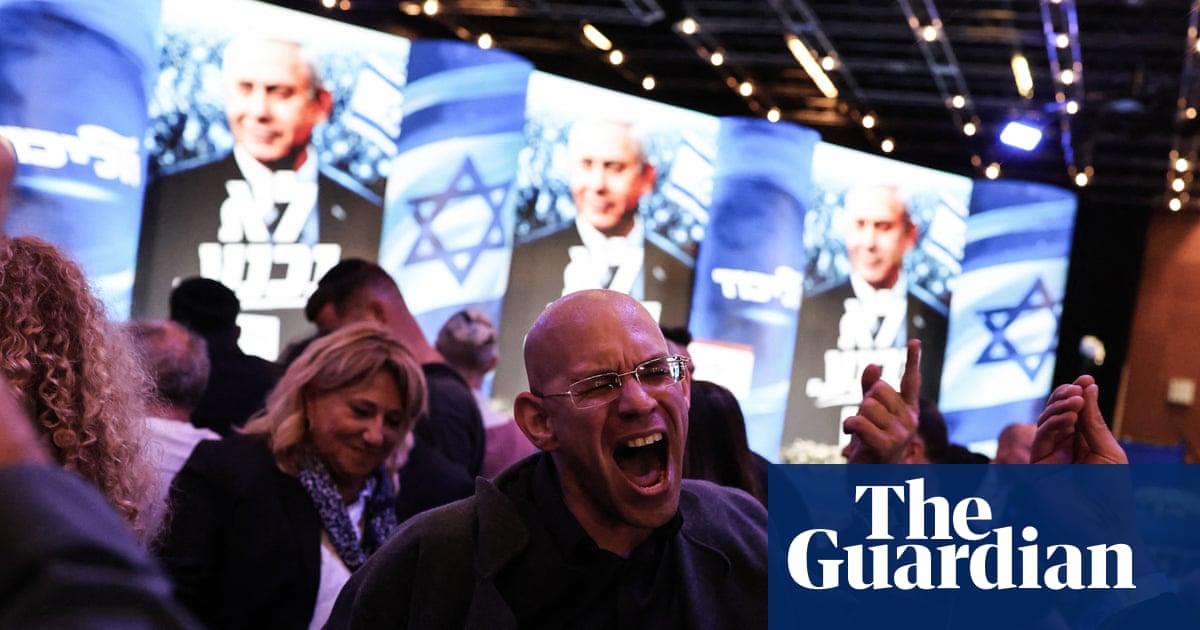
Hours before the final results from Israel’s elections were in, several things were clear. Benjamin Netanyahu’s far-right coalition had lost its mandate, and the opposition had a firm majority.But most of Israel’s Jewish opposition ruled out governing with Palestinian-led parties, in the course of a racist election campaign in which Netanyahu painted Palestinian citizens as an enemy inside the state.The self-imposed ban on a broader opposition alliance, if it holds, offers Netanyahu the prospect of turning his defeat into another term in office – or at least a prolonged mandate as caretaker prime minister and perhaps another round of elections.This confected barrier to unseating Netanyahu became the focus of Israeli media and analysts. “No Clear Government” announced the newspaper Israel Hayom. “Road to Unity Government Has Been Paved”, read an article on Channel 12.Yair Golan, leader of the centre-left Democrats, attacked that framing. “Netanyahu lost. I know how to count,” he said in a statement calling for a government with Palestinians, who make up about 20% of Israel’s population.“We must no longer accept Netanyahu’s racist division between Jewish votes and Arab votes,” he said. “We have a majority. We have a responsibility. And we have an opportunity to form a change government in partnership with Arab citizens of Israel.”Mansour Abbas, leader of the Ra’am party, holds his daughter as he casts his vote in Maghar, Israel. Photograph: Rami Shlush/ReutersOther Israelis were even more direct. “If you stop being racist two amazing things will happen to you,” musician Yali Sobol wrote in a Facebook post. “First, you will stop being racist. Second, you will discover you have won.”While Palestinian-led parties do not describe themselves as Zionist, neither do some of the ultra-Orthodox groups who are a key part of Netanyahu’s current coalition.A survey taken as polls closed on election day showed that a clear majority of opposition voters supported forming a government with the Palestinian-led Ra’am in order to unseat Netanyahu, political psychology researcher Eran Halperin said.But opposition leaders were silent on Wednesday, as they apparently tried to balance their desire to unseat Netanyahu with promises against working with Palestinians.Former general Gadi Eisenkot, who leads the biggest opposition party, has not directly ruled out governing with Palestinians but laid out conditions that made it politically impossible for them to join a coalition.Gadi Eisenkot waves to supporters at an election night rally. Photograph: Noam Galai/Getty ImagesPalestinians have been clearer about their priorities. “We are ready and prepared to pave the way for the ousting of the Netanyahu government,” Yousef Jabareen, leader of the larger Joint List, said on Wednesday. “The change comes through Jewish-Arab partnership.”The Islamist Ra’am party put a Jewish former police chief in second position on their slate, in a signal of their commitment to working with Jewish Israelis.A precedent from three decades ago, when Yitzhak Rabin relied on Palestinian support for a minority government as he sought a negotiated end to the Israel-Palestine conflict, gets little mention in contemporary Israeli political debate.Netanyahu put racism at the heart of his campaign, in a strategy critics said was designed both to bolster voter support and complicate post-election coalition negotiations for the opposition.A slogan featured on many of his election posters, “The right or Palestine”, framed 20% of the population as an enemy within Israel’s borders.On election night he shrugged off the loss of about 10 seats from the 64 seat-coalition he assembled in 2022 – a severe rebuke from voters by most counts – to claim that his vision for Israel had been vindicated in the poll.The Knesset overall has shifted further right, as have young Israelis, and after the results came in, he issued an open invitation to put their opposition to Palestinian parties ahead of their opposition to him.“The rightwing bloc has a clear, decisive majority among the Zionist public,” he said. “We must form a strong national-right government”.Many in Israel described this election as existential, as they struggled to halt the erosion of democracy inside Israel’s pre-1967 borders, and secure a State Commission of Inquiry into the 7 October attacks.For Palestinian citizens facing surging crime, discrimination and home demolitions inside Israel and watching family and friends endure ethnic cleansing in the occupied West Bank and a war of annihilation in Gaza, that was viscerally true, and they came out in record numbers.Israel describes itself as a Jewish and democratic state. If the representatives of Palestinians are now effectively excluded from government because of their race, Netanyahu will have turned that promise into more of a choice – between a Jewish future or a democratic one.
Israel’s choice: Netanyahu remaining in power or a Palestinian-backed coalition
Full Article
Original Source
Read the full article at Theguardian →KhanList aggregates and links to publicly available news content. We do not host full articles from third-party sources. Always verify important information with original sources.