
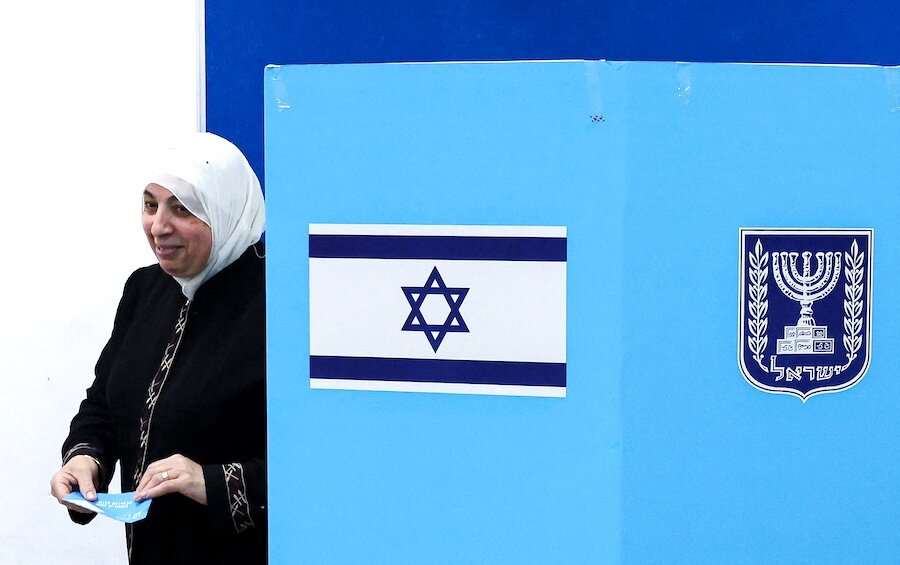
Israel’s election Oct. 27 saw a stunning endorsement of the country’s democracy – by its Arab citizens. Making up about a fifth of the population, this often neglected and reviled minority turned out in record numbers to vote – close to an estimated 80%. As a result, Arab-led political parties won an unprecedented number of seats, or 19 out of 120 in parliament, the Knesset. With no Jewish parties winning a clear majority, “the future of Israel now depends on its Arab citizens and on the attitude of its Jewish citizens toward its Arab ones,” declared one Jewish commentator, Gideon Levy, in Haaretz. “The Arab citizens of Israel have become, for the first time in their history, a part of the state of Israel.” Just how many Arab politicians will become influential in a new government remains to be seen. Political horse-trading among Jewish parties to form a ruling coalition could take several months and, if unsuccessful, lead to a new election. Ahmad Tibi, leader of the Arab Movement for Change and a member of the Knesset, said Zionist opposition parties have already approached Arab leaders to gain support for replacing the current Knesset speaker, an ally of Prime Minister Benjamin Netanyahu.Nonetheless, the point has been made at the ballot box: Israeli Arabs (often called Palestinians) have rejected a claim that they must live in apartheid-style enclaves with little say in solving their many community problems, from high crime to racist fearmongering by right-wing Jewish leaders.“Victimization will get us nowhere,” stated Mansour Abbas, a leading Israeli Arab who heads the United Arab List, or Ra’am, according to The New Yorker. One Arab voter, Haaretz journalist Nagham Zbeedat, wrote why she overcame a reluctance to vote:“I wanted to leave open the smallest possibility that someone might be spared more pain. I also wanted to show that Palestinians can participate when we choose to, and that our exclusion cannot be blamed on our refusal to enter the political arena.” Since the Oct. 7, 2023, attack by Hamas – in which some Arab Israelis were killed along with hundreds of Jews – this sizable Israeli minority has struggled to ensure equal civil and political rights for itself. Discrimination has risen. Yet many also see its constructive engagement with politics as a benefit for a highly polarized Jewish society. Deepen your worldviewwith Monitor Highlights.Politics with respectGet political stories with respectful analysis.There‘s a world of new ideas in everyBooks newsletter.There‘s more to life, enrich yours withCulture & Learning weekly.Follow humanity‘s discoveries withScience & Nature stories in your inbox.Gain a spiritual perspectivefrom the stories in your inbox.Want to understand the deeper impact of critical events? Learn the Monitor‘s insight.Already a subscriber? Log in to hide ads. “We are promoting a different kind of politics, one that brings people together. And this is not just about Jews and Arabs,” Mr. Abbas said while campaigning before the election. “We also need to talk about partnership among all citizens of the country, across all the different sectors and communities.” “Jewish-Arab partnership can also strengthen Jewish-Jewish partnership and cohesion,” he added, “as well as Arab-Arab partnership and cohesion, within the State of Israel.” ALREADY A SUBSCRIBER? LoginReal news can be honest, hopeful, credible, constructive.The Christian Science Monitor was founded in 1908 to lift the standard of journalism and uplift humanity. We aim to “speak the truth in love.” Our goal is not to tell you what to think, but to give you the essential knowledge and understanding to come to your own intelligent conclusions. Join us in this mission by subscribing.
Israel’s Arab voters hug their civic rights
Full Article
Original Source
Read the full article at Csmonitor →KhanList aggregates and links to publicly available news content. We do not host full articles from third-party sources. Always verify important information with original sources.