
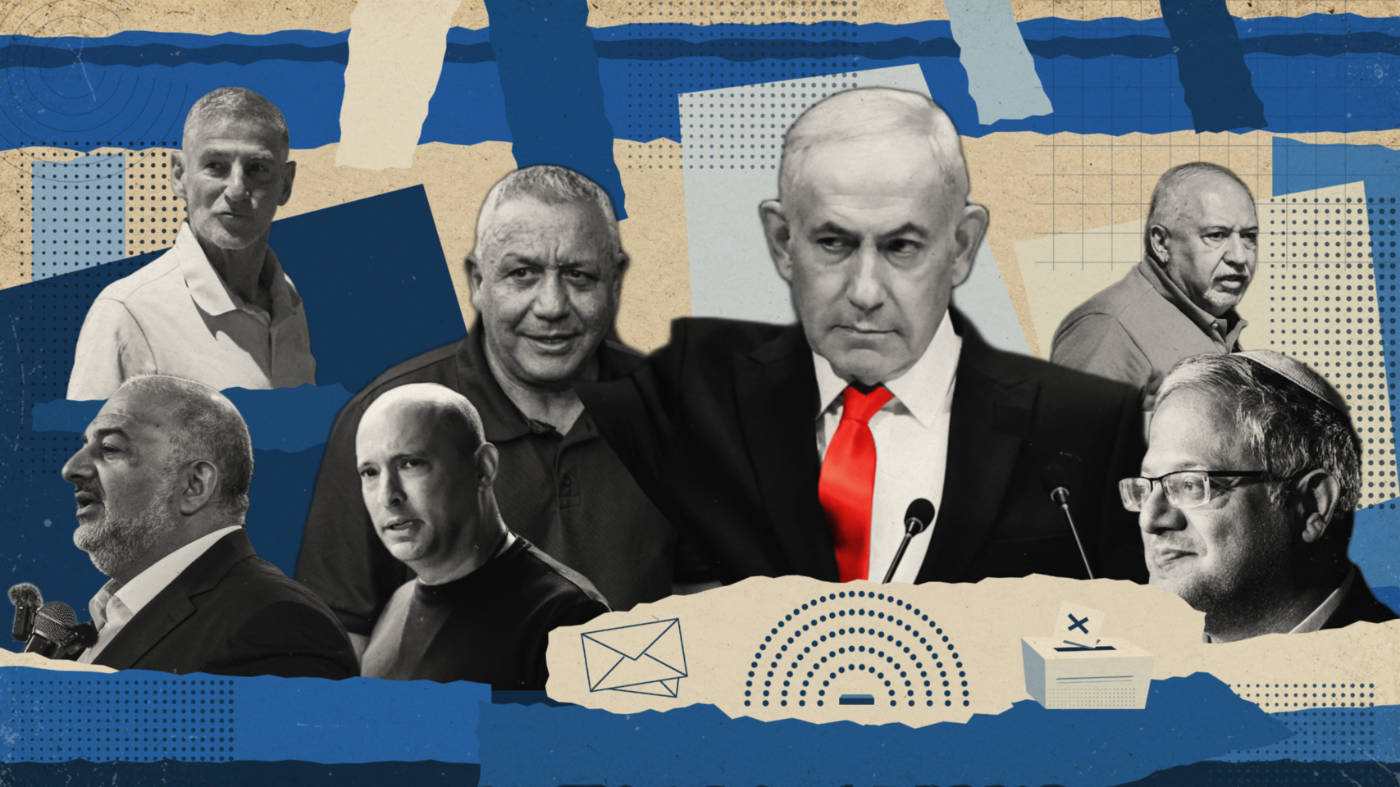
The Israeli election on 27 October is one of the most important in the country’s history, the first since 2022 and the Hamas-led attacks of 2023, the genocide in Gaza and the war on Iran. Prime Minister Benjamin Netanyahu, Israel’s longest-serving premier and now seeking a seventh term, faces wide criticism for his handling of the wars, which have isolated Israel internationally. Other issues facing Israelis include the security of the occupied West Bank, including the growth of settlements, and compulsory military conscription for ultra-Orthodox communities. Israel uses proportional representation to elect 120 members to the Knesset, although no single party since the nation was founded in 1948 has won a 61-seat majority. Instead, politicians and parties cut deals and form coalitions to win power. The anti-Netanyahu Change bloc, for example, led by front-runner Gadi Eisenkot, includes ex-PM Naftali Bennett (B’Yachad) and former deputy prime minister Avigdor Liberman (Yisrael Beiteinu) among others. New MEE newsletter: Jerusalem Dispatch Sign up to get the latest insights and analysis on Israel-Palestine, alongside Turkey Unpacked and other MEE newsletters Polls at the time of writing forecast a deadlock. Netanyahu or his rivals will need to once again reach out to smaller parties, such as those backed by ultra-Orthodox voters or the Israeli far right, to form a government. Millions of Palestinians in the West Bank, East Jerusalem and Gaza, occupied by Israel for nearly 60 years, do not have Israeli citizenship and so cannot vote, in contrast to Israeli settlers living in the occupied territories. Arab parties that draw support from the two million-plus Palestinians living inside Israel were initially banned from entering the race in September, before the ban was overturned earlier this month. Arab voter turnout in national elections is usually below average amid boycotts. But for this election, more Palestinian citizens of Israel are predicted to vote than usual according to polls, with the Palestinian-led Joint List expecting 70 percent voter turnout. These are the main candidates and their parties. Benjamin Netanyahu / Likud Current seats: 32/120 Netanyahu, first elected in 1996 and prime minister for 20 of the last 30 years, faces his toughest election yet. His career has been built on hawkish stances against Israel’s enemies, expanding West Bank settlements and blocking Palestinian statehood. His current government, in power since 2022, is the most right-wing in Israeli history and has overseen genocide and war crimes in Gaza, for which Netanyahu faces an arrest warrant from the International Criminal Court. Israeli Prime Minister Benjamin Netanyahu delivers a speech to members of the Likud party in Tel Aviv on 17 September 2026 (AFP) Many Israelis have questioned his decisions leading up to 7 October 2023, including playing off Hamas against Fatah to weaken the Palestine Authority; also whether he ignored warnings of the attack which killed 1,200 people. Netanyahu opposes an official commission of inquiry. The Israeli-US war on Iran has failed to secure a decisive victory. Tens of thousands of Israelis are still displaced amid attacks from Hezbollah in Lebanon. Controversial proposals to weaken the judiciary have mostly been shelved amid protests. But Netanyahu and Likud (which translates as “The Gathering”) still retain strong support among many on the Israeli right, where they are seen as no-nonsense protectors of Israel who have pledged to disarm Hamas and maintain “security zones” in Lebanon. The government is also seeking to push ahead with the E1 settlement project east of Jerusalem, which will divide the West Bank, amid international condemnation. Gadi Eisenkot / Yashar Current seats: New party Gadi Eisenkot, Netanyahu’s biggest rival, heads Yashar (“Honest” in Hebrew), the party he founded in September 2025. An ex-chief of staff in the military (2015 to 2019), Eisenkot, 66, has served in the Knesset since 2022 but has limited ministerial experience save eight months in the emergency government formed after 7 October. Gadi Eisenkot (centre) holds a meet-and-greet at a coffee shop in Jerusalem on 12 August 2026 (AFP) He is of Moroccan Jewish heritage and, if elected, would be Israel’s first Mizrahi prime minister. His upbringing in Eilat, far from the elite of Tel Aviv and Jerusalem, and his faltering English, have added to his image as a political outsider. Many Palestinians and human rights campaigners question Eisenkot’s military past: during Israel’s 2006 invasion of Lebanon, he formulated the Dahieh Doctrine, which advocated “disproportionate force” in civilian areas to deter attacks. A self-styled moderate, Eisenkot has been critical of aspects of Netanyahu’s approach on Gaza, not least the long-stalled hostage talks. His personal story is well-known to many Israelis: Eisenkot’s son, Gal, and two of his nephews were killed in Gaza in 2023 and 2024, with Gal’s funeral broadcast on national TV. Eisenkot opposes the two-state solution, which he says is unviable after 7 October, and the formal annexation of the West Bank, which he says will only worsen security. Leading the polls, he has become the unofficial leader of the Change bloc but will likely need more parliamentary partners to govern. He has said that allies will need to agree that Israel is a Jewish and democratic state; that military service must be universal; and that Hamas is a terrorist organisation that must be dismantled. While Eisenkot has rejected the option of relying on the Palestinian parties, he also vowed to form a government "even if we don't have 61 seats". This, coupled with statements from some of the Palestinian parties, is seen as indicating there may be options for some form of cooperation. His conditions about military service likely rules out partnering with ultra-Orthodox parties who want to keep the Haredim’s draft exemption. Itamar Ben-Gvir / Otzma Yehudit Current seats: 6/120 Once shunned as too extreme for mainstream politics, Otzma Yehudit (“Jewish Power”), led by Itamar Ben Gvir, has pulled Netanyahu’s government further to the right since 2022. In September it avoided a vote in Israel’s Central Election Committee to bar it from standing. Now it is likely to increase its seats. A kippah-bearing a portrait of Otzma Yehudit leader Itamar Ben Gvir, at a shop in Jerusalem on 4 October 2026 (AFP) It has heavy support from Israeli settlers, and it backs annexing the West Bank (Ben Gvir, 50, lives in the settlement of Kiryat Arba). Relations between Ben Gvir and Netanyahu have often been tense during the past two decades, with the Otzma Yehudit leader recently saying that the prime minister wants to form a government without him. A Knesset member since 2021, Ben Gvir became national security minister in 2022 when his party unexpectedly won seven seats, despite his criminal convictions for incitement to racism and support for terrorism. He has been sanctioned by the UK, France and others for backing the genocide in Gaza; led invasions of al-Aqsa mosque, over which he proclaims Jewish sovereignty; and taunted detained activists from the Global Sumud Flotilla. Otzma Yehudit advocates the “voluntary emigration” of Palestinians from Gaza; rallies draw chants of “death to Arabs”. In government, it has sponsored judicial reforms and the death penalty for Palestinians. Its junior ministers have discussed nuking Gaza. But Otzma Yehudit has tense relations with ultra-Orthodox communities because it backs universal conscription. Bezalel Smotrich / Religious Zionism Current seats: 7/120 Once a marginal extreme-right faction, the Religious Zionist Party (RZP) has ascended as a partner in the ruling coalition. It had a strong showing in 2022 amid an electoral pact with Otzma Yehudit, but the parties have now severed this to run as competitors, despite Netanyahu’s pleas for an alliance. Finance Minister Bezalel Smotrich arrives at the Israeli settlement of Maale Arugot in Gush Etzion, occupied West Bank on 2 September 2026 (AFP) Leader Bezalel Smotrich, 46, the son of an Orthodox rabbi, draws support from a more religious base than Ben Gvir, wants the implementation of Jewish law (halacha), and says Torah scripture has underpinned his strategy as finance minister since 2022. Smotrich also wants a judicial overhaul, the abolition of the Oslo Accords, the dismantlement of the Palestinian Authority, and the Israeli settlement of Gaza and the West Bank. He calls himself a “proud homophobe”. Like Ben Gvir, prosecutors at the ICC have sought warrants for Smotrich’s arrest for war crimes and crimes against humanity against Palestinians in the West Bank. RZP backs military conscription for ultra-Orthodox communities but, sitting alongside Haredi parties in Netanyahu’s fragile coalition, has voted for Haredi-backed laws, such as stopping arrests of Haredi draft dodgers. Naftali Bennett and Yair Lapid / Together Current seats: 24/120 Former prime ministers Naftali Bennett (2021-22) and Yair Lapid (July-December 2022) announced a joint ticket in April, later named B'Yachad (“Together”). Bennett will be prime minister if the party wins. The pair unseated Netanyahu in 2021 amid an on-off political partnership that has lasted more than a decade. Yair Lapid, left, and Naftali Bennett hold their inaugural conference of their "Together - Under Bennett's Leadership" party in Tel Aviv, Israel, on 12 May 2026 (AFP) Bennett, 54, sits on the right, is a longtime opponent of Palestinian statehood and ex-leader of The Yesha Council that represents West Bank settlers. A software multimillionaire, he was Netanyahu’s chief of staff from 2006 to 2008, when they fell out. Lapid, already known as a TV host and writer, founded Yesh Atid (“There is a Future”) in 2012. A secular centrist, he opposes Palestinian statehood and, like many Jewish politicians, supports the settler movement in principle, while distancing himself from Ben Gvir and Smotrich. In April, Lapid, 62, said: “Bennett is a clear right-winger, but he is a liberal, decent, law-abiding right-winger, who did not sell his values - neither to Haredi extortion nor to corruption.” Both men oppose the ultra-Orthodox draft exemption and have pledged a commission of inquiry into 7 October. Yair Golan / The Democrats Current seats: 4/120 The centre-left Democrats, who regard themselves as a “liberal-democratic Zionist party”, formed in 2024 from the Labor Party and the smaller Meretz. They are led by Yair Golan, 64, one of the few Israeli politicians to criticise the killing of Palestinians in Gaza, calling it a “national psychosis”. The Democrats leader Yair Golan meets with potential voters in Tel Aviv, Israel, on 24 September 2026 (AFP) Amid a massive backlash, he has qualified that he blames the government, not the military. He was deputy chief of staff from 2014 to 2017, re-enlisted on 7 October and is credited with saving several Israelis amid the Hamas-led attacks, for which many Israelis regard him as a war hero. The Democrats have led protests against judicial reforms, oppose annexing the West Bank, and back the two-state solution. They have an Arab candidate in Soumaya Bashir, and are the only major party to openly support joining Arab parties in a coalition. Avigdor Lieberman / Yisrael Beiteinu Current seats: 6/120 The right-wing Yisrael Beiteunu (“Our Home”), which relies on Israel’s 1.5 million Russian speakers for support, has been led since 1998 by its founder, Avigdor Lieberman, 68, an emigre from Soviet-era eastern Europe. The party has never finished higher than third, but has been in coalition with seven of the last 10 governments. Avigdor Lieberman, centre, in Tel Aviv, Israel, on 26 September 2026 (AFP) Yisrael Beiteinu backs universal conscription, the expansion of settlements and tougher stances against Iran, Hamas and Hezbollah. Lieberman has held all the key cabinet roles, including deputy prime minister (2009 - 2012). He has faced probes over alleged corruption, allegations of an assasination plot, and was convicted of physically assaulting a 12-year-old boy in 2001. Known for his brash statements, he was an ally of Netanyahu and served under him in his first term. But their relationship is rocky and Yisrael Beiteinu is now outside Netanyahu’s ruling coalition. Lieberman claims he warned Netanyahu and Eisenkot of a potential Hamas attack ahead of 7 October. The Joint List Current seats: 5/120 Three of Israel’s four major Arab-led parties, Hadash, Ta’al and Balad, are standing together as the Joint List, led by Hadash leader Yousef Jabareen, 54. Avigdor Lieberman, centre, in Tel Aviv, Israel, on 26 September 2026 (AFP) WRONG CAPTION The Central Electoral Committee banned the parties from participating in September amid claims that they denied Israel’s existence as a Jewish and democratic state, before that was overturned by the Supreme Court on 2 October. (Balad leader Sami Abu Shehadeh has dropped out of the election after the court signalled it would uphold the ban against him for an article he wrote regarded as celebrating the Hamas attacks). All three parties, which are secular, want greater rights for Palestinians in Israel, especially when it comes to crime and policing, condemn Israeli conduct in Gaza and settlements in the West Bank and supports a two-state solution. Jabareen said recently in a clear message to the Change Bloc: “Removing the threat called the Netanyahu-Ben Gvir-Smotrich government is our central goal, and we will act in every possible way to send this criminal government home." But past attempts within the List to present a unified front have collapsed over ideology. Hadash, led by Ayman Odeh until his retirement in May, includes communist and left-wing groups that back Arab and Jewish candidates, including draft refuser Ofer Cassif. Ta’al, led by Ahmad Tibi is regarded as a moderate Arab nationalist party. Balad has proposed a Jewish candidate. The Joint List hopes to gain enough seats to be a powerbroker in the Knesset, although none of its members have ever been invited to form a coalition. Most Jewish-led parties say they will not work with it. Mansour Abbas / Ra’am Current seats: 5/120 Ra’am (the Hebrew acronym for the United Arab List), is led by Palestinian citizen of Israel, Mansour Abbas, 52. It is the only Arab-led party to have served in government, during the short-lived Bennett-Lapid coalition from 2021-22. Alongside the Joint List, it was banned in September, before that decision was overturned. Leader of the Palestinian Israeli party Ra'am Mansour Abbas campaigns in Ka'abiyye-Tabbash-Hajajre, Israel, on 26 September 2026 (AFP) Rooted in political Islam, Ra’am is socially conservative, and criticises Israeli conduct in Gaza and illegal settlements in the West Bank. But it has more moderate stances toward Israel than other Arab-led parties and is seen by many Jewish Israelis as preferable to the Joint List. Abbas’ demands from potential Jewish partners include prioritising the civil rights of Palestinian citizens of Israel instead of the Palestinians in the occupied territories. For the first time it has put forward a Jewish candidate, former police chief and Yesh Atid lawmaker Yoav Segalovitz. Aryeh Deri / Shas Current seats: 11/120 Two parties draw strong support from the Haredim, Israel’s ultra-Orthodox Jews, who make up around 14 percent of Israel’s population. Each believes religious authority should govern politics and play a more decisive role in political life. Israeli Prime Minister Benjamin Netanyahu, left, and Aryeh Deri, of the Shas party at the Knesset, Jerusalem, in May 2023 (AFP) Shas is the bigger of the two, backed principally by Sephardic and Mizrahi ultra-Orthodox. It has sat in seven of the last 10 Israeli governments and is part of the ruling coalition. In recent years it has moved further to the right, aligning itself with Ben Gvir. The party is chaired in the Knesset by rabbi Aryeh Deri, 67, who has had 10 ministerial roles since the 1980s. He served two years in prison for taking bribes in the early 2000s. Shas is focused on protecting Torah study and the rights of its ultra-conservative voter base. In government, it has demanded funding for Haredi institutions and welfare benefits: more than half of the Haredim do not work, prioritising Torah study. In exchange, it has voted with Netanyahu on issues such as the genocide in Gaza and West Bank expansion. Shas ministers quit the cabinet in 2025 over Netanyahu’s plans to end Haredim military exemption, although continued to back him on other key issues. Yaakov Asher / United Torah Judaism Current seats: 7/120 United Torah Judaism (UTJ) is heavily backed by Ashkenazi branches of Judaism and is itself a union between two groups that occasionally fall out: the Hasidic Agudat Yisrael and the Lithuanian Degel HaTorah. It is chaired in the Knesset by Yaakov Asher, although its ultimate authorities are more senior rabbis. The UTJ is chaired in the Knesset by Yaakov Asher, although its ultimate authorities are more senior rabbis (Creative Commons). Like Shas, its priorities centre around preserving ultra-Orthodox life. Although many of the party’s voters live in settlements, the party is officially not Zionist, instead believing that a Jewish state should only be established after the Messiah arrives. Some rabbis from the party have criticised the war on Gaza, citing the deaths of Israeli soldiers. But it is conscription that has all but undone the party’s alliance with Netanyahu. In May, UTJ pulled support and called for the collapse of the government after it failed to pass laws securing their military exemption. It had done so previously in 2025, though continued voting with Netanyahu on key decisions. The party now reportedly sees Eisenkot as a preferred coalition partner to Netanyahu.
Israel’s 2026 election: Who are the main leaders and where do they stand on the key issues?
Full Article
Original Source
Read the full article at Middleeasteye →KhanList aggregates and links to publicly available news content. We do not host full articles from third-party sources. Always verify important information with original sources.