
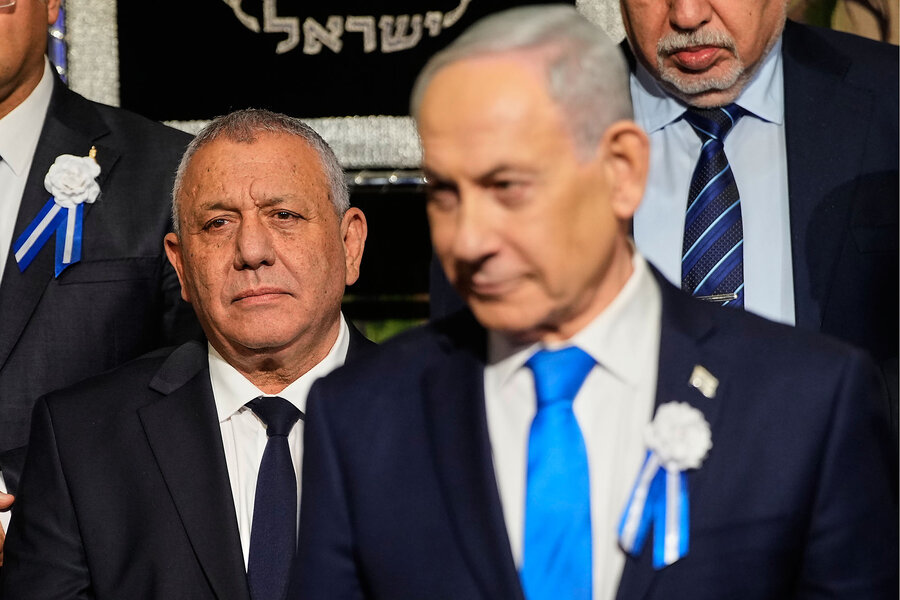
Jerusalem | Nov. 16, 2026, 5:13 p.m. ET | 5 min read Four Israelis are sinking in a swamp when a dashing man in a fedora appears and offers to throw them a rope.“Are you an Arab?” one asks.“Yes, an Arab,” he replies. “Yalla, you’re sinking, no time to waste. Grab the rope.” They hem and haw. “Next time you come to save us from sinking in a swamp, above all, don’t be an Arab,” one eventually responds before all four are pulled under the water. This recent skit from Israel’s long-running sketch comedy show “Zehu Ze!” highlighted an issue that many Israelis are thinking about right now. Indeed, after October’s inconclusive elections, Yashar party leader Gadi Eisenkot – and the country as a whole – is facing a defining choice: whether to seize a potential lifeline being offered by Arab lawmakers in parliament.Mr. Eisenkot was tasked last week with forming a new government. The good news for him is that the majority in Israel’s 120-seat parliament oppose Prime Minister Benjamin Netanyahu. Six different opposition parties – which range from a small Islamist faction to a hawkish secular party – won a total of 67 seats, compared with 53 for Mr. Netanyahu and his allies. But in a country riven by ideological fault lines, the political arithmetic doesn’t necessarily add up to a goverment with a majority in parliament.“Majority chose change”One of Mr. Eisenkot’s options is to form a minority government with help from Israel’s two main Arab parties. The Islamist Ra’am party could potentially be part of the coalition government, while the Joint List would provide vote support from the outside. Both parties benefited from high turnout in Arab towns and cities, and won an unprecedented 19 combined seats in the new parliament. If Mr. Eisenkot takes this path, it could herald a new era of Jewish-Arab cooperation in Israel. Banners in support of such a move fluttering from overpasses along the length of Route 6, Israel’s main north-south highway, proclaim “the majority chose change” and “embarking on a new path together” in Hebrew and Arabic. Advocates point to the fruitful integration of Arab citizens in high-tech, education, and healthcare.Nasim al-Gergawi, an Arab citizen who lives in southern Israel, says it’s time for that kind of cooperation to extend into the Knesset, Israel’s parliament. Hamas gunmen killed Mr. Gergawi’s cousin Sami, a minivan driver, in the attack on southern Israel on Oct. 7, 2023.“Even though he said, ‘I am an Arab,’ and recited something from the Quran, it didn’t matter to them,” because Sami was an Israeli citizen, says Mr. Gergawi. “Now, suddenly we’re – pardon the expression – second-class Arabs that can’t be in the government? Can’t be part of the state? That’s absurd. Truly, I can’t understand it.” Jamal Awad/ReutersYousef Jabareen of the Joint List party reacts to exit polls during Israel’s national elections, at the party's election headquarters in Nazareth in northern Israel, Oct. 27, 2026. Attitudes are shifting about Arab parties joining a government, something long considered anathema in Israeli politics until Ra’am broke that glass ceiling in 2021. Among Israelis who voted for the parties in Mr. Eisenkot’s “change coalition,” 59% supported the formation of a minority government with the help of Arab members of parliament, according to a public opinion poll conducted this month by Hebrew University’s aChord Center. Just 26% of respondents said they preferred that Mr. Eisenkot form a unity government with Mr. Netanyahu’s Likud.“I think a real attempt to have that kind of breakthrough is going to be underway, and I think it has huge implications for how Israel and Israelis view themselves and how Israel is viewed around the world as well,” says venture capitalist Erel Margalit, a former Labor party lawmaker. “It’s time to have a much broader political collaboration.”Danny Citrinowicz, a senior fellow at the Institute for National Security Studies, made the point in a social media post. Including Ra’am and the Joint List in a governing coalition, he wrote, would be “a historic turning point in relations between the State of Israel and its Arab citizens,” and would also strengthen its ability to respond to international criticism at a key juncture. Excluding them simply because they’re Arab “would reinforce some of the most damaging accusations made against Israel, particularly regarding its discrimination and the unequal political standing of its Arab citizens,” Mr. Citrinowicz said. SOURCE: Israeli Central Elections Committee | Jacob Turcotte/Staff But while many Israelis back such a move, others do not. And that includes key members of Mr. Eisenkot’s alliance. They have reservations about a government that would rely upon Ra’am and the Joint List. The Joint List includes lawmakers from avowedly anti-Zionist factions, such as Israel’s Communist party and the Palestinian nationalist Balad party, who reject Israel’s identity as a Jewish state.“Most of the Arabs are part of the struggle against Israel, to destroy Israel unequivocally,” says Avi Farhan, a former Gaza Strip settler. He had traveled to Jerusalem from his home near Haifa with a large placard calling on Mr. Eisenkot and Mr. Netanyahu to set aside their differences and form “an emergency Zionist government” without the Arab parties.“Today the nation needs unity in order to contend with the internal and external problems, including in Europe and the United States with antisemitism,” Mr. Farhan says, heading to a demonstration outside parliament.Differing views from the oppositionAvigdor Liberman, head of the hawkish Yisrael Beytenu party, has vowed not to join a government that depends on Ra’am and the Joint List. Mr. Eisenkot would need Mr. Liberman to ditch that promise if the opposition coalition wants to build a majority with those 67 seats. Yossi Shain, a professor of political science at Tel Aviv University and a former member of parliament with Yisrael Beytenu, says, “There’s a fear that you’re becoming completely hostage, in a sense, to political parties that are with you only in terms of expediency rather than sharing your agenda.”The concern is that in the event of a military operation or national security crisis, Professor Shain says of the Arab parties, “they can bring the government down.”“There’s a devil’s choice to be made by the change bloc,” says Alan Abbey, a research fellow at the Shalom Hartman Institute, a Jerusalem think tank. After three years of war, “there is a fear, and it’s not rational, and it’s not fair, and it’s not defensible,” about Arab parties joining the government, Mr. Abbey says. “We are all very much on edge, whether our politics are right, center, or left. And as much as people of the center have goodwill, and want to see a successful, peaceful Israel, there is just something hanging in the back of our heads that the Arab Palestinian Israelis are worrisome,” he says. Deepen your worldviewwith Monitor Highlights.Politics with respectGet political stories with respectful analysis.There‘s a world of new ideas in everyBooks newsletter.There‘s more to life, enrich yours withCulture & Learning weekly.Follow humanity‘s discoveries withScience & Nature stories in your inbox.Gain a spiritual perspectivefrom the stories in your inbox.Want to understand the deeper impact of critical events? Learn the Monitor‘s insight.Already a subscriber? Log in to hide ads. Rutie Guter, a social worker in Jerusalem who voted for the left-leaning Democrats in the Oct. 27 elections, says she is willing to accept Ra’am in the government, though was circumspect about the Joint List because of its politics. Nonetheless, she says Mr. Netanyahu has fueled fear, division, and hate, and that he cannot continue to serve as prime minister.“I completely understand the fear that people are coming from, and it’s valid,” she says. “But I think we can’t live our lives out of fear.” ALREADY A SUBSCRIBER? LoginReal news can be honest, hopeful, credible, constructive.The Christian Science Monitor was founded in 1908 to lift the standard of journalism and uplift humanity. We aim to “speak the truth in love.” Our goal is not to tell you what to think, but to give you the essential knowledge and understanding to come to your own intelligent conclusions. Join us in this mission by subscribing.
Israelis voted for change. Can Gadi Eisenkot deliver?
Full Article
Original Source
Read the full article at Csmonitor →KhanList aggregates and links to publicly available news content. We do not host full articles from third-party sources. Always verify important information with original sources.