
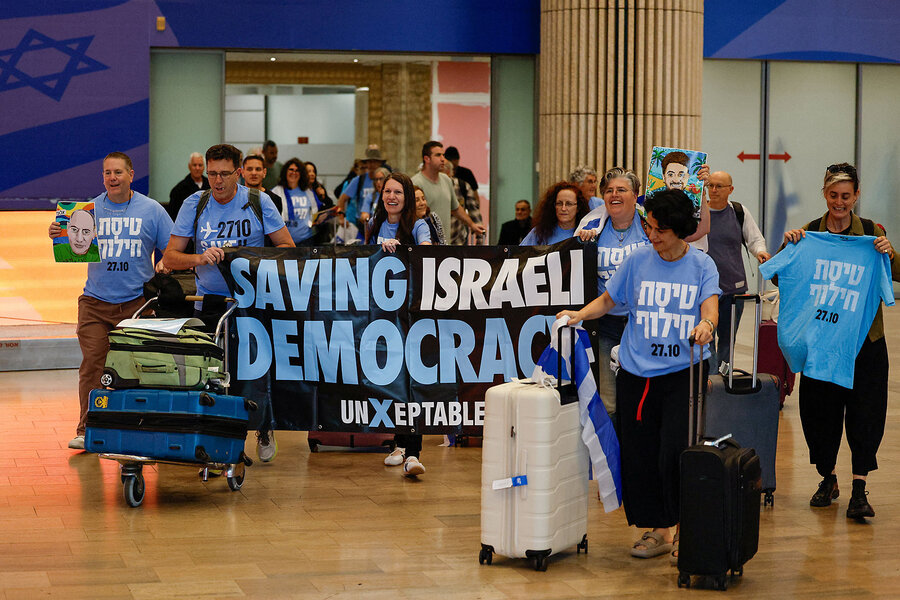
Haifa and Tel Aviv, Israel | Oct. 27, 2026, 5:00 a.m. ET | 4 min read To cast a ballot in Israel’s pivotal elections Tuesday, Shai Schoenfeld had to fly home.But unlike most Israeli expatriates, his return voyage was a 10,000-mile, 30-plus-hour odyssey from a remote sheep station in the Australian outback to his village in the Galilee, in northern Israel.His transit from Down Under put him in rare company among the tens of thousands of Israelis returning to the country from around the globe to vote in parliamentary elections widely regarded as critical for the Jewish state’s future. “I’m doing this 99% out of fear,” says the 20-something Mr. Schoenfeld, who will be participating in his second national election. It is “probably the most important election we’ve ever had as a country.”The length of his travels is a barometer for the importance he places on this election.From the ranch near Tarcoola, in southern Australia, where he’d been working in recent months, he drove eight hours to the southern city of Adelaide to catch a two-hour flight to Sydney. There he boarded a 14.5-hour flight to Abu Dhabi and then another three-hour flight to Tel Aviv, before driving two hours home to the village of Kfar Hananya. “The whole world is about to boycott us. We’ve failed in every battlefront – I feel like we’ve failed – and just the people on both sides, to be honest, are suffering. And I think it’s time for a change,” Mr. Schoenfeld says. Courtesy of Shai SchoenfeldShai Schoenfeld holds a sheep at a farm where he works near Tarcoola, Australia. He traveled 10,000 miles from this remote sheep station in Australia to Israel to vote in Tuesday's election. Tuesday’s contest is expected to be a tight race pitting Benjamin Netanyahu and his religious and ultranationalist allies against a coalition led by Gadi Eisenkot, a former military chief of staff, that seeks to unseat Israel’s longest serving prime minister. The vote is widely perceived to be a referendum on the country’s future, and on Mr. Netanyahu’s fitness to serve as prime minister after Hamas’ Oct. 7 attacks and the subsequent wars in Gaza, Lebanon, and Iran.The final preelection polls published Friday suggest that neither Mr. Netanyahu’s nor Mr. Eisenkot’s bloc will win an outright majority. With few swing voters in this highly polarized country, the final results will largely hinge on voter turnout.Israel doesn’t allow absentee voting. Aside from diplomatic delegations, eligible voters living abroad must fly back to Israel to exercise their democratic right.The number of Israelis returning from abroad to vote is tough to nail down precisely, but AID Coalition, a U.S.-based nongovernmental organization advocating for overseas Israelis to vote, estimated that around 67,000 people were flying to Israel to participate in the elections.Ron, an Israeli citizen living in New York, says he hasn’t voted in Israel since the 2003 elections. Outraged by the Netanyahu government’s attempt to defang the country’s judiciary, which led to massive pro-democracy demonstrations in Israel in the months before the Hamas attack, he bought a ticket in July after seeing an AID Coalition advertisement on social media. “I choose not to take the risk of losing the country, and having it potentially become a pariah state,” Ron says. He asked to be identified only by his first name because he conducts business extensively in the Muslim world, including states with which Israel does not have formal diplomatic relations. “If I want to protect that future, then I’d better show up to vote when it’s most critical.” Courtesy of Offir GutelzonOffir Gutelzon waits for his flight to board at the San Francisco airport, Oct. 25, 2026. He flew to Israel with a group of Israelis who live in the Bay Area, many of whom are voting for opposition parties. Like him, many returning voters are motivated by a desire to end Mr. Netanyahu’s 19 years in office. On Sunday, Offir Gutelzon boarded a 15-hour flight from San Francisco to Tel Aviv. He and dozens of other passengers – many of them fellow high-tech employees living in the Bay Area – wore identical T-shirts that read “Flight for Change,” as they arrived at Ben Gurion International Airport.“Israel is the homeland of all the Jewish people, and I find myself a representative on behalf of all Jewish people since I have the privilege to vote,” says Mr. Gutelzon, a co-founder of the Israeli-American pro-democracy group UnXeptable. The group has organized protests against Mr. Netanyahu’s government and its planned overhaul of the country’s judiciary since 2023.“I am doing it for my family in Israel, to help keep Israel Jewish and democratic,” he says, and to prevent it from becoming a “messianic theocracy.”Mr. Gutelzon says the influx of determined voters reminds him of the waves of Israelis who returned from abroad to join their military units after the surprise outbreak of the 1973 Mideast war, or in the aftermath of the Oct. 7 attack.But, Mr. Gutelzon notes, the flood of Israelis returning home for this vote is on a much larger scale. Deepen your worldviewwith Monitor Highlights.Politics with respectGet political stories with respectful analysis.There‘s a world of new ideas in everyBooks newsletter.There‘s more to life, enrich yours withCulture & Learning weekly.Follow humanity‘s discoveries withScience & Nature stories in your inbox.Gain a spiritual perspectivefrom the stories in your inbox.Want to understand the deeper impact of critical events? Learn the Monitor‘s insight.Already a subscriber? Log in to hide ads. In the terminal at Fiumicino Airport in Rome, Daniel and Ariela Icekson wait for their connecting flight to Tel Aviv. They had left their home near Boston to vote against Mr. Netanyahu.“These are the most fateful elections in Israeli history, the last chance to bring change,” says Mr. Icekson. Referring to Mr. Netanyahu by his nickname, he says it may be “the last chance to overthrow Bibi.” ALREADY A SUBSCRIBER? LoginReal news can be honest, hopeful, credible, constructive.The Christian Science Monitor was founded in 1908 to lift the standard of journalism and uplift humanity. We aim to “speak the truth in love.” Our goal is not to tell you what to think, but to give you the essential knowledge and understanding to come to your own intelligent conclusions. Join us in this mission by subscribing.
Israelis abroad flock home for ‘most important election we’ve ever had’
Full Article
Original Source
Read the full article at Csmonitor →KhanList aggregates and links to publicly available news content. We do not host full articles from third-party sources. Always verify important information with original sources.