
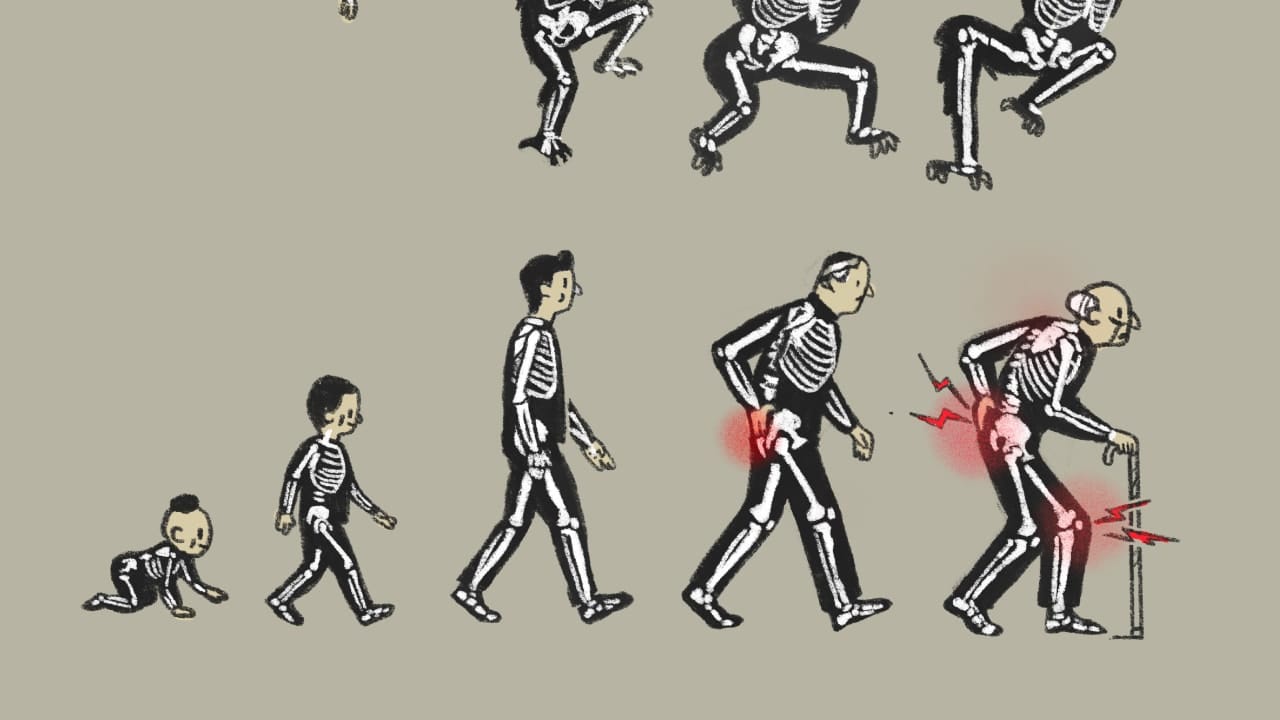
NOVEMBER 14, 2026 12:48If you suffer from a chronic joint disease such as osteoarthritis, you may be overweight and put a burden on your knees. But you can also blame evolution and envy chimpanzees and gorillas, which are almost always exempt from this painful and debilitating condition.Associate Prof. David Gokhman of the Weizmann Institute of Science in Rehovot has just conducted a study of the problem in collaboration with the lab of Dr. Fumitaka Inoue of Kyoto University in Japan.He and his team, led by doctoral students Nadav Mishol from Gokhman’s lab and Yizhi Yan from Inoue’s lab, have just published their findings in the prestigious journal Nature, titled “The gene-regulatory evolution of the human skeleton.”“That shift made our joints less effective at absorbing shocks and exposed us to skeletal diseases – including osteoarthritis, degeneration of the spinal discs, and herniated discs – that are uncommon in other great apes, including those that reach old age.“Even chimps that live into their 60s or 70s, for example, are almost as agile as younger ones while climbing trees,” Gokhman, a molecular geneticist, told The Jerusalem Post in an interview.FROM LEFT: Dr. David Gokhman, Noam Priel, and Nadav Mishol. (credit: WEIZMANN INSTITUTE OF SCIENCE)At first glance, “We seem to have struck a poor evolutionary bargain. Natural selection is supposed to weed out harmful traits, so why are we so much more prone to wear-and-tear disorders of the joints and spine than our cousins?” he continued.“Osteoarthritis, for example, a major cause of disability and reduced quality of life, affects hundreds of millions worldwide.”The researchers proposed an answer based on hybrid human-chimpanzee cells and other advanced techniques. They reveal that painful joints may be a hidden price we pay for traits that make us human.“Unlike the joints of other great apes, whose composition hasn’t changed for millions of years, human joints underwent a dramatic evolutionary shift,” Gokhman added.He said he chose to look at the skeleton because it has been the major source of knowledge about how our species evolved. “It also reflects many of the features that distinguish us from other great apes – including our upright walking, slender bones, and long legs,” he explained.Cartilage cells release enormous quantities of molecules called glycosaminoglycans (GAGs) into the space around them.“GAGs, along with the water they hold, make up most of the cartilage,” Mishol added. “Cartilage cells are like tiny islands floating in an ocean of GAGs filling the joint.”The reduction in GAG content was found in all eight joints they studied, including hips, elbows, shoulders, wrists, and finger joints, so “apparently it was the same in the whole body,” Gokhman said.“We saw differences among the youngest specimens, at 20 or 30, so we believe it was present even at birth. Human cartilage is thinner, stable, and strong, so there is a benefit.“GAG molecules attract and retain water because both are polar, with a minus charge on one end and a plus on the other end, like with a magnet, and this makes the cartilage more resilient, creating a dense, gel-like network that behaves like a shock absorber.”The team mapped about half a million single-letter mutations that set human DNA apart from that of chimpanzees, but they discovered that the vast majority of them had little or no effect on the genome’s function.They therefore focused on the small fraction of mutations – around 3% – that actually changed gene activity in the course of human skeletal development.They then built the first comprehensive atlas of genomic regulatory features that distinguished the human skeleton from those of our closest living relatives and explained the function of each mutation that made possible the humans’ upright posture and other distinctively human skeletal features, they said.To arrive at this result, the researchers developed in Inoue’s lab a “massively parallel reporter assay,” which attaches tiny genetic barcodes that determine changes in gene activity to thousands of DNA segments at once.They also used hybrid human-chimpanzee or human-gorilla stem cells. “This sounds stranger than it really is.”In practice, the approach, which Gokhman developed during his postdoctoral work at Stanford University in California, where he met the Japanese researchers and which he later refined at Weizmann, makes it possible for the human genome and that of another great ape to operate inside the same cell, under identical conditions.They forced these stem cells to mature into skeletal cells to identify skeleton-related genes whose activity differs between humans and chimpanzees or gorillas.“Evolution thus produced a human being capable of walking upright, running long distances, developing an extraordinary brain and living much longer than most other mammals,” said Gokhman.“Yet we suffer from degenerative joint diseases that appear to be much less common in our closest evolutionary relatives. We have paid a biological price for becoming human.“Female’s hips are narrower, making it more painful to give birth, and humans live longer lives, which can lead to more chronic diseases. Having smaller jaws can lead to orthodontic problems, including crooked teeth and chewing difficulties.”The reduction in GAG production took several million years, and the mutation probably happened very quickly. It took the team five years to conduct their study.The Japanese researchers identified 15,077 regulatory elements with human-specific activity. A few hundred of them were involved in the GAG pathway. The Israelis did the analysis.Asked why evolution would give humans weaker joints, Gokhman said: “If there is less GAG, the brain develops more slowly over 20 years, but we pay for this in our skeletons. In a wolf, for example, it takes only two years.”The team suggested that early humans evolved for endurance running and long-distance hunting. Reduced cartilage cushioning actually improved running efficiency.On the path to better treatmentCompared with other great apes, humans have lighter, more slender bones, so fewer GAGs may have helped build this delicate skeleton.“That idea fits neatly with one of the leading hypotheses in human evolution – that our bodies were shaped for long-distance running. We may be relatively weak, and we cannot sprint as fast as many mammals, but we can keep moving for hours,” said Gokham.“This adaptation may have allowed early humans to pursue prey over long distances until the animals overheated and collapsed,” he suggested. “I myself hate to run, but when my father lived in Russia, he was an Olympic sprinter. Then he broke his wrist and had to stop; he suffers from this even today.”Gokhman believes that their discovery could eventually lead to better treatment of patients.“Already today, many hospital orthopedists give injections of GAGS, so maybe early treatment could help prevent the disability. Simple genetic testing can identify some people with cartilage degeneration; better ones will have to be developed. But we are far from using it for gene therapy.”Much larger GAG volume explains why other great apes tend not to develop osteoarthritis or other joint disorders, showing almost no signs of skeletal disease even as they age, unless their cartilage is severely damaged by trauma, he continued.Humans, by comparison, start life with much less cartilage, and what we do have is less effective at cushioning the joints.Since cartilage has almost no capacity to regenerate, decades of use gradually erode this already limited reserve, making joint disease much more likely later in life.If thinner cartilage is so problematic, why would evolution preserve it? One possible explanation involves the brain.Although GAGs are best known for their role in cartilage, they are also abundant in the brain and the rest of the nervous system, where they help stabilize connections between neurons.High levels of GAGs lock neural circuits into place, limiting the brain’s ability to keep rewiring itself.Lower GAG levels may have allowed the human brain to remain exceptionally malleable for much longer compared to other great apes, giving humans more time to learn, adapt, and acquire increasingly complex skills, he explained.Whether that trade-off was worth it is impossible to answer.“Millions of years after those traits took hold, humans have become a species capable of studying their own evolution using sophisticated tools. We also have remarkably bad knees,” Gokhman said.Follow us on Google
Israeli study finds why humans suffer from joint pain while other great apes stay agile
Full Article
Original Source
Read the full article at Jpost →KhanList aggregates and links to publicly available news content. We do not host full articles from third-party sources. Always verify important information with original sources.