
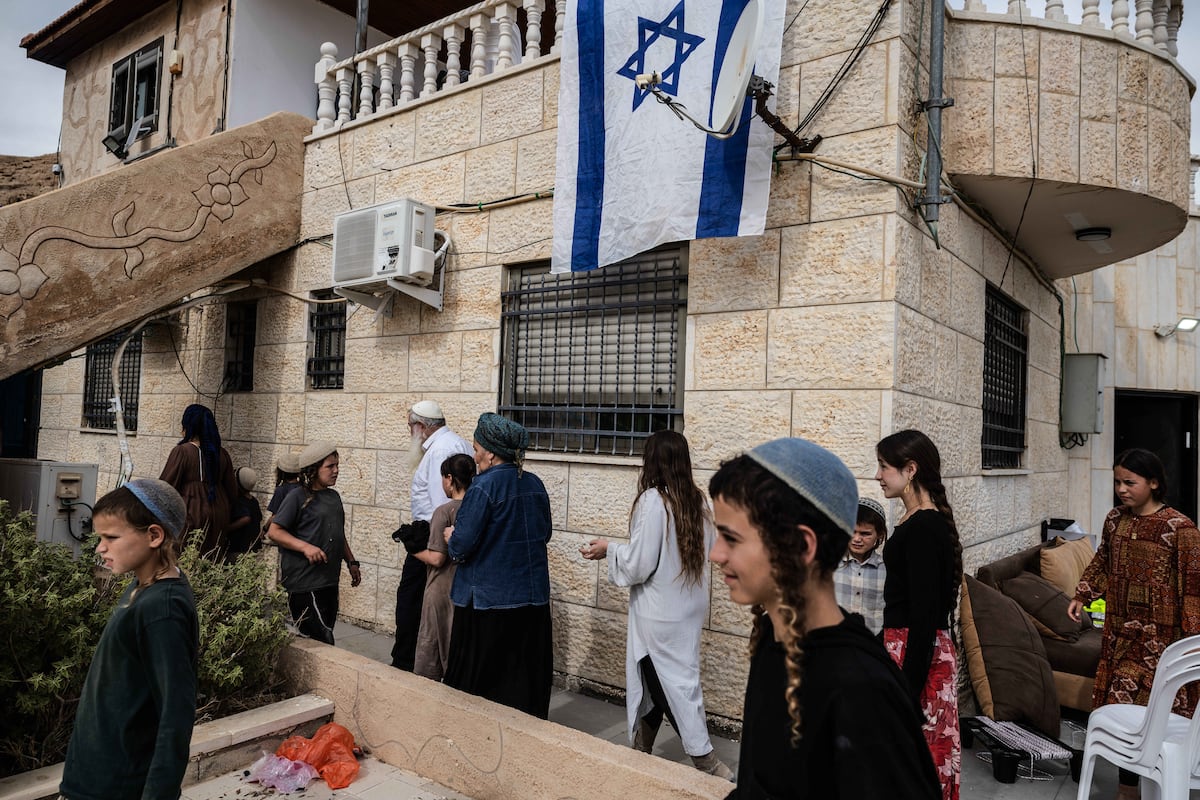
Ahmed Fheidat shows the bullet holes in the metal gate that gives access to his sister-in-law Fada’s house in Ein al Duyuk al Tahta. It is a neighborhood on the outskirts of the Palestinian city of Jericho that, for the past two weeks, has had new and unwanted neighbors: radical Israeli settlers who have just occupied eight houses about a five-minute walk away. The holes, he says, are from shots the settlers fired at him on Monday night when he was dragging Fada — 10 years older and bleeding from another gunshot wound — into the house. He recalls it with one leg bandaged, the result of the bullet that did hit him.His sister-in-law was not so lucky. A bullet to the head made her the first person killed in the latest drive by Israel’s settlement movement to push ever deeper into the West Bank and ever closer to its major cities, with Jericho the newest frontier. Settlers call it “erasing the lines” or “expanding the line of friction” with Palestinians. Here, on Wednesday, it leaves the two sides separated by only a few hundred meters: settlers encouraged by institutional support, and Palestinian women grieving for Fada in a dimly lit home.The new settlement, backed by Nachala, an organization that promotes Jewish settlement in Gaza, the West Bank, Lebanon and Syria, lies on the edge of Area C, the two-thirds of the West Bank under full Israeli control. This Wednesday, its newest residents demonstrated who really holds power by threatening a group of journalists and activists into leaving the vicinity of the occupied homes, wielding no legal authority other than that conferred by their weapons and the complicity of the Israeli soldiers watching the scene.“I’m an Israeli citizen. Why can’t I be here while you can?” one activist challenged a settler in Hebrew.“That’s for the soldiers to decide,” the settler replied, fully aware of which of the two would be driven away.Fada Fheidat died a few hundred meters from those houses. A stone’s throw away, but already in Area A of the West Bank, where the Palestinian National Authority formally holds administrative and security control, and where Israel prohibits its citizens from entering.Israeli authorities described the events as an attempted Palestinian “terror attack” by vehicle ramming. The army justified Fada’s death by saying a group of Palestinians was throwing stones at the Israelis and one of the settlers fired in self-defense. Four other Palestinians were wounded by gunfire, and no Israelis were arrested.Arafat, the victim’s son, was instead pulled from the ambulance by the army and arrested, Ahmed says. He is accused of the purported “terrorist” ramming. Locals insist he drove at high speed after learning his mother was being attacked and that the settlers were outside the car he struck. Three of them suffered minor injuries. The Israeli army has not released footage of the incident.Witnesses describe it as yet another provocation by the settlers, this time with a fatal outcome. Ahmed says several settlers insulted him on the main road, just a few dozen meters from the house, at a side street. “I said to him, ‘Shame on you. I’m 60 years old, you’re the age of my grandson, and you’re insulting me?’” He says they then tried to run over an 18-year-old relative, Abdala.The confrontation eventually spilled over to a nearby car wash, where more and more armed settlers began to gather. That was when the two brothers-in-law went to see what was happening. “They began shooting heavily […] I shouted at them in Hebrew: ‘Stop, we don’t want trouble,’” he recalls. When he heard people shouting, “They’ve killed Grandma!”, he turned toward Fada and put his hand on the back of her head — he recalls — “it was covered in blood.”No Palestinians opened fire. The settlers, by contrast, were carrying M16 rifles, pepper spray and bats, according to eyewitnesses.They have both long and short firearms because they are mobilized as local reserve units and live in an area where Israel allows civilians to obtain firearms permits. Some of their vehicles are also provided by the Ministry of Settlements and National Missions, headed by another far-right politician, Orit Strook, and by the World Zionist Organization.The Netanyahu government has also allocated 20 million shekels (about $6.1 million) to develop the Hasmonean palaces — dating from the first and second centuries BCE and adjacent to the new settlement — and in March issued a military order (theoretically reserved for urgent needs) to seize a strip of land that would allow access to the archaeological site without passing through Jericho, which is in Area A and home to about 20,000 Palestinians.One of Netanyahu’s ultranationalist ministers and the real strongman in the West Bank, Bezalel Smotrich, visited the settlers on Tuesday. He praised the “excellent work” of the soldiers protecting them, pledged to “continue strengthening settlement presence” and described the new colony as a kind of historical redress for the “damned Oslo Accords” (which granted Palestinians limited self-rule), noting that the first two places where the Palestinian flag flew were Jericho and Gaza. Najalá’s veteran president, Daniela Weiss, insisted on the importance of colonizing both territories: first Jericho, then Gaza.It is not just government support. The settlers entered the houses on November 4. They claim to have bought them, a claim under investigation by the Palestinian National Authority, which forbids such purchases. According to Haaretz, the head of the army’s Central Command, Avi Bluth (who was born and received his military training in a Jewish settlement), met with the group the day before. He instructed them not to inform local military commanders until after they had established themselves on the site.Bluth is the same officer responsible for operations in the West Bank who, in May, acknowledged during a private forum that the army was killing Palestinians “at a rate not seen since 1967,” when Israel occupied the territory during the Six-Day War. He also said that troops had opened fire on 42 Palestinians for throwing stones, but never on Jews who did the same because doing so would carry “serious social consequences.”For that reason, Yael Sela, an activist with the Palestinian Solidarity Cooperative, which organized the visit to the site together with the Israeli human rights group B’Tselem, describes the Jericho case as a “microcosm of the ethnic cleansing taking place in the West Bank,” because it contains all its elements. There is the “exploitation” of archaeology tied to Jewish history, given the proximity of the Hasmonean palaces; the seizure of territory; and “the cooperation between settlers and the army and the rest of the state’s arms.” “And now, the murder,” she says.Local residents stress the same point. The first killing occurred on Monday, but they say they have been subjected to constant harassment for months by a settlement farm, a newer form of settlement expansion that allows settlers to take control of larger tracts of land without requiring a large population. It was established in 2024 by prominent settler leader Hanan Herbst.Originally known as Havat Armonot, it was renamed Daya in April, when the Netanyahu government granted it legal status under Israeli law, along with around a hundred other outposts. Under international law, however, all Israeli settlements are considered illegal.DemolitionsThe problems began in February, when dozens of settlers attacked residents and, according to their accounts at the time, stole agricultural vehicles and cash. More significantly, they did something that, in theory, falls under the authority of the military: they demolished 13 homes with an excavator brought from Havat Armonot.Several houses in the area are under demolition orders. However, enforcement is the responsibility of a military body, the Civil Administration, and some of the orders had been frozen by the Supreme Court. Israel considers the structures illegal because they lack permits that Palestinians are rarely granted, even as it promotes and legalizes the construction and expansion of Jewish settlements in the same territory.That day, another far-right minister, Amihai Eliyahu, who heads the Heritage Ministry, posted a video on Facebook showing himself raising the Israeli flag over the ruins of the Hasmonean Palaces. “We will destroy everything that has been built on the heritage of the Jewish people […] Everyone knows this is our land,” he says in the video.Mohamed Salah says the name Hanan Herbst 18 times in eight minutes. He stresses that he does not know him personally and has nothing against him, sounding torn between conciliation and anger after being forced four months ago to move to Bethlehem, abandoning his home in Ein al Duyuk al-Tahta, fed up with settler harassment. “We reached a point where our children were in danger. They had stolen our house and broken the cameras [the surveillance systems],” he says. “Our lives have no value. Not even our presence here has value. Today, the Israeli army has no authority over Hanan. He is the law here.”Sign up for our weekly newsletter to get more English-language news coverage from EL PAÍS USA Edition
Israeli settlement drive reaches Jericho’s doorstep
Full Article
Original Source
Read the full article at English →KhanList aggregates and links to publicly available news content. We do not host full articles from third-party sources. Always verify important information with original sources.