
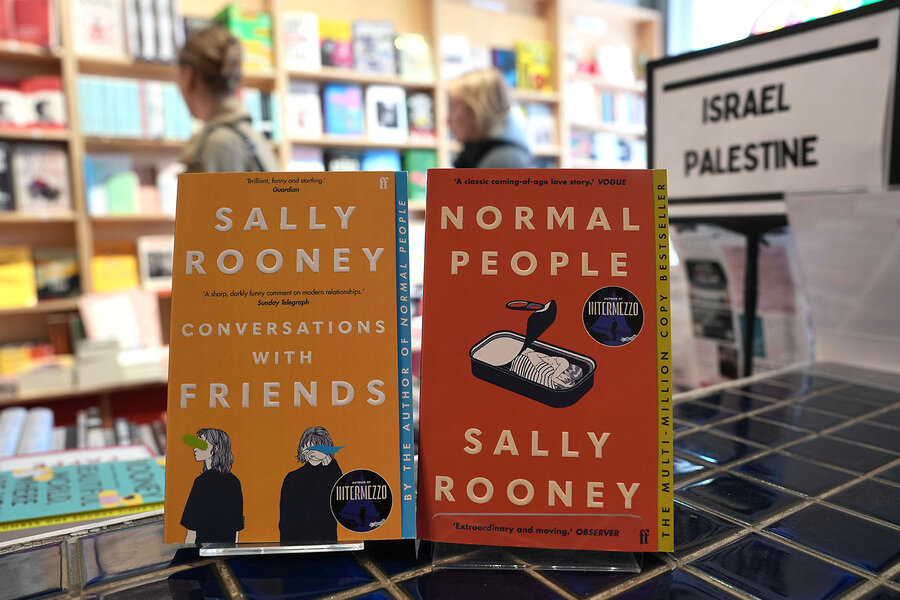
London | Nov. 03, 2026, 12:30 p.m. ET | 5 min read In the bookshops of central London, an odd thing is happening. Titles by a once ubiquitous prize-winning author are vanishing. In Hatchards, on Piccadilly, there is just one novel by Sally Rooney left. And staff members say they won’t order any more.It’s all because Ms. Rooney announced she is donating her royalties to the organization Palestine Action, which is proscribed as a terrorist group in the United Kingdom.That could make the Irish writer’s support a criminal offense. So, to avoid flouting the country’s terrorism laws, her publisher, Faber, is withdrawing her books from sale in the U.K. While some have dismissed the move as an instance of virtue-signaling by an author whose choices, they say, should be challenged, many others see it as the latest sign of increasing censorship in Western democracies. The controversy exposes a growing fault line in the arts over the Israeli-Palestinian conflict. As writers and musicians use their platforms to take political stands, publishers, booksellers, and promoters face difficult choices of their own over where legitimate political expression ends and prejudice begins – and whether the consequences of taking a stand do amount to censorship.At a time of intense polarization, the boundaries of acceptable expression are becoming increasingly contested, just when many argue that societies most need the ability to hear opposing views.Jemimah Steinfeld, chief executive of the U.K.’s Index on Censorship, says restrictions cut both ways and that some limitations are needed. Yet she worries that more is at stake than fewer books on shelves or gigs on stages. “We are at a time of increased tensions and division. We need more dialogue, rather than the closure of spaces,” she says. Alberto Pezzali/APForensic experts prepare to investigate a scene in the Golders Green area of London on March 23, 2026, after an arson attack there destroyed four vehicles belonging to a Jewish ambulance service. The Rooney case comes on the heels of another dispute involving American rapper Macklemore, who was dropped from British musician Ed Sheeran’s U.S. tour because of his declarations of support for Palestinians. Macklemore had, in the past, apologized for donning a Jewish caricature costume on stage, which many viewed as antisemitic. The cases raise different questions about freedom of expression. Ms. Rooney’s involves the reach of government legislation into the literary world, even though the controversy concerns her financial support for a political cause rather than the content of her novels. Macklemore’s involves decisions by private organizations about which artists to promote. Both have prompted debate about the consequences artists face for their political positions.And the succession of incidents has watchdogs on alert.“We are witnessing a deeply worrying erosion of freedom of expression in the U.K.,” says Amnesty International UK chief executive Kerry Moscogiuri, pointing to crackdowns on university protests and street demonstrations as further cases in point. “The case of Sally Rooney shows just how far the chilling effect can reach,” she told the Monitor.Jewish speakers, musicians and events have also been canceled in the U.K., U.S., and elsewhere – sometimes over the fear of violence. Performances in the U.K. by Radiohead guitarist Jonny Greenwood and Israeli musician Dudu Tassa, as well as the British band Oi Va Voi, have been affected.There are some who feel a chilling of speech because they are not part of the perceived cultural majority in support of Palestinian views. “Jewish and Israeli artists have also been subject to silencing in various forms,” says Ms. Steinfeld. “Palestine solidarity organizations have exerted pressure on venues to get performances canceled.” Rob Grabowski/Invision/AP/FileJonny Greenwood of Radiohead performs with his band The Smile at the Riviera Theatre in Chicago, Dec. 1, 2022. “There is also a question around how many people have not been invited to begin with because of either supporting Israel or not speaking out strongly enough against Israel or even simply being Israeli,” she adds.When it comes to free speech, few believe it should be without limitations. There are red lines. Members of the Irish hip-hop group Kneecap were accused of crossing one by declaring support for Hamas and Hezbollah from the stage – an accusation they reject. Welsh singer Charlotte Church was forced to deny she was antisemitic after leading a choir in a rendition of “From the River to the Sea,” a phrase many interpret as a denial of Israel’s right to exist.Artists themselves don’t agree on where those lines should be drawn. Some say rock concerts should never cross the boundary into political rallies. Lead singer James Hetfield recently told fans that his band, Metallica, “is not here, like some other entertainers, to influence you.”But veteran British songwriter and musician Billy Bragg says it is the job of artists to confront the biggest issues of the day. “The mainstream has always resisted ideas that it found questionable or inconvenient,” he adds. Jack Plunkett/Invision/AP/FileU.S. rapper Macklemore performs at the Moody Theater in Austin, Texas, during the South by Southwest Music Festival, March 17, 2023. “If Macklemore doesn’t feel what’s happening in Palestine ... is getting enough attention, then it’s his right to bring that to his gig,” Mr. Bragg says. Macklemore has since embarked on his own “Free Palestine” tour.Nuance gets lostOne of the main problems with free speech is contested language. As it relates to the Israeli-Palestinian conflict, society is debating what constitutes ‘antisemitism’.The growing number of attacks on Jewish people in the U.K. clearly counts. But what about criticism of Israel and its assault on Gaza? Is it antisemitic to denounce the military action of a nation that, according to the Palestinian Ministry of Health, has killed more than 70,000 people, both civilians and combatants? Nicola Pratt, an academic at the University of Warwick in England, says that a very broad definition of antisemitism has been responsible for a widespread crackdown on free speech on U.K. university campuses since the Oct. 7, 2023, Hamas attack on Israel. Her research has pinpointed more than 100 “far-reaching restrictions” in 18 months.“Our research was only based on reported incidents,” Dr. Pratt says. “They could be just the tip of the iceberg.”Mattias Wahlström, a Swedish academic at the University of Gothenburg, points out that the problem with protests and speeches is that nuance – so important in this conflict – gets lost. Deepen your worldviewwith Monitor Highlights.Politics with respectGet political stories with respectful analysis.There‘s a world of new ideas in everyBooks newsletter.There‘s more to life, enrich yours withCulture & Learning weekly.Follow humanity‘s discoveries withScience & Nature stories in your inbox.Gain a spiritual perspectivefrom the stories in your inbox.Want to understand the deeper impact of critical events? Learn the Monitor‘s insight.Already a subscriber? Log in to hide ads. “Slogans don’t include caveats or footnotes,” Mr. Wahlström says. “If you shout ‘from the river to the sea,’ the widespread assumption is that that automatically means the eradication of Jewish people in Israel. Some might mean that, but others won’t.”“The right to say disagreeable things”Peter Tatchell, a longtime activist in Britain, sees a double standard. “Increasingly, the right to free speech stops when people dare to criticize Israel’s mass killing of Palestinian civilians.”Yet he says it is imperative that both sides listen to the other. “Almost any idea could potentially cause offense to some people,” he says. “Freedom of speech includes the right to say disagreeable things that other people do not wish to hear.” ALREADY A SUBSCRIBER? LoginReal news can be honest, hopeful, credible, constructive.The Christian Science Monitor was founded in 1908 to lift the standard of journalism and uplift humanity. We aim to “speak the truth in love.” Our goal is not to tell you what to think, but to give you the essential knowledge and understanding to come to your own intelligent conclusions. Join us in this mission by subscribing.
Israeli-Palestinian conflict tests limits of free speech for artists
Full Article
Original Source
Read the full article at Csmonitor →KhanList aggregates and links to publicly available news content. We do not host full articles from third-party sources. Always verify important information with original sources.