
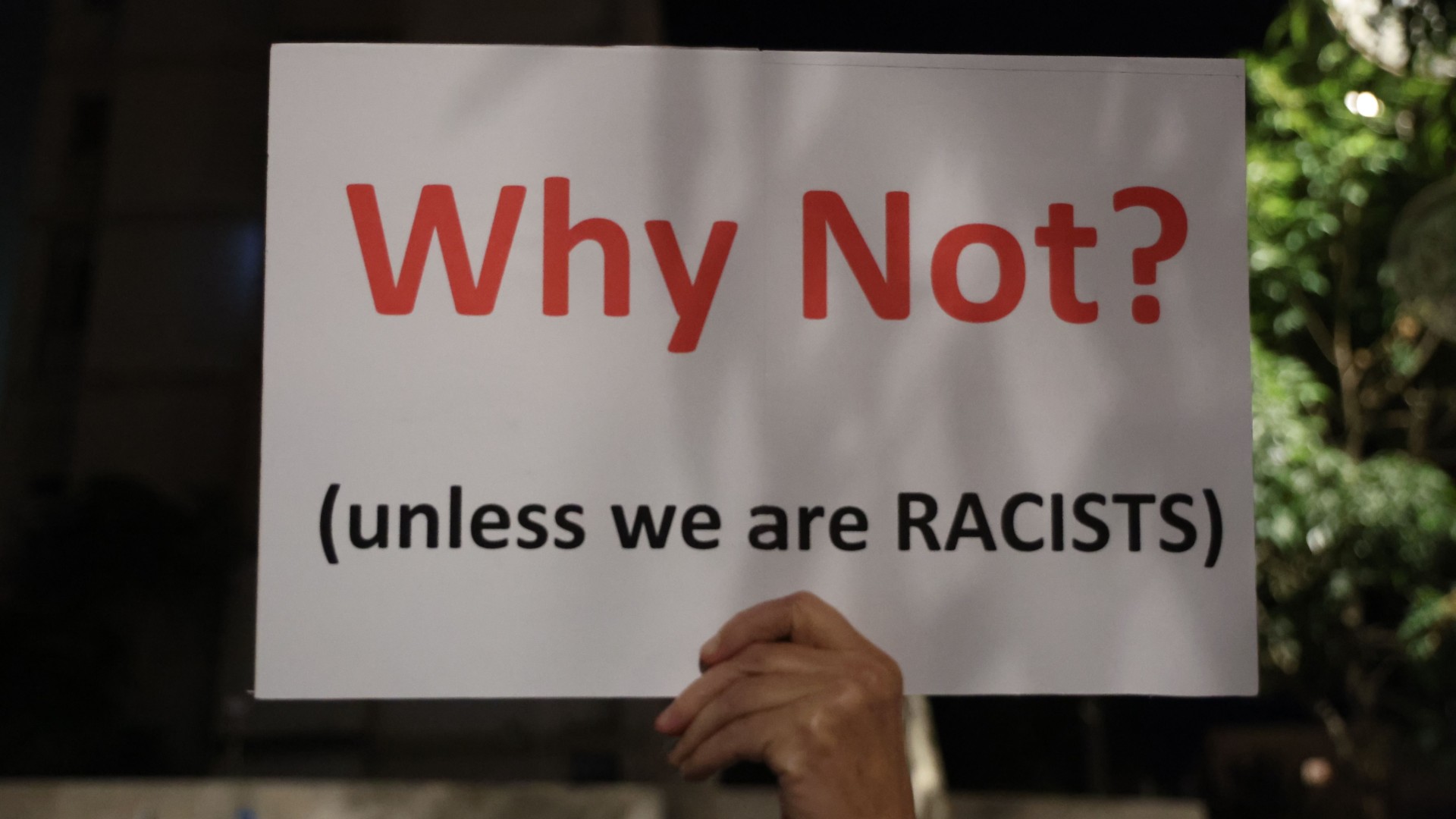
Just a week has passed since Israel’s election, and the mass participation of Palestinian citizens, obstructing both Benjamin Netanyahu and his challenger Gadi Eisenkott from easily forming governments, has lit a fuse under Israeli society. Palestinian citizens of Israel, who make up about a fifth of the population, have been accused of stealing the election by the prime minister. And the airwaves are choked with commentators and politicians vilifying the community. Ameer Fakhoury, an analyst at the Vanleer Institute think tank specialising in Jewish-Arab relations in Israel, says the “racism that has flooded television screens, social media and political discourse” may be the “ugliest fear campaign, racist campaign and incitement against a national minority ever”. “And it is very dangerous,” he tells Middle East Eye in an interview a few days after election day, with Israel’s political future uncertain and up for grabs. New MEE newsletter: Jerusalem Dispatch Sign up to get the latest insights and analysis on Israel-Palestine, alongside Turkey Unpacked and other MEE newsletters Fakhoury describes the racism as political, systematic and unprecedented, not “random incidents”. “This might be the ugliest incitement campaign against a national minority, perhaps excluding Rwanda,” he says. “When I open the mainstream Israeli channels, I remember Radio Rwanda. Radio Rwanda is a known case of national radio in Rwanda that incited against the Tutsi minority until this incitement transformed into full-fledged genocide, which took the lives of almost one million Tutsis in less than 40 days.” According to a recent study, racist discourse against Palestinian citizens on Israeli social media increased by 428 percent on election day and the following two days. Arab voters have been described as domestic enemies and linked to Hamas and the 7 October 2023 attack on Israel. Who are the Palestinian citizens of Israel? Read More » On television, meanwhile, the Palestinian participation - where 80 percent of the community of 2.1 million people voted - has been accused of “ballot-box terrorism”, with one senior journalist at Channel 14, Shimon Riklin, saying the Israeli public wasn’t “racist enough”. One candidate from Netanyahu’s Likud party told prominent Arab journalist Lucy Aharish that “merely living among us does not make you Israeli in any way”, adding: “You will never be part of us, nor part of the people of Israel.” This disturbing discourse, says Fakhoury, is part of a conflict currently playing out within Israel’s Jewish society. Netanyahu’s Jewish Zionist opponents cannot unseat him without the help of the Palestinians, and so the very question of Arab citizens’ legitimacy within the state has taken centre stage as some in the opposition try to reconcile their inherent hostility towards Palestinians with this new political reality. “There is a real, acute conflict going on now between two camps within the Jewish majority,” says Fakhoury, who is himself a Palestinian citizen of Israel and heads Vanleer’s Nisan Center for a Shared Society, which is described as “an intellectual hub for Jewish–Arab Palestinian partnership in Israel”. “And racism is only a tool, a style, and not the objective.” The legitimacy of the Palestinian minority It is easy, Fakhoury says, to be racist against Arabs in Israel. “It is almost the soundtrack and second nature of the state.” But this time, he argues, it is more dangerous and complicated because it is unfolding in a "constitutional moment" for Israel. “It is pivoting around the legitimacy of the Arab minority, the Palestinian minority. But in essence, if you zoom out, it is about the nature of the Israeli regime: can Israel really be Jewish and democratic?” he says. 'The heated, inciteful debate about the Arab minority is just a proxy for the greater debate over the inherent contradiction in the Israeli regime' - Ameer Fakhoury, analyst “And we are the proxy. The heated, inciteful debate about the Arab minority is just a proxy for the greater debate over the inherent contradiction in the Israeli regime.” For Fakhoury, the racist targeting of Palestinians who have completely accepted the Zionist narrative and nature of the Israeli state, such as journalist Aharish, whose Jewish husband fought in Gaza, is particularly revealing. “It seems that it does not matter what Palestinians do or what political positions they adopt. In the eyes of the genocidal right, anti-Arab sentiment is central.” Moshe Feiglin, a popular far-right figure who was elected as part of Finance Minister Bezalel Smotrich’s Religious Zionism slate, described Palestinian participation in the election as a “political 7 October”. “This description, this sentiment, resonates with many Jewish Israelis who understood a Jewish state not as a state that embodies or expresses self-determination for Jews, but as an ethnocratic state, a state that can bestow real, substantial citizenship only upon Jews,” says Fakhoury. In the leadup to the election, when it became clear that Palestinians would vote in record numbers, Fakhoury spoke to MEE about the reasons underpinning the momentum towards the ballot box. He detailed how Palestinian citizens of Israel had been compelled to vote by the insecurity they felt by watching the Gaza genocide, surging settler attacks in the occupied West Bank and Israeli ministers campaigning on promises that they would deport Palestinians. Combined with the violent crime authorities have allowed to run rampant in Palestinian communities in Israel, and rising discrimination following 7 October, Palestinians said they were voting to ensure their very survival. But when survival becomes the dominant motivation to vote, Fakhoury noted, the symbolic and substantive meaning of citizenship is fundamentally undermined. Palestinians are voting in Israel to ensure their very survival Read More » By securing 19 of the 120 seats in Israel’s parliament, the Knesset, Palestinians have pushed their political citizenship to a level not seen since Israel’s founding in the 1948 Nakba. This, Fakhoury says, “unleashed all the devils”. “And these devils feed not only on racism. They feed on national ethnocracy, on fascism and on colonial eliminationist logic.” This struggle being played out with the Palestinians in the centre is essentially, Fakhoury believes, a contest over the question of who owns the state. “So if we understand our struggle not as a struggle over entering a government, but as a struggle to change the nature of the Israeli regime, we can change the nature of the Israeli regime,” he says. “The issue is not that the Israeli regime does not see us. It sees us. The question is: how does it see us?” he adds. “And I know this may sound counterintuitive, but I think that if we zoom out from these immediate events, and if we detach our political sentiments in order to enable ourselves to see the political event, we will understand that we have brought Israel to a predicament.” In Fakhoury’s telling, the mass Palestinian participation was not only based on an attempt to find relief for the community’s immediate problems, but was inherently a challenge to Israel by creating a clash “between its ostensibly democratic promise or institutions and its proclaimed Jewish nature”. “Now Israelis have to decide. They have to decide whether they are a full-fledged ethnocracy or a democracy. And we have brought them to this decision, among themselves first and foremost, and before the world,” he says. “The world is watching. And Jews themselves are now debating this question: what does it mean to be a state if we are excluding one-fifth of the citizenry? What does it mean?”
'Israeli mainstream media now resembles Radio Rwanda'
Full Article
Original Source
Read the full article at Middleeasteye →KhanList aggregates and links to publicly available news content. We do not host full articles from third-party sources. Always verify important information with original sources.