
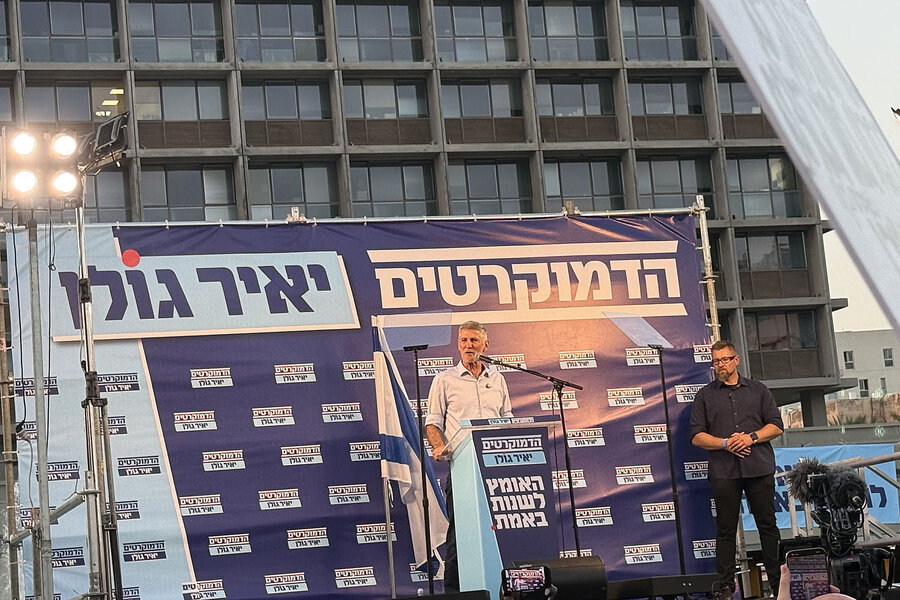
At the rally in which Israel’s new left-wing party, the Democrats, kicked off its election campaign, its leaders called to replace the “rotten” hard-right government of Prime Minister Benjamin Netanyahu and fed the crowd what it expected from topics that have dominated the headlines.The leaders vowed to reverse the government’s efforts to weaken the judiciary, crack down on Jewish terror attacks on Palestinians in the West Bank, and establish a state commission of inquiry into the Hamas-led Oct. 7, 2023, attack, the deadliest day in Israel’s history.But at the late July rally in Tel Aviv’s Rabin Square, named for the prime minister who was assassinated in a bid to destroy the peace process he helped forge, any mention of peace with the Palestinians was notably absent. Why We Wrote This For decades what distinguished the Israeli left were its calls to negotiate with the Palestinians and for two independent states living in peace. But as it campaigns for national elections, the first since Hamas’ Oct. 7 attack, the peace process is not on the agenda. While some speakers referred to peace generally, none explicitly said with whom.The omission reflects how profoundly Oct. 7 has hardened the Israeli public’s stance on the conflict with the Palestinians. Even the left treads cautiously, wary that outspoken support for Palestinian statehood will alienate voters. Today the opposition is laser-focused on replacing Mr. Netanyahu, on whose watch the devastating attacks on civilians and soldiers took place.The prime minister, fighting for his political survival and keenly aware of the electorate’s hardening, this week risked angering U.S. President Donald Trump by rejecting his most recent attempt to revive the moribund Gaza ceasefire.Mr. Netanyahu knows that being seen as giving concessions to Hamas could be fatal to his reelection. He said he would not withdraw from any of the 60% to 70% of the land Israel controls in Gaza until the Palestinian militant group fully disarms.A dramatic shift in thoughtThe change in discourse on the political left regarding the Palestinians reflects an accelerated rightward political shift that has been building for years in Israel.The Democrats’ leaders are reluctant today to campaign on the issue that once distinguished the left: attempting to negotiate an end to a century of conflict with the Palestinians. While they say the party supports that goal, it’s presented as more aspirational than as an immediate objective.Polls reflect the shift in public thought. A June survey by Mitvim, a think tank, found that only 25% of Jewish Israelis support a two-state solution for the conflict, about half the support that existed before Oct. 7. In a September 2025 Israel Democracy Institute poll, 78% of Jewish respondents said a Palestinian state was not in Israel’s national interest. People mark Israel's annual Memorial Day at the site of the Nova music festival, where hundreds of revelers were killed and abducted in the Oct. 7, 2023, Hamas attack, near Kibbutz Reim in southern Israel, April 21, 2026. Efrat Tolkowsky, a Reichman University lecturer and former member of the Tel Aviv City Council representing Meretz, a left-wing party that for years ran on a pro-peace platform, exemplifies that shift. (It was Meretz that merged with center-left Labor to form the Democrats.)Israel’s withdrawal from Gaza, for which she fought more than 20 years ago, failed to hasten the peaceful relations she imagined. Then came Oct. 7, which moved her views so sharply she won’t be voting for the Democrats.A strategy of ongoing violent conflict “continues to define” the Palestinians, she says.It was not just the trauma of Oct. 7 that changed her outlook, Dr. Tolkowsky says, but the growing world antipathy toward Israel in the wake of the Gaza war, in which she feels Israel’s very legitimacy has been called into question.The near flattening of Gaza by Israel – with the accompanying death toll of more than 70,000 Palestinians, both civilians and combatants – has captured world attention. But in Israel the public lens has remained largely fixed on the devastation of Oct. 7, when 1,200 people along the Gaza border were killed, most of them civilians in their own homes, or young people gunned down at a music festival.“If my existence is under discussion, it means that after we leave Judaea and Samaria [the West Bank], discussion about Tel Aviv then begins,” she says.First “change the domestic scene”The two-state vision laid out during the 1993 Oslo peace accords had already faded by the early 2000s, when Palestinian terror attacks during the second intifada squelched hope for many Israelis that peace was possible.“The left is now concentrated on trying to change the domestic political scene, so they can’t deal at the same time with drawing some new blueprints for the establishment of a Palestinian state,” says Tamar Hermann, a senior research fellow at the Israel Democracy Institute.“[Members of the left] understand,” she argues, that “unless they change the domestic scene, this issue will not be discussed in the foreseeable future [and] maybe never.”Democrats’ leader Yair Golan said in an interview last year that, post Oct. 7, to expect Israelis “to make the galactic leap from the current situation to a two-state solution is impossible.”“It’s not enough to return to old formulas, we need to adjust our plans, our ideas, our perceptions,” he said, advocating instead for civil separation, to lessen the friction between two hostile populations, while retaining responsibility for Israel’s security. Tzvi and Giselle Tal, Democrats supporters from southern Israel, pose for a portrait in Tel Aviv, July 25, 2026. A two-state solution is not on the agenda for any of the Jewish Israeli opposition parties contesting upcoming elections, says Mr. Tal. To be able to change the government, they have had to adapt their messages to the mood of the nation. Yet according to Itamar Avneri, a candidate for a new Jewish-Arab political party, Makom Lekulanu (A Place for Us All), neglect of the peace process “blew up in our faces” on Oct. 7.It’s important to keep reminding both the Israeli and Palestinian publics that “no one is going anywhere,” argues Mr. Avneri, whose party is polling below the threshold to enter parliament. “The only way we can protect ourselves and guarantee safety and security for Israelis and Palestinians is to understand that, and to start to talk about how we can live on this land together and how we want to share this land.”Fine-tuning a winning messageAt the Democrats’ Tel Aviv rally, Giselle and Tzvi Tal, a couple from southern Israel in matching blue-and-white Democrats t-shirts, recount that a relative who was held hostage in Gaza has since returned home. Despite enduring that agony, they say, they remain committed to Palestinian statehood.“There are Palestinians who want to talk to us, and together we can have two states for two peoples,” Ms. Tal says.The two-state solution is not on the agenda of the upcoming elections for any of the opposition Jewish Israeli parties, says Mr. Tal. They have had to adapt their messages to the mood of the nation to be able to change the government.“All the parties have fine-tuned their messages so they can win,” he says.Nevertheless, former diplomat and former deputy national security adviser Eran Etzion, who is No. 20 on the Democrats’ slate, insists that “peace is high on the agenda of the party.”“It does distinguish this party from all other political parties,” he says.But, he admits, “for the average Israeli … the lesson learned from the [2005] disengagement from Gaza is that any territory you evacuate becomes the basis for terrorism.”“It is understandable why Israelis are skeptical,” he says. “But it is also the harsh and undeniable reality that unless we separate ourselves from the Palestinians within the context of an agreement, there is no future for a democratic and Jewish majoritarian Israel. That is the winning argument.” Yaffa (at left) and Moshe Bachar came to the rally from northern Israel to support the Democrats in Tel Aviv. Even after Oct .7, they say, Israelis can talk to Palestinians. That message resonates with Yaffa and Moshe Bachar, who came to the rally from northern Israel. “The conflict will lead to the destruction of Israel,” Mr. Bachar says.“We think that even after Oct. 7 we can talk to Palestinians. They are not all Hamas,” he adds, a reference to “All Gazans are Hamas,” now a catchphrase in Israeli discourse. Images of crowds of Gazan civilians cheering when Israeli hostages were hauled to Gaza on Oct. 7, and of other civilians taking part in the attacks and looting Israeli homes that day, helped reinforce that view.Focus on “how to survive”Sitting on a shady bench during the rally, Or Meir says she once voted for Meretz. Now she is debating whether to vote for the Democrats or for Gadi Eisenkot, another former general who heads a new centrist party.“Many of those killed, burned, and raped on Oct. 7 were for a two-state solution and helped Palestinians and employed them,” Ms. Meir says. “But they later came and slaughtered them.”The focus of these elections must be, she insists, on “how to survive in a region under which we are under threat. Now is not the time to hand over land to them. I’d be happy if there was someone to talk to,” she says, echoing a common refrain among Jewish Israelis that there is no Palestinian partner for diplomacy.“We want to live in peace,” she says. “But we also want to survive.”Benny Gorer, from Tel Aviv, was also at the rally. “We will change the government and then make sure to create two states for two peoples,” he says. “Even after Oct. 7 there is room to talk.”
Israeli election: As left campaigns, peace with Palestinians seen as a risky proposal
Full Article
Original Source
Read the full article at Csmonitor →KhanList aggregates and links to publicly available news content. We do not host full articles from third-party sources. Always verify important information with original sources.