
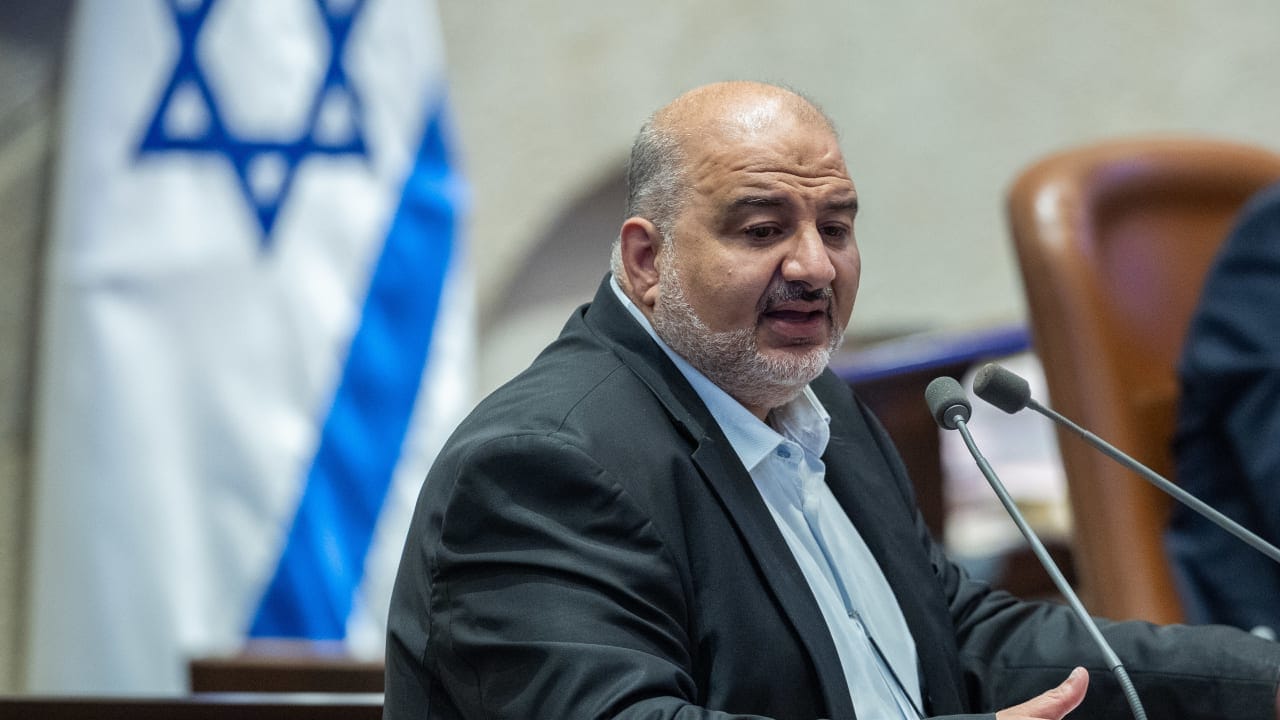
OCTOBER 28, 2026 02:38Late on election night, Mansour Abbas was asked about the conditions Gadi Eisenkot had set for working with Arab parties. His reply went to a more immediate problem: was there a government to be formed in the first place?In the Channel 16 interview, the Ra’am leader put the arithmetic before the negotiations. First establish whether a government is viable, then discuss the terms. With the television projections pointing in different directions, there was a practical reason for that sequence. Abbas was assessing the possibilities available to his party and its voters. He might have leverage. He might discover that the final results left him with very little.Israel’s Arab citizens are often discussed abroad as evidence in somebody else’s case. Their own political arguments receive less attention. They are invoked as evidence of Israeli democracy, or described through the discrimination they face. Meanwhile, their parties are debating how to exercise influence, what to demand, and how much compromise their supporters will accept.Some of those choices have already changed Israeli history. Ra’am participated in the Bennett-Lapid coalition formed in 2021, helping sustain a government led initially by a prime minister from the Israeli right. This election could again put Arab parties near the center of coalition negotiations. Three broadcasters projected Netanyahu’s bloc short of a majority; Channel 14’s updated projection put it above one. These remain projections, not the official result.In Israel’s 120-seat parliament, 61 seats give a coalition a majority. An Arab citizen’s ballot contributes to that calculation in the same way as a Jewish citizen’s. Governments can depend on those votes, and governments can fall when parliamentary support disappears. Anyone describing Israel to an international audience needs to give that political power its proper weight.Head of Ra'am Mansour Abbas holds a joint press conference with new party member Yoav Segalovich in Nazareth. August 31, 2026. (credit: MICHAEL GILADI/FLASH90)The weight of the word 'apartheid'The word “apartheid” requires more care than an election-night slogan allows. Amnesty International’s allegation extends to Israel as well as the occupied territories, and its report acknowledges Arab representation in parliament. Arab electoral rights do not resolve the status of Palestinians living under Israeli occupation in the West Bank, whose legal and political circumstances differ. Participation also does not erase discrimination inside Israel. Those arguments require scrutiny on their own terms. So does the democratic reality of Arab citizens organizing parties, winning seats and negotiating over how their country is governed.The differences among those parties matter. Abbas wants Ra’am to participate in government. The Joint List, comprising Hadash, Ta’al, and Balad, has offered to negotiate support from outside a government that replaces Netanyahu. Its leader, Yousef Jabareen, has demanded a funded and monitored plan to combat crime, while setting red lines over national issues, including war and settlement budgets. Cooperation would have to survive those disagreements. A shared interest in replacing a prime minister does not settle what comes afterward.Ra’am has taken another striking step by recruiting Yoav Segalovitz, a Jewish former Yesh Atid lawmaker who once headed Israel’s national serious-crime unit. His move to a party with Islamist-conservative roots brings questions about policing, partnership and political identity into the same room. Voters can regard it as an opportunity, a mistake, or an arrangement unlikely to last. The decision is theirs. What interests me is that such a choice exists, crossing a boundary that can look immovable from a distance.There are equally consequential differences among the Jewish parties. When Keshet Neev and I interviewed Eisenkot in September, he described conditions for partnership: acceptance of Israel as a Jewish and democratic state, the Declaration of Independence’s values, an obligation of service, and recognition that Hamas is a terrorist organization that must be dismantled. He said he saw no Arab party meeting those principles. He later ruled out aligning himself with any Arab party in an October podcast reported by Reuters.These are questions about the responsibilities of government. After October 7, a disagreement over Hamas reaches directly into national security, and the confidence citizens place in those making decisions on their behalf. Arab leaders seeking a governing role should expect close scrutiny of their positions and record, as should their prospective partners. Their proposals deserve attention without anyone assuming in advance that they must be accepted.The mistrust also has a history. In an article published on October 8, 2023, Balad chairman and former MK Sami Abu Shehadeh discussed the attack’s strategic significance and potential political gains without condemning the killing and abduction of civilians. He later condemned the massacre, said he had written before understanding the full scale of the atrocities, and said the article should not have appeared in that form. On November 5, 2023, Ra’am MK Iman Khatib-Yasin questioned reports of babies being killed and women raped while discussing footage she acknowledged she had not watched. In that interview, she also condemned the attack as inhumane, contrary to Islam, and unjustifiable. She apologized and retracted her remarks that evening; Mansour Abbas rejected minimization of the massacre and demanded her resignation. The damaging remarks and the responses to them both belong in the record.Naftali Bennett, who led the government that included Ra’am in 2021, now opposes repeating that arrangement. He has explained his objection in terms of the party’s non-Zionist character rather than its members’ ethnicity. Yair Golan, leader of the Democrats, supports bringing Ra’am into a coalition. Each position carries implications for the kind of government that could be formed and the compromises it would require. Neither can be understood through the seat totals alone.Whether either Arab list belongs in a particular government depends on a workable agreement, its policies and the trust its partners can sustain. Refusing a coalition partnership does not, by itself, establish racism. Equally, an Arab citizen’s political legitimacy cannot depend on choosing a party the Jewish majority finds agreeable. A democracy has to keep those distinctions clear, especially when elections make them inconvenient.National identity reaches into the most ordinary parts of Israeli life: the safety of a street, public services, the obligations citizens owe one another. Arab parties differ over how those concerns should shape their political strategy. Jewish parties have their own disputes over the country’s character and the price of cooperation. No single leader speaks for an entire community, and a voter’s identity cannot tell us everything about the decision made behind the curtain.Abbas began with the question of whether a government was possible. The answer may eventually leave him inside a coalition, supporting one from outside, or sitting firmly in opposition. Any of those outcomes could emerge from democratic politics. The important test will be whether Israel can turn the result into responsible government while preserving the standing of citizens whose representatives remain outside it.That is the future worth imagining: a country secure enough for serious disagreements to be argued through institutions, where equal citizenship survives the collapse of a coalition or the defeat of a party. On election night, attention settles on the seats around the cabinet table. The country’s democratic life also depends on what remains true for everyone who has no place at it.Follow us on Google
Israeli Arab political power rising with elections, challenging world’s assumptions - analysis
Full Article
Original Source
Read the full article at Jpost →KhanList aggregates and links to publicly available news content. We do not host full articles from third-party sources. Always verify important information with original sources.