
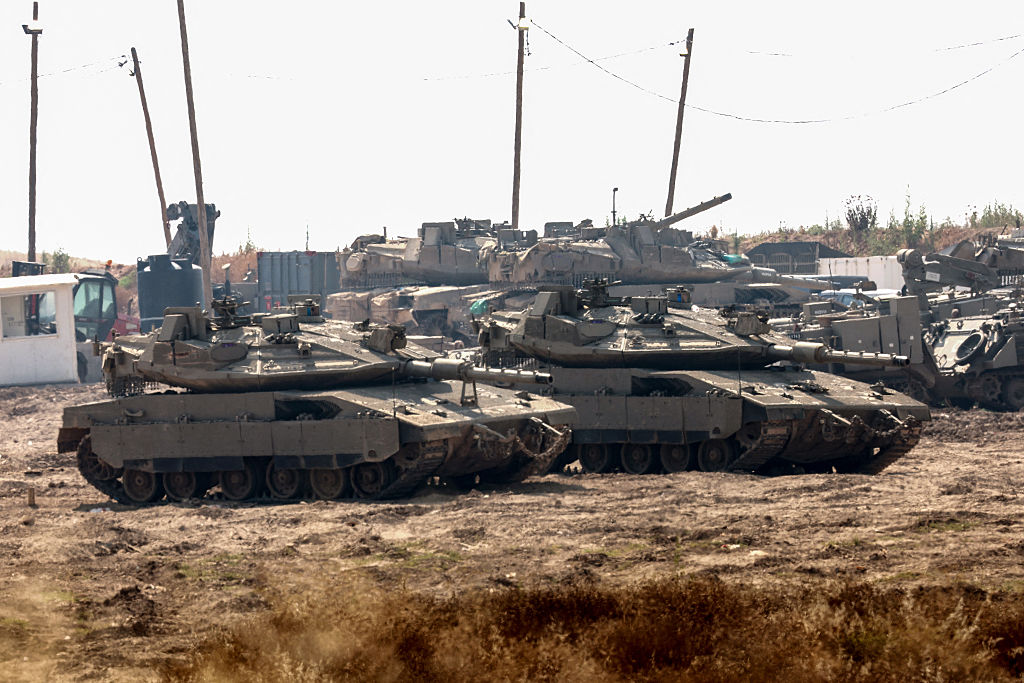
“Israel is currently at the yellow line,” the Board of Peace’s high representative for Gaza, Nickolay Mladenov, told Israeli television on August 9. “That is where its troops are. What we are asking is that the IDF not position troops further from the yellow line. We would like them to stay at those positions.” The first phase of the ceasefire under President Donald Trump’s 20-point Gaza peace plan established a “yellow line” separating Israeli forces from Hamas-controlled territory. It left Israel in control of roughly 53 percent of the Gaza Strip — an area now almost entirely devoid of Palestinian civilians. Since the ceasefire, the IDF has spent months clearing the area of remaining manned Hamas bunkers and conducting search-and-destroy operations against tunnels. Hamas’s refusal to move into the plan’s second, peacemaking phase has given Israel room to extend its control farther into Gaza. Israeli Prime Minister Benjamin Netanyahu has said Israel’s objective is ultimately to control 70 percent of the strip. Yet Israeli officials have offered conflicting estimates of how much territory Israel actually controls, ranging from 63 to 70 percent. According to Mladenov, the IDF would withdraw progressively from that line only as Gaza is demilitarized sector by sector and weapons are removed, stored, and rendered unusable. The IDF has declined to respond in detail to Mladenov’s account. So how does that square with Netanyahu’s insistence that Israel will not withdraw as envisaged in the Trump plan’s roadmap? An Apparent Contradiction Resolved A clue came from Israeli Security Cabinet Minister Avi Dichter, a former director of the Shin Bet internal security agency, in an August 12 interview with Tel Aviv’s 103FM. Israel, he said, “is sitting in or controlling almost 70 percent of the strip.” The distinction between “sitting in” and “controlling” may resolve the apparent contradiction. Israel appears to have used ground operations to clear roughly another 12 percent of Gaza west of the yellow line without maintaining a permanent troop presence there. Dichter’s reference to Israeli “control” therefore appears to describe a wider no-go zone monitored and enforced largely from the air, while IDF ground forces remain at the yellow line. That additional area is also expected to become the site of the proposed pilot humanitarian zone, where Palestinians could seek housing outside Hamas rule under the protection of the National Committee for the Administration of Gaza (NCAG) and the International Stabilization Force (ISF). If that happens, there may be no additional IDF withdrawal required to launch the pilot: Israeli troops will already be positioned at the yellow line. In other words, Netanyahu and Mladenov may not be contradicting each other at all.If the humanitarian pilot succeeds, the process is likely to take many months. By then, Netanyahu — or whoever succeeds him as prime minister — will have another opportunity to reconsider whether Israel should withdraw farther. Israel, after all, accepted the principle of a phased withdrawal when it signed on to Trump’s plan. Gaza Maneuvers Echo Israel’s Strategy in Lebanon, Syria The emerging arrangement closely resembles Israel’s strategy on its northern fronts. In southern Lebanon, Israel maintains an IDF-patrolled, largely depopulated buffer zone extending roughly five miles from the border. But it has also warned Hezbollah to remain outside the next band of territory, between that buffer zone and the Litani River — creating a second layer of “hands-off” control enforced largely from the air. In Syria, Israel’s new buffer zone extends roughly six miles into Syrian territory. At the same time, armed personnel have been warned to stay away from areas farther inland, toward Damascus, or risk Israeli fire. The same model may now be emerging in Gaza: a formal buffer zone occupied by Israeli forces, backed by a wider informal zone in which Israel exercises control without maintaining permanent ground positions. In all three theaters, the effect is the same: one buffer zone on the ground, another beyond it enforced from the air. Israel needs defensible borders against merciless enemies and, for now, the extra territory gives Israel additional military depth and diplomatic room for maneuver. Mark Dubowitz is the CEO of the Foundation for Defense of Democracies (FDD). For more analysis from Mark and FDD, please subscribe HERE. Follow FDD on X @FDD. Follow Mark on X @mdubowitz. FDD is a Washington, DC-based, non
Israel Seeks To Preserve Military Depth in Gaza
Full Article
Original Source
Read the full article at Fdd →KhanList aggregates and links to publicly available news content. We do not host full articles from third-party sources. Always verify important information with original sources.