
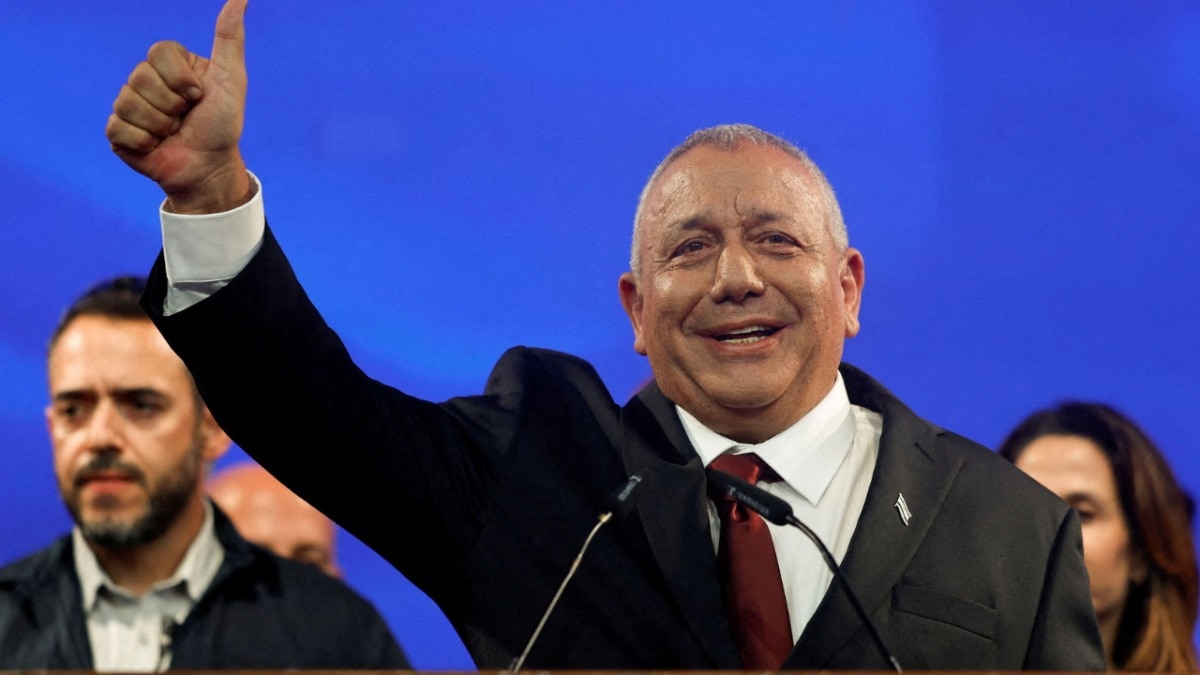
Israel's political deadlock has taken a decisive turn after President Isaac Herzog chose opposition leader and former military chief Gadi Eisenkot to try to form the country's next government, dealing a setback to Prime Minister Benjamin Netanyahu's efforts to remain in power.Herzog is expected to formally hand Eisenkot the mandate at a ceremony at the President's Residence at 5 pm (local time) on Sunday. Eisenkot will then have 28 days to build a governing coalition, with the president able to grant him another 14 days if he needs more time.In an election in which Netanyahu's religious-nationalist bloc remained the largest political force, it still lost its parliamentary majority. With no obvious coalition able to command the 61 seats needed to govern, Israel is now facing weeks of difficult negotiations.HOW EISENKOT GOT THE FIRST CHANCEThe Israeli presidency is largely ceremonial, but after an election it plays an important role in deciding which politician gets the first opportunity to form a government. Herzog held consultations with the parties elected to the Knesset, Israel's 120-member parliament, before making his decision. Eisenkot emerged with a clear advantage. According to the Times of Israel, he received 67 recommendations from lawmakers for the premiership, compared with 46 for Netanyahu."President Herzog has invited Gadi Eisenkot to the President's Residence, where he will be tasked with forming the government tomorrow," Herzog's spokesperson said. The numbers do not mean Eisenkot already has enough support to govern. They simply give him the first opportunity to attempt what could be a highly complicated coalition-building exercise. Netanyahu's Likud won 27 seats, the highest total for any single party. But his alliance secured only 53 seats, eight short of the 61 required for a parliamentary majority.Meanwhile, Eisenkot's Yashar party won 21 seats and emerged as the second-largest party. His four-party, Jewish-led bloc has 48 seats. Two parties representing Israel's Arab minority won a combined 19 seats and backed Eisenkot during the presidential consultations.EISENKOT'S PATH TO POWER IS NARROWEisenkot faces several possible options, none of them easy.One possibility is a minority government that receives outside support from Arab lawmakers. Another is an agreement with ultra-Orthodox parties that have traditionally been aligned with Netanyahu. A third option would be some form of broad unity government involving Netanyahu’s Likud.There is a major obstacle to the last option: Eisenkot has repeatedly said he will not serve in a government with Netanyahu.His position has also been shaped by four conditions he has set for potential partners. He wants them to recognise Israel as a Jewish, democratic, liberal and egalitarian state, respect the values of the Declaration of Independence, support military or national service for all citizens, and recognise Hamas as a terrorist organisation while backing the destruction of its military and governing capabilities in Gaza.These conditions could make coalition negotiations particularly difficult. If Eisenkot fails to form a government, another candidate can be given the opportunity. If that effort also fails, lawmakers can nominate another candidate.Israel has roughly 100 days to complete the process. If no candidate manages to form a government within that framework, the country could be forced into another election.NETANYAHU FIGHTS BACK WITH UNITY CALLNetanyahu has already begun pushing back against Eisenkot's nomination. In a forceful post-election appeal, the veteran leader called for a national unity government and warned against any administration that depends on Arab parties."There is someone who wants to hastily swear in a government, already next week, with terrorism supporters," Netanyahu said."To establish a government in the State of Israel with those who want to eliminate the State of Israel," he added. Netanyahu also accused a government dependent on Arab support of being unable to confront Hamas or protect Israeli soldiers.WHO IS GADI EISENKOT?Eisenkot, 66, is a former military chief who entered politics only in 2022. He briefly joined Netanyahu's wartime cabinet after Hamas' October 7, 2023, attack before eventually returning to the opposition.Unlike Netanyahu, Eisenkot has spent much of the period since then criticising the government's handling of the Gaza war and its broader security policies. His opposition to Netanyahu is also personal and political. Eisenkot has said he would not join a government led by the prime minister.His family has also paid a heavy price during the war. One of his sons and two nephews were killed while fighting in Gaza.During the election campaign, Eisenkot leaned heavily on his military background and presented himself as a security-focused alternative to Netanyahu.He has also criticised violence by Israeli settlers against Palestinians and opposed Netanyahu's far-right allies, including National Security Minister Itamar Ben-Gvir and Finance Minister Bezalel Smotrich.Both figures have faced sanctions from some Western countries over their positions and actions relating to Palestinians.THE ARAB PARTIES ARE KEY TO THE DEADLOCKThe role of Arab lawmakers is at the heart of the political standoff. Eisenkot has declined to formally join forces with Arab parties, meaning he cannot simply build a conventional majority with their 19 seats. However, their decision to recommend him for prime minister has given him the strongest initial mandate.The situation has also exposed a changing political landscape inside Israel.Netanyahu has portrayed Arab support for Eisenkot as a major security threat, while Arab leaders have strongly opposed Netanyahu and his far-right allies, accusing them of pursuing discriminatory and hostile policies.At the same time, some politicians from the anti-Netanyahu camp are exploring partnerships that once appeared politically difficult.Avigdor Liberman, leader of Yisrael Beytenu, recently dropped his longstanding opposition to working with ultra-Orthodox parties and indicated a willingness to compromise over military service for the ultra-Orthodox.That could potentially create another route for an anti-Netanyahu coalition. But Eisenkot himself continues to insist that ultra-Orthodox citizens should be subject to mandatory military or national service.WHAT HAPPENS NEXT?Eisenkot's nomination does not mean Netanyahu has been removed from office. For now, Netanyahu remains caretaker prime minister and his Likud party remains the largest single party in the Knesset.The immediate battle is over whether Eisenkot can turn his 67 recommendations into an actual governing majority. That will require him to bridge deep differences among centrist, right-wing, left-leaning, Arab and ultra-Orthodox lawmakers.If he succeeds, Netanyahu could lose the premiership despite leading the largest individual party.If he fails, Netanyahu could get another opportunity to build a coalition.- EndsWith inputs from agencies
Israel President taps Netanyahu's rival Eisenkot to form government
Full Article
Original Source
Read the full article at Indiatoday →KhanList aggregates and links to publicly available news content. We do not host full articles from third-party sources. Always verify important information with original sources.