
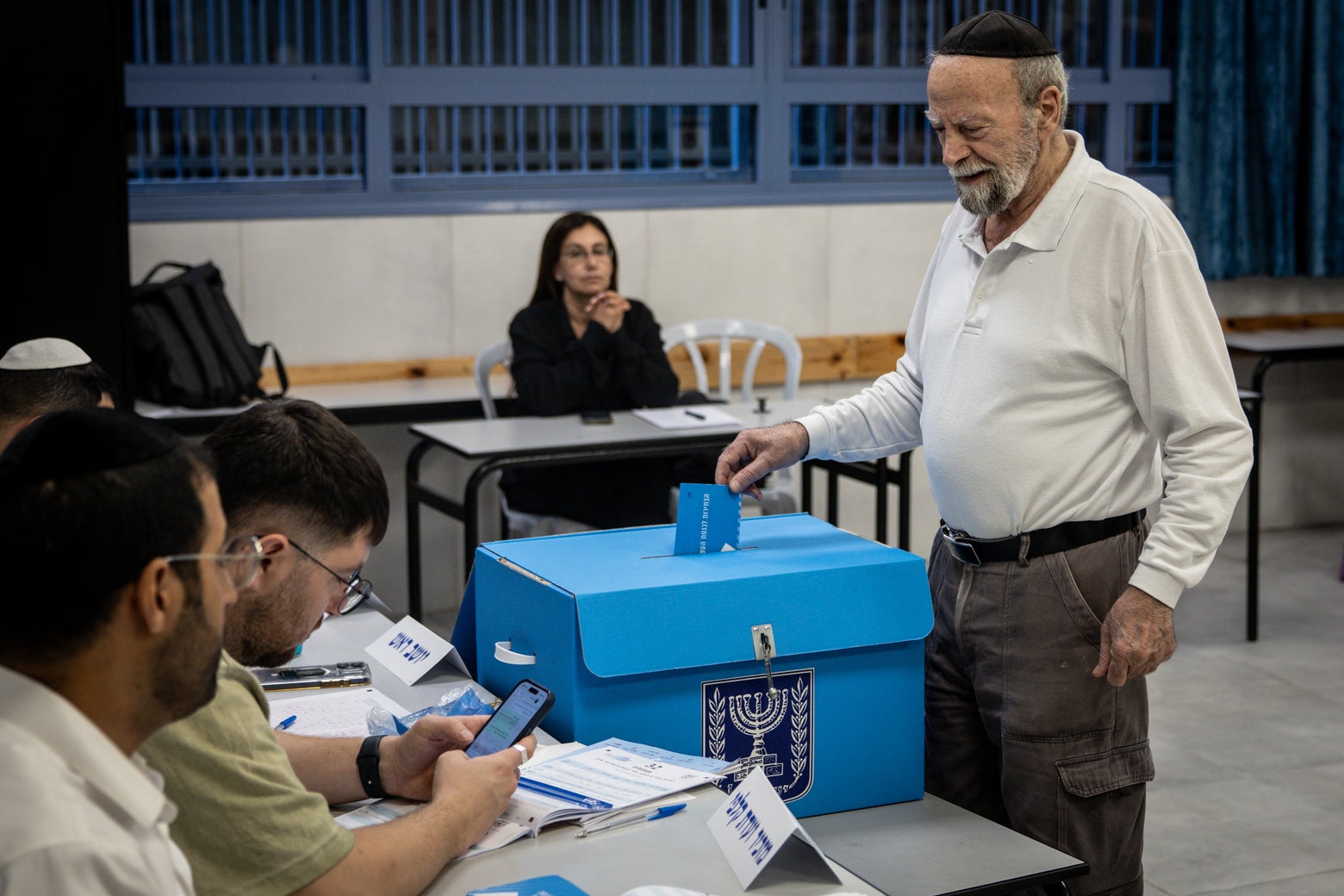
Politics Israelis are waiting on the results of a historic election. But their priorities are more revealing than their votes. A man casting a vote at a polling station in Tel Aviv, Israel, on Tuesday. Chris McGrath/Getty Images Sign up for the Slatest to get the most insightful analysis, criticism, and advice out there, delivered to your inbox daily. ISRAEL—In Tel Aviv, one of Israel’s more liberal hubs, Ben Friedhaim sits with his young daughter in HaKnesset Square as waves gently lap onto the nearby beach just days before the election. Even during Shabbat, the boardwalk here is full of families basking in the sunshine, electric scooters whizzing past, and bars blasting American hits. Ice cream melts down his daughter’s hand as he tells me about his family’s recent return to the country. He came to vote. Friedhaim, who now lives in Prague, is one of more than an estimated 80,000 Israelis who returned to the country this week, having left after Oct. 7, when, he says, things got “scary.” Without the option of absentee voting in most cases, this cohort signals how important this election is. For Friedhaim, he wants to make Israel feel safe for his daughter to grow up here; this safety, in his mind, is provided by the Israeli military. “I think the army is very important when she turns 18,” he said about his toddler. The military is crucial to many here, given the country’s embattled status. “It is an important election, but Israel is always going to be at war,” he said. “There is no diplomatic solution.” Indeed, even as the election seems so critical that people like Friedhaim are returning home to vote in it, there’s a certain stasis to what’s to come. A largely right-wing Zionist vision appears entrenched across Israel’s political bench, and most candidates hoping to unseat Benjamin Netanyahu in this election offer little clarity on the future facing Palestinians in Gaza and the West Bank, or the broader region. The field has been crowded: 36 parties initially in the running. The main challengers to Netanyahu include Gadi Eisenkot of the Yashar party, the centrist former army chief of staff who opposes a two-state solution and backs some settlements in the West Bank. Former Defense Minister Avigdor Lieberman, of the right-wing Yisrael Beitenu party, is also in the running, and previously said the two-state solution is dead. And there’s Naftali Bennett, a nationalist businessman who rejects Palestinian self-determination—that’s the candidate Friedhaim is voting for because “he comes from a right-wing background.” There’s also the country’s left-leaning Democrats party, fronted by Yair Golan, who is more open to ending wars and reaching a two-state solution, though he believes that it’s not immediately realistic. Eisenkot—who also lost a son in Gaza—is essentially fronting this coalition bloc, hoping to oust Netanyahu. Then there are a handful of ultra-far-right figures, Orthodox parties, and the country’s Arab parties, none of which had a chance to win the majority outright. Just after 10 local time here on election night, the first exit polls were published: Many showed Eisenkot’s coalition initially holding a narrow lead over Netanyahu’s bloc, but no clear majority. By morning the results had already shifted toward Netanyahu, casting uncertainty over what comes next. Regardless of who wins the count, these factions will still have to work together to form a government and determine the next leader. Notably, it was a historic night for the Arab parties—but even now, it’s too early to tell what the next government will look like. The backdrop to this election has been one of tension, dissatisfaction, and fear. Even if a new coalition ushers in top-level change, it might do little to resolve the much deeper fractures beneath it. “Things have become very polarized here,” Friedhaim had said that Saturday before the election. “They’re turning people against each other.” In the time I spent in Israel in the week leading up to the vote, the election mood became visible, as did furious sentiment over what’s at stake. Looking out across a sea of Israeli flags during a massive anti-Netanyahu demonstration, one bystander bluntly says: “This country has been on the verge of civil war for years.” Still, this time feels different from past elections. The country is angry: some at Netanyahu’s cultish leadership, which they feel is running Israel into the ground; others convinced he’s the only one who can steer the country amid an increasingly hostile region. And yet, the options at the ballot box do little to address what lies ahead for Palestinians in Gaza and the West Bank, for Syrians living in the embattled Golan Heights, or for the residents of southern Lebanon who have been forced from their homes by yet another illegal Israeli expansion. Despite the differences in opinion on domestic policy, there is a pervasive sense that the Israeli identity is under threat and that its enemies must be defeated at all costs. Which means that real change in Israel—and the idea of peace—has been the hardest to envision. Hours after I spoke with Friedhaim, I witnessed a tense exchange break out among strangers at a bar discussing the need to protect Israel’s borders. They were debating the unnecessary loss of life—not of civilians from neighboring countries, but of the Israeli soldiers stationed in those occupied territories—with one person arguing that sacrifices were necessary. That same day, crowds carrying homemade signs marched to Hostage Square (“change is going to come,” said one), with attendees largely backing one of the opposition candidates listed above. Rallying for an inquiry into Oct. 7, the crowd suddenly erupted as Eisenkot gleefully passed supporters, shaking hands with potential voters eager to see a new direction for the country. Dani Schrire and his wife work in academia and had traveled from Jerusalem just to attend the Tel Aviv demonstration. “The division is not between Israelis and Palestinians,” Schrire said, though not everyone would agree. “It’s crazy fanatics who are Israeli and Palestinian on the one hand—and those who have some kind of vision of mutual acceptance, whether it’s a two-state, one-state, doesn’t matter.” The treatment of the Palestinians shapes the couple’s vote as well, though it wasn’t necessarily the only factor. As for their thoughts on Netanyahu after his latest clampdown in the West Bank, Schrire said: “I think the guy is a total nut.” Palestinians in the occupied territories—some 5.6 million people—cannot vote in Israel’s election. Among them is hostel owner Issa Nazzal, who sits in his office in the picturesque Palestinian town of Ramallah in the occupied West Bank, looking out the window at the encroaching settlement on the hilltop. For many Palestinians here, the focus hinges on surviving day by day under a terrifying occupation that has ramped up its violence in the run-up to the election. In recent days, the situation has reached a breaking point—violent settlers attack anyone in their way, including Palestinians and international journalists. People are particularly despondent about what plays out beyond the 30-foot concrete barrier surrounding the territory in the Israeli election. “I didn’t see anything that makes me feel they can change,” Nazzal said. Within Israel, change means different things depending on whom you ask. Not far from Israel’s seat of government, the Knesset, in Jerusalem, last-minute canvassing was prominent. A group of teenagers, not old enough to vote, pass flyers in support of Bezalel Smotrich, a far-right ultranationalist politician who models himself on policies including the total destruction of Gaza. Military fatigues are worn like a badge of honor in Jerusalem’s historic center, where young recruits sling automatic weapons over their shoulders. Trumplike “Make Israel Great Again” caps are flogged in tourist shops across the Old City, one of the world’s oldest continuously inhabited cities. Standing outside the family-run carpet business, Yal and his father—who didn’t share their last names—perch near a table featuring a poster of Netanyahu alongside Donald Trump, framed by fighter jets and Israeli flags. There’s no question about where Yal stands: “The Arabs here are the problem,” he says. “Israel is a small country, and everyone wants to kill Israelis.” Netanyahu’s party appeared to have been prepping the ground for claims of election fraud, and Israelis across the political spectrum raised concerns in passing about whether the country will accept whatever results emerge. At the time of writing, the mood in Jerusalem was calm, but Netanyahu tried to extend voting hours, which the elections committee rejected. It’s hard to ignore what Yal had told me days before: “I don’t want to think what’s going to happen [if Netanyahu doesn’t win].” Propaganda has undoubtedly framed this election, with the country’s most popular TV channels portraying contrasting polls over who will win. Few here appear to see—or want to see—the devastating images that continue to emerge from places like Gaza, footage that international audiences are more exposed to. Instead, campaigning hinges on the threats facing Israel, and the urgent need for more secure borders—even if that means expanding into other countries. More than 850 polling stations were set up in occupied outposts for Israeli soldiers currently serving in Palestine, Syria, and Lebanon, up from 710 in 2022. The highway heading north along the country’s Mediterranean coastline has been littered with campaign billboards in a recognizable Israeli blue for weeks. There’s also an image of New York City Mayor Zohran Mamdani alongside Iran’s supreme leader, the chief of Hezbollah, and Turkey President Recep Tayyip Erdoğan. It’s an illustration of the alleged enemy, provided by Netanyahu’s Likud party. The shape of the new government could take weeks to sort out. Because of Israel’s proportional representation system, no party has ever won 61 seats outright to achieve a Knesset majority, meaning that the election will be followed by potentially long, drawn-out negotiations. Israel’s election committee tried to bar the country’s Arab parties from running, but the move was overturned. They might play a decisive role in who secures the Knesset—though few Israeli politicians in the opposition bloc currently appear open to working with the Arab parties to secure a majority government. Official election results, however, won’t be published until Nov. 4. In the oceanside city of Haifa, streets are quieter than in Israel’s major cities, but the mood in one of the Arab parties’ campaign offices was anything but. Some people here cling on to hope that Israeli politicians will have to pay attention to the Arab parties this time around. Historically, the Arab-led parties have only ever secured a record high of 15 seats, and only once did they join the governing coalition (in 2021). Then and now, they face considerable right-wing pushback. Before the election, I met with political activist Reem Hazzan as she was working on last-ditch canvassing for a party called Hadash. Here, she’s also running the campaign for the Joint List, an alliance of Arab parties that could have some determining influence in the overall election outcome. I ask her what makes this election different from others. Her answer is immediate: “The necessity to get rid of Netanyahu, Smotrich, and [far-right leader Itamar] Ben-Gvir.” She added: “If we do not get rid of them, apartheid will continue and be deepened, ethnic cleansing and Jewish terrorism in the West Bank will continue. The very slow genocide in Gaza will continue.” Hazzan worries that even of the Arabs eligible to vote, not everyone plans to: “A lot of people are worried that whatever we do, we will not be able to change anything; we will not be able to actually influence. “I wish people were much angrier, really, and much more furious about the situation, about what they are willing to sacrifice in order to change the situation,” she adds. “But I must also say that I understand why. We have been struggling for decades … and things are only getting worse.” The fear is different among this community, more visceral. Arabs in Israel are disproportionately affected by violent crime, and accounts of Muslims being targeted just for wearing hijabs or speaking Arabic are rife. “I’m afraid, regardless of these elections,” says Sally Abed, a Palestinian City Council member in Haifa. “I became a mother two years ago. I gave birth during a very active war. I am very worried as a woman, as a Palestinian, as a mother. … I really feel unsafe.” After spending a week in Israel—and witnessing a vote that seems as if it will not provide a definitive outcome and instead require more negotiation for a government to even form—I worried most about people like Abed. Israelis will argue over who actually takes charge in the weeks ahead. Palestinians will continue to live through the consequences. The fissures here run dangerously deep, and massive questions remain over whether the next government can pull people together—or push them even further apart. Elections Israel Palestine
Israel Is Waiting on Results in Its Historic Election. But on the Ground, I Saw What the Future Looks Like.
Full Article
Original Source
Read the full article at Slate →KhanList aggregates and links to publicly available news content. We do not host full articles from third-party sources. Always verify important information with original sources.