
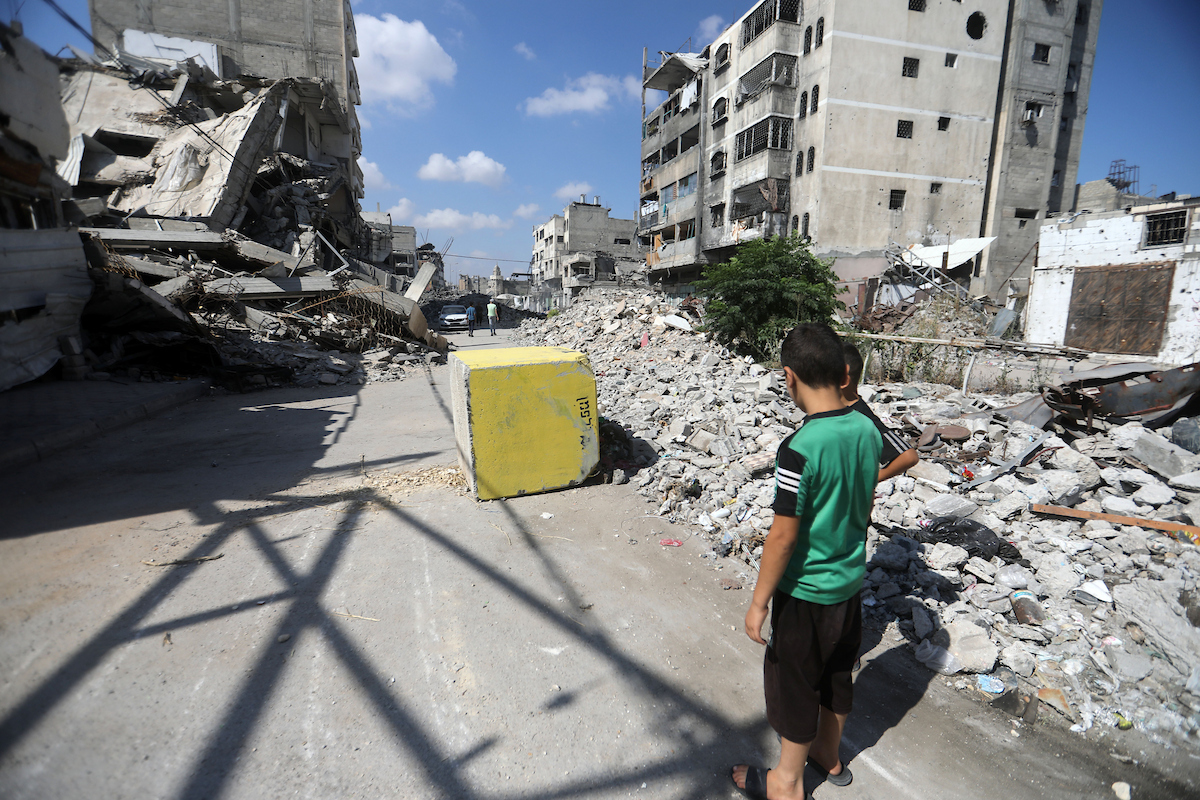
For 38-year-old Walid Sakhr, displacement has become a journey of a few hundred meters at a time. Since the ceasefire agreement in October 2025, he has repeatedly been forced to pack up his belongings and move farther west, as Israeli forces gradually advance the so-called ‘yellow line,’ the boundary dividing the Gaza Strip into two unequal parts. Israel is steadily expanding the territory under its control through the movement of yellow concrete blocks marking the new line and ever-expanding border. The boundary separates areas controlled by Israel from those where Gaza’s population continues to live under Hamas rule. Israel currently controls approximately 70 percent of the Strip, including the eastern areas beyond the yellow line. Every few weeks, Israeli forces move the yellow blocks forward for hundreds of meters, imposing a new reality on displaced Palestinians living in those areas and forcing them to leave. As a result, displacement has become an almost continuous process. The last recorded advance of the yellow concrete blocks in Gaza took place on October 25, in Shuja’iyya, east of Gaza City, when Israeli quadcopter drones were seen dropping incendiary bombs on displacement tents in the Shuja’iyya neighborhood. The attacks triggered a panic, sending people fleeing their tents and leaving their belongings behind as the fires rapidly spread. Their immediate concern was to save their lives. Hundreds of families were subsequently displaced from the area. Even when the yellow markers are stationary, Israeli forces have maintained a pattern of intimidation and pressure against displaced Palestinians living near the line, forbidden from entering their own land. Walid Sakhr, a resident of Shuja’iyya who is now displaced on the neighborhood’s outskirts, is waiting for the day he can return to his home, or what remains of it. He believes that the Israeli army’s objective is to drive Palestinians out of the area and take control of their land. “We live here as if we are in an isolated place,” Sakhr told Mondoweiss. “At night, nobody can move around. People cannot leave or enter the areas where we are displaced. They constantly target these areas. They even burned the tents. If people had not reacted quickly and gotten out, they would have burned people alive inside their tents without the slightest concern,” he said. For several months after the October 2025 ceasefire, Sakhr had been living east of Salah al-Din Road, near the Shuja’iyya intersection, one of the most well-known areas in Gaza City’s largest and oldest neighborhoods. As the yellow markers advanced, he began heading west with his family of five, moving away from their displacement site. On one occasion, he found the concrete blocks positioned directly in front of the family’s new shelter. They had no choice but to pack their bags and leave. After multiple moves, Sakhr and his family reached a location several hundred meters away from their original displacement site, where they had lived following the ceasefire. But even after moving farther away from the yellow line, Sakhr and the rest of the displaced Palestinian families living nearby cannot escape the bullets that penetrate their tents and kill civilians. “Every day, we hear that a bullet has struck someone’s tent. Sometimes people are killed, sometimes those inside the tent survive. We know that behind this yellow line, soldiers and militias are amusing themselves by killing innocent civilians in displacement tents,” he said. In the southern Gaza Strip, where displaced Palestinians are concentrated in areas close to the yellow line, casualties from indiscriminate gunfire have mounted. Israeli soldiers and militias affiliated with them have fired toward displacement tents from positions inside the line. On November 4, Nour Sheikh Eid, 54, was killed in Khan Younis after being struck by a stray bullet fired by Israeli soldiers or their affiliated militias stationed inside the yellow line toward nearby displacement tents. Soon after, on November 6, Israeli gunfire killed 15-year-old Muhammad Barbak in Khan Younis. Earlier this week, on November 17, another bullet fired by Israeli forces or militias struck a child in Khan Younis. Yamen Sheikh Eid, 15, recalls that his aunt Nour had just bid farewell to her daughter who had left Gaza for medical treatment in Egypt. Her daughter was still on her way to the crossing and did not know that her mother had just been killed. “She was inside her tent. She was killed,” Yamen said. “This is madness. How can someone who was living peacefully inside her tent be shot in the head and killed for no reason?” Since the beginning of the ceasefire, Israel has imposed a difficult reality around the yellow line, in which anyone who approaches or crosses the line risks being killed without warning. Each time the line advances, families must pack up and leave, and those who remain face the threat of death through bombardment, attacks by militias, gunfire, or arrest. Adham Rifaat, 36, has been displaced from the Shuja’iyya neighborhood to western Gaza City. After several attempts to remain as close as possible to his home beyond the yellow line, he was eventually forced to move and search for shelter with his family of six. They left the Shuja’iyya area in October, following the burning of displacement tents. “We were sitting when suddenly we saw balls of fire falling onto our tents and burning our belongings,” Rifaat said. “We ran out with nothing. It was as if the war had started all over again, as if it were Judgment Day.” “No human being can accept living with his children under the constant threat we face every day near the yellow line,” he said. Rifaat said the Israeli army wants to turn the yellow line and a wide area beyond it into an empty zone, free of residents and any human activity, reserved exclusively for its forces and those operating alongside them. “The Israeli army wants this area empty. It deals with anyone who approaches it through death,” he said. “Sometimes it burns the tents. Other times, it directs running water and sewage onto the tents closest to the line, moves the yellow blocks forward repeatedly, fires bullets throughout the night without stopping, and uses every form of intimidation to force people to leave.”
Israel is still displacing Palestinians in Gaza, expanding its ‘yellow line’ deeper into the strip every day
Full Article
Original Source
Read the full article at Mondoweiss →KhanList aggregates and links to publicly available news content. We do not host full articles from third-party sources. Always verify important information with original sources.