
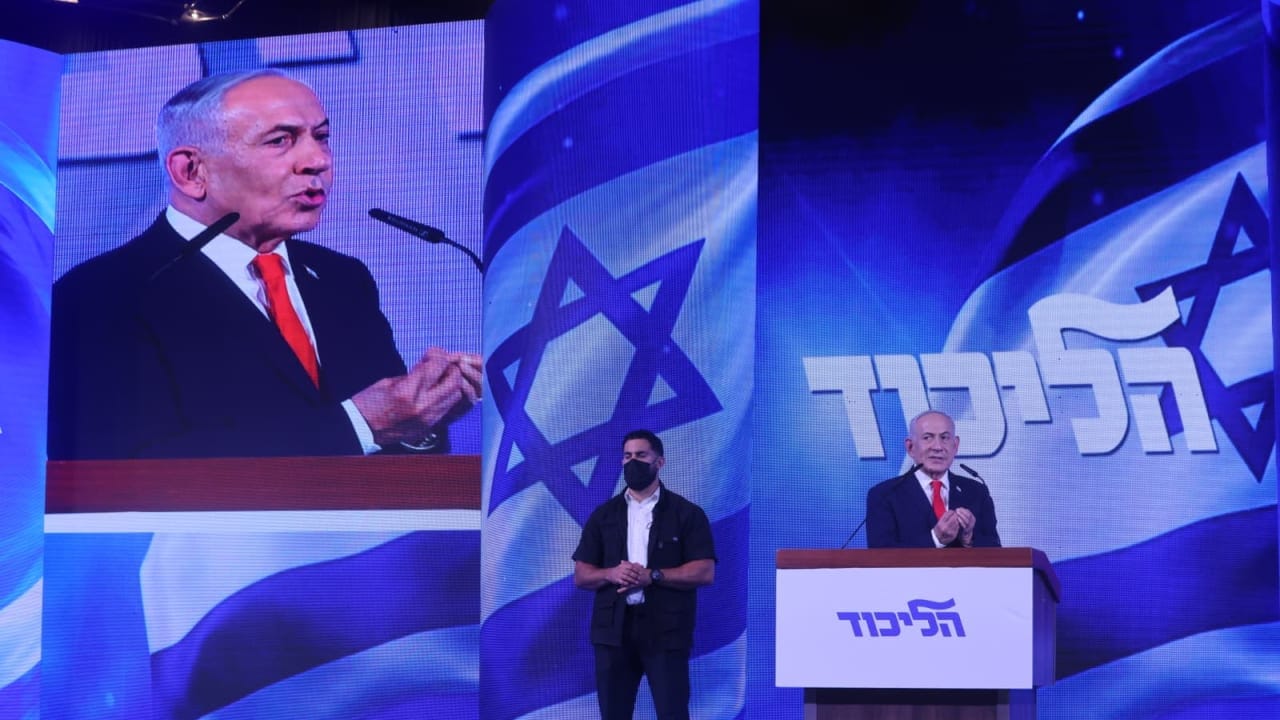
OCTOBER 30, 2026 14:34Here is the question Israel’s political leaders need to ask themselves in the aftermath of Tuesday’s election: Do we really want to go through this all over again?It is a simple question, but one with enormous implications for the country’s future. And if the answer is no, as it should be, then the parties elected to the Knesset this week need to start thinking differently about what comes next.There is no question that Israelis who voted for Gadi Eisenkot, Naftali Bennett, Avigdor Liberman, and Yair Golan did not want Tuesday’s result. They voted with the overriding objective of removing Prime Minister Benjamin Netanyahu from office. That was the purpose of their vote and the promise they made to their supporters.For months, it seemed like it might actually happen. The opposition had momentum, and unlike previous elections, no votes were going to be wasted on parties failing to cross the threshold.Naftali Bennett (L), Gadi Eisenkot, Avigdor Liberman. (credit: AVSHALOM SASSONI/FLASH90, MARC ISRAEL SELLEM)Tens of thousands of Israelis flew in from abroad to cast their ballots, and while the polls did not show a clear 61-seat majority, they suggested that the opposition would emerge with the larger bloc, potentially allowing Eisenkot to establish a minority government and begin advancing at least part of his agenda.But that is not what happened.Instead, Netanyahu emerged as the political winner. Likud is the largest party with approximately 27 seats, while his bloc has about 53, more than the 48 won by the Eisenkot bloc. That is a remarkable achievement considering that almost all polls predicted the exact opposite.It is true that the opposition, together with the Arab parties, is projected to hold approximately 67 seats, meaning that a majority of the next Knesset will be represented by parties opposed to Netanyahu, but that is not how governments are formed in Israel.What matters is who can assemble 61 seats and turn them into a functioning coalition. Neither side can do that right now, but Netanyahu appears to be in the stronger position, and his success can be explained by two factors.The first is that Israeli politics remains deeply tribal. Despite the massacre on October 7, 2023, the failures of his government, and the momentum against him, Netanyahu’s traditional voters largely remained loyal. They might have reservations about his policies and even his leadership, but when they enter the voting booth, they come home.The second is that Netanyahu ran an extremely effective closing campaign. He focused on two fears: Iran and massive Arab turnout. To his critics, it looked like desperation. But Netanyahu understood something about the Israeli electorate. These messages tapped into deep, visceral fears about the country’s security and future.For many Israelis, he remains the known commodity, the leader they instinctively turn to when danger looms. Whatever they think of his record, the alternative was perceived as an even greater gamble.That is the political reality. And whether we like it or not, it is the reality from which the next government needs to emerge.Which brings us back to the question of what happens now. I would argue that if we accept two basic premises, there is only one responsible path forward.The first is that Eisenkot does not have a realistic path to forming a government. Some on the Left have suggested that he take the roughly 48 seats of the Zionist opposition parties and establish a government with the support of the Arab parties.That is almost impossible to imagine happening. It would have been one thing had Eisenkot emerged with a bloc in the mid-50s and needed just a handful of votes from Mansour Abbas’s Ra’am party. But relying on both Ra’am and the Joint List is something entirely different.Bennett and Liberman would almost certainly reject such an arrangement, even if Eisenkot was willing to consider it, which itself is unlikely.Looking back at multiple electionsThat leaves us with the second premise: Israel cannot afford another election.Consider what this country is confronting. Iran remains a threat, with another military confrontation possible as early as next week. In Gaza, Hamas has yet to disarm; in Lebanon, Hezbollah is rebuilding its military capabilities while terrorism in the West Bank is increasing. The unresolved issue of the haredi draft continues to tear Israel apart.The cost of living remains high, the deficit is growing, and Israel faces an increasingly isolated situation on the international stage than ever before. And hovering over all of this is a society that remains deeply divided, still struggling to recover from the trauma of October 7 and the wars that followed.Does anyone seriously believe another election would help solve any of these problems?On the contrary: it would paralyze the political system for months, postpone critical decisions, and deepen divisions that Israel desperately needs to begin healing.We know this because we saw this exact process happen before.When Israelis look back at the years leading up to October 7, they tend to focus on 2023 and the government’s judicial reform, which tore the country apart. But we often forget what preceded it: five elections in less than three-and-a-half years. Judicial reform did not create all those divisions. It poured fuel on a fire that had already been burning for years.And as October 7 demonstrated, the erosion of social cohesion is not just a political problem. It is directly tied to national security. Israel’s enemies watch what happens inside this country; they study our divisions and look for opportunities to exploit them.Why would we willingly send ourselves back into that destructive cycle?Now consider something else. What, exactly, are the ideological differences between Netanyahu, Eisenkot, Bennett, and Liberman that make it impossible for them to sit together in a government?Their four parties would have about 68 seats. That is more than enough to form a stable coalition, one that would not be held hostage by the demands of small sectoral parties or the extremes of either side of the political spectrum.Do they fundamentally disagree about Iran? Is it as if one believes the Islamic Republic should be allowed to obtain nuclear weapons while the others oppose it? Do they have radically different approaches to Gaza? Is any one of them advocating that Israel simply withdraw and allow Hamas to rebuild its military capabilities?What about the Palestinians, the traditional divide between Israel’s Right and Left? Also, no real difference here. Netanyahu opposes Palestinian statehood; Bennett advocates annexing Area C, which comprises about 60% of the West Bank; and Liberman has proposed having Jordan take over while Eisenkot has called a two-state solution delusional.On the economy, none are socialists. All broadly support the free market, private enterprise, and economic growth.And what about the haredi draft?Here, Netanyahu’s record is certainly different. For years, he has accommodated the demands of his ultra-Orthodox coalition partners, but that was when his political survival depended on the haredim.Put him in a different coalition, one that does not depend on Shas and United Torah Judaism, and the political equation changes.None of this means these four leaders agree on everything. They do not. There are real differences over governance, the judiciary, the handling of October 7, and, most importantly, accountability for what went wrong. But those differences are not necessarily insurmountable. Certainly not when compared with the challenges Israel faces.So what is really preventing such a government from being formed?The answer is not ideology but rather personalities and a profound lack of trust between them.That distrust is not imaginary, and Netanyahu has earned much of it. His political history is filled with broken commitments and efforts to undermine partners when doing so served his interests. Bennett, Eisenkot and Liberman have legitimate reasons to doubt that an agreement signed today would be honored tomorrow. And their voters did not send them to the Knesset to rescue Netanyahu. They voted for change, accountability and a different direction.These concerns cannot simply be brushed aside in the name of national unity. But neither can they become an excuse for condemning Israel to another election.If the obstacle is trust, then the challenge is to create mechanisms to try to verify it, since if they can do that, such a government could tackle the real challenges Israel faces. It would be difficult. Perhaps extraordinarily difficult. But is it really more difficult than sending the country to another election, with all the damage that would entail?Imagine what a government representing such a broad cross-section of Israeli society could accomplish. A government that could make decisions on Iran and Gaza without constantly calculating their impact on coalition survival. That could finally confront the ultra-Orthodox draft crisis, begin repairing Israel’s standing internationally, and tackle the economic challenges that have been neglected for far too long.Most importantly, imagine what it would mean for Israeli society to see political leaders who have spent years attacking one another decide that the country matters more than their personal rivalries.I am not naive about the obstacles. Netanyahu would need to demonstrate that he can be trusted. Eisenkot, Bennett, and Liberman would need to explain to their voters why joining him does not mean abandoning the principles for which they were elected. All four would have to give up something they desperately want.But that is what leadership is supposed to be about: recognizing when the circumstances have changed and finding the courage to adapt.Israel has been through too much over the last four years. Too many lives have been lost, too many families have suffered, and too many opportunities have been missed. Another election would be the easy way out since everyone could stand by their promises, blame the other side, and return to the campaign.The harder path would be to compromise, try to create trust, and form a government capable of governing.After everything this country has been through, perhaps it is time for our leaders to try it.The writer is a co-founder of the MEAD policy forum, a senior fellow at the Jewish People Policy Institute, and a former editor-in-chief of The Jerusalem Post. His newest book is While Israel Slept.Follow us on Google
Israel cannot afford another election - its leaders must compromise for unity - opinion
Full Article
Original Source
Read the full article at Jpost →KhanList aggregates and links to publicly available news content. We do not host full articles from third-party sources. Always verify important information with original sources.