
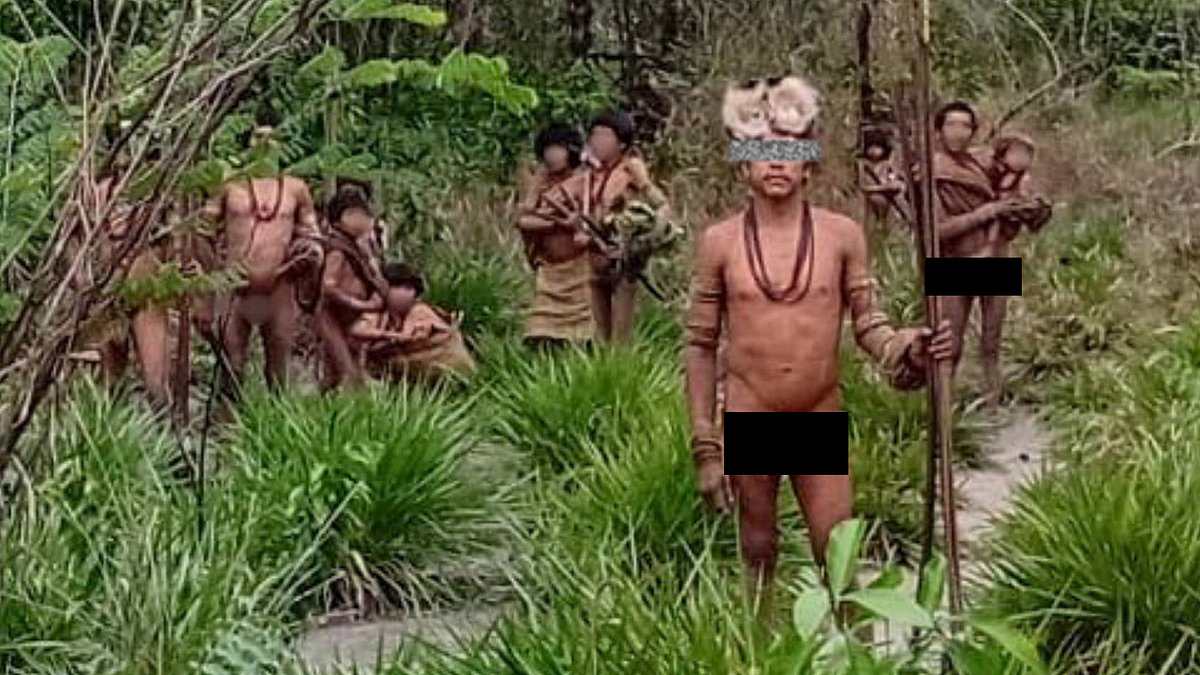
Rare images of an isolated group of Indigenous people emerging from a remote part of Brazil's Amazon rainforest have underscored the threats facing them from loggers, hunters and ranchers, advocates said on Tuesday.Survival International, a UK-based Indigenous peoples' rights group, shared images on Tuesday of what it said was a 'historic encounter' a day earlier in a region of Brazil's northeastern Maranhão state between a government team and about 20 uncontacted Awá Indigenous people, who asked for food.The rights organisation defines uncontacted groups as Indigenous peoples who avoid contact with outsiders and have no permanent relationship with them even while being aware of the outside world.'There hasn't been a similar approach like this with the Awá in recent history, certainly for some decades,' said Survival International, adding the people may have asked for food due to pressure from outsiders entering their territory.Brazil's Indigenous affairs agency Funai said in a statement to Reuters that it was reviewing videos and accounts shared on social media showing isolated Awá people interacting with a village in the Araribóia Indigenous Land in Maranhão.The agency said it has activated a contingency plan for contact situations with a focus on minimising health risks for the Indigenous people. Funai also said the Brazilian state is not seeking contact with the group and its policy remains one of non-contact.The Awá are a Tupi-Guarani people in northwest Maranhão with some remaining in voluntary isolation, according to Funai.Survival International said it released the images at the request of a group of Indigenous people known as the Guardians of the Amazon, which campaigns against illegal loggers and cattle ranchers. Rare images of an isolated group of Indigenous people emerging from a remote part of Brazil's Amazon rainforest have underscored the threats facing them from loggers, hunters and ranchers, advocates said on Tuesday Survival International, a UK-based Indigenous peoples' rights group, shared images on Tuesday of what it said was a 'historic encounter' a day earlier in a region of Brazil's northeastern Maranhão state between a government team and about 20 uncontacted Awá Indigenous peopleLocal community leaders said the villagers offered food to the group. 'They asked for yams and took them back into their forest,' said Survival International.A video of the encounter, filmed by Guajajara villagers and released by Survival International, shows a group of men, women and children at the edge of the forest.Partially concealed by vegetation, they appear naked and are wearing necklaces. The men carry bows and long arrows.The NGO explained that the Awa typically subsist on hunting and gathering. However, they have faced increased incursions from illegal loggers, hunters and cattle ranchers. In recent decades, isolated Indigenous groups across the Amazon, the world's largest rainforest, have come under threat from encroaching illegal miners, loggers and ranchers.'The uncontacted Awá are under extreme pressure as intruders encroach from all sides of their territory, driving them into an ever-smaller island of the Amazon rainforest, surrounded by destruction,' Survival International's director, Caroline Pearce, said.She added that the group's choice to emerge from isolation was a 'troubling indication of how the continued invasion of uncontacted peoples' forests puts otherwise self-sufficient Indigenous people in real danger'.The organisation has identified 196 uncontacted Indigenous groups across 10 countries in South America, Asia and the Pacific. It says almost 95 per cent of these groups are in the Amazon, with 124 specifically in Brazil.The Maranhão Indigenous people's organisation COAPIMA said on Tuesday that the encounter with the Awá people 'underscores the importance of careful action by the responsible agencies, given the risks that unplanned contact can pose to isolated Indigenous populations, mainly through exposure to diseases and other threats to their integrity'.It continued: 'The physical condition of some members, particularly the children and the elderly, caused concern among the villagers, who noted clear signs of severe emaciation.'It comes after Pope Leo on Sunday forcefully condemned what he called the exploitation of the Amazon jungle and urged Catholics to oppose 'with perseverance' deforestation and pollution caused by gold and oil production.The pope, meeting with a largely Indigenous audience in the Peruvian Amazon as part of a South America tour, also lamented a spate of killings of tribal leaders protesting deforestation, calling them murders that must be solved. 'Many Indigenous leaders have been murdered for defending their territories,' Leo said in the Peruvian city of Pucallpa, an eastern gateway to the Amazon about 200 km (124 miles) west of the Brazilian border.'The blood of these brothers cries out to God and demands justice!' he said. Many of the Indigenous community members at the event wore intricate traditional clothing and feathered headdresses and had detailed geometric designs painted on their faces.Leo is known for choosing his words carefully and preferring to eschew headlines. But he has emerged as a more forceful voice on the world stage in recent months, decrying the direction of global leadership. He drew the ire of US President Donald Trump earlier this year for denouncing the Iran war.
Isolated Amazon tribe is photographed in 'historic encounter' with outside world as they are forced to beg for food due to loggers intruding on their land
Full Article
Original Source
Read the full article at Dailymail →KhanList aggregates and links to publicly available news content. We do not host full articles from third-party sources. Always verify important information with original sources.