
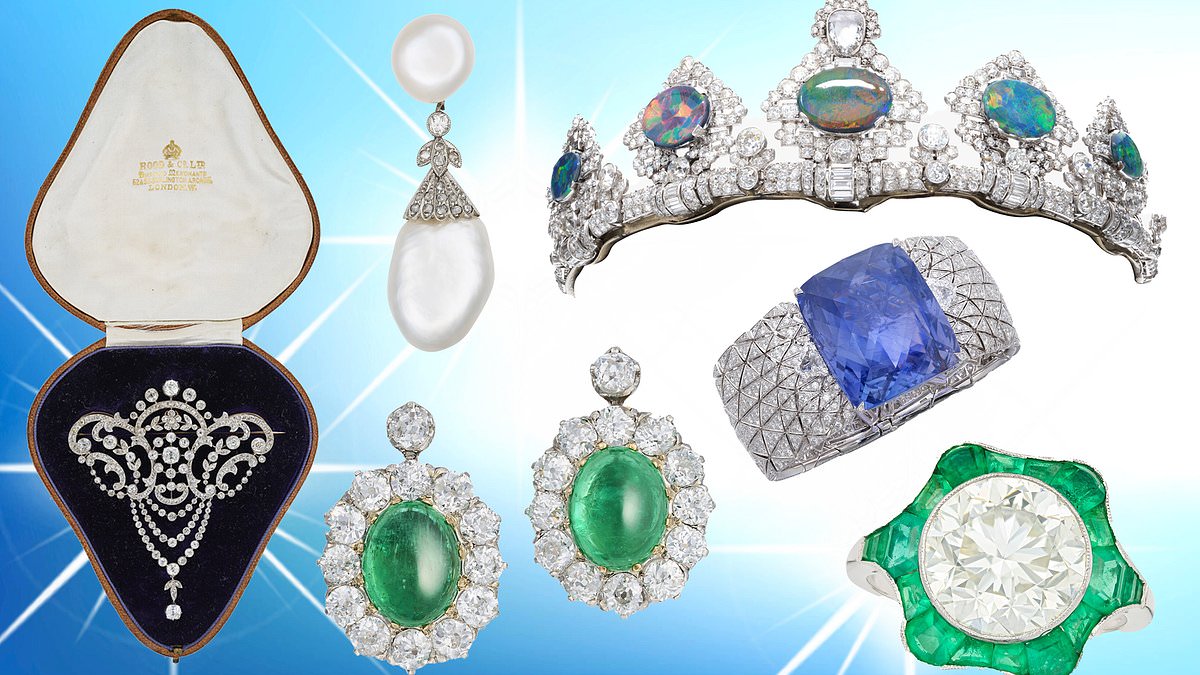
Looking through your old jewellery box, it can be easy to dismiss an item you bought long ago as a costume piece when the crowning stone might in fact be real.This was the reality for one family in London when their grandmother's collection of antique jewellery, which had been kept in the attic for decades, sold for over £500,000 at an auction in Chelsea.Her collection sold for over three times over its initial estimate and included real diamonds and gems.Jewellery valuer Karra Ellison, an expert who has worked in the jewellery and watch trade for over 13 years, frequently meets with clients who think their antique jewellery is worth very little.She said: 'Due to the increase in metal prices, the drive to be sustainable in all parts of our lives and a newfound love of the old, jewellery which has often sat at the bottom of jewellery boxes could now hold more value than you'd think.'I visit many a client who tells me not to bother with certain pieces of their collection because they're worthless, only to tell them some wonderful news.'I've saved many an heirloom from going to the charity shop, when clients believed Granny's old brooch was nothing but paste but it turned out to be diamonds,' she added.In fact, Ellison once had a client who had planned to use the stones from a ruby and diamond bangle that was actually worth around £60,000.Ellison has shared her expert tips with the Daily Mail on what you can do at home to help to identify whether that dusty old jewellery box might be a treasure chest in disguise. Vintage brooches that were part of the grandmother's jewellery collection.Diamond bracelet that was part of the grandmother's jewellery collection.She also debunked some popular authenticating myths and it's bad news for a certain viral diamond checker.So, while it's unlikely (but not impossible) that you're sitting on a hidden fortune, it might be worth learning the indicators that a piece of jewellery is authentic, and revisiting that ring you dismissed as nothing more than plastic.HallmarksThat small inscription on the inside of a ring, for example, can be a great indicator of the metal that's been used. 'Hallmarks are applied by an Assay Office in the United Kingdom to confirm the purity of the metal. You may see '375' to indicate 9 Carat Gold, '585' for 14 Carat and '750' for 18 Carat,' said Ellison.However, while this is one of the easiest indicators that a piece of jewellery contains a precious metal, Ellison warned that it can also be easily faked.She said: 'Be prepared for what may appear to be a hallmark or stamp of purity may be forgery. Due to the high costs of precious metals a number of base metal pieces are stamped with a fineness or even given fake hallmarks to pass as a precious metal.'So, while as a first indicator, hallmarks can be useful, Ellison suggests consulting a professional jewellery valuer to be sure.DiamondsWhen diamonds are concerned, it's best to leave it to the professionals. According to Ellison, viral diamond testers aren't as reliable as the internet has given them credit for. She said: 'There are some remarkably interesting apps available that claim they can identify gemstones and diamonds from an image however; I can say with full confidence that this is not possible. 'Whilst an image may give an indication, it cannot determine the identity of the stone, whether it is natural or synthetic, or whether it has been treated in any way.'Ellison added: 'The best piece of advice I could give would be to contact your local registered valuer. 'All valuers who are registered with these organisations have completed Diamond and Gemmological Diplomas and undergo regular CPD (continued professional development), meaning they can identify whatever comes across their desk, whether any treatments have taken place and provide a value in the relevant market.' Diamond and emerald earrings that were found in grandmother's jewellery collection. Diamond brooch found in grandmother's antique jewellery collection.Beware of fake diamondsBefore quitting your day job and getting overly excited about the authenticity of a diamond, it's worth remembering that jewellery fraudsters have developed some clever ways to try and fool you.'Most diamond testers work on thermal conductance - the transfer of heat. If the stone was diamond, then the tester would bleep. Most people assume if it bleeped then all it could be is diamond; however, this is incorrect - synthetic moissanite and synthetic diamond will also give a positive reading for diamond.'She added: 'To tell the difference between synthetic moissanite and diamond (natural or synthetic) you can use an electrical conductance probe, as synthetic moissanite is electrically conductive.'However, a number of synthetic diamonds are being doped with Boron, which affects the crystal lattice and enables the stones to become semiconductors - therefore some synthetic diamonds (and natural blue diamonds which contain boron) will also pass as synthetic moissanite on these testers.'Cut According to this jewellery expert, the cut of a stone or diamond doesn't necessarily guarantee that it's genuine.She said: 'Just because a stone is cut in the 'old' way, as in old mine or old European, that doesn't mean the stone is a natural diamond. I have seen many synthetic diamonds cut that way to deceive people, especially at auction.'Her advice: 'Don't just assume that because it looks old it is genuine. Paste (a form of lead glass) has been around since the Roman era, synthetic rubies, and sapphires since the late 19th century.'
Is your old jewellery worth a fortune? Expert reveals how to tell if your antique pieces are couture or costume - after one grandmother's collection sold for over £500,000 at auction
Full Article
Original Source
Read the full article at Dailymail →KhanList aggregates and links to publicly available news content. We do not host full articles from third-party sources. Always verify important information with original sources.