
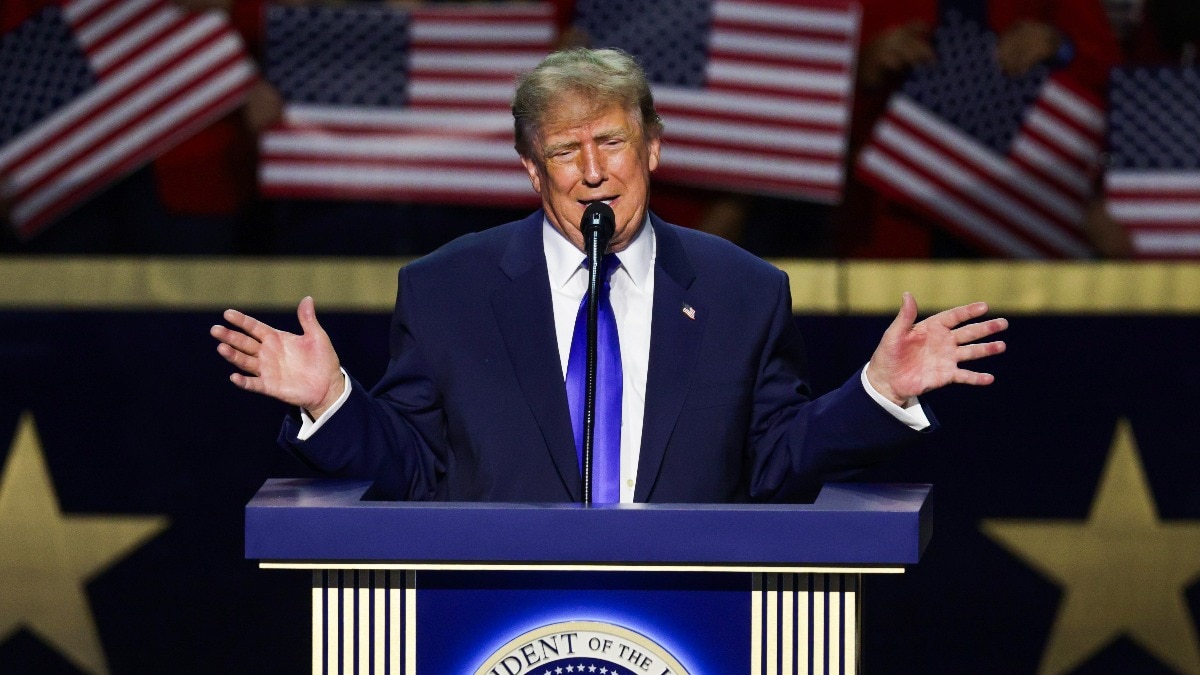
US President Donald Trump appears to have borrowed an electoral strategy from India to ease the political pressure caused by the Iran war. Months before the crucial November midterms, Trump announced a $5,000 dividend for every American adult, as a Republican defeat could curtail his powers.The strategy Trump turned to looks familiar to anyone who has followed Indian elections. Trump has adopted the tried-and-tested formula from the Indian electoral playbook, the revdi (freebie) promises. Whenever a political party in India fears losing an election, wants to reverse anti-incumbency, seeks to stay in power, or an opposition party wants to win the polls, it often, and in recent years increasingly, turns to one of the most successful electoral formulas of promising voters direct financial benefits, packaged under well-branded welfare schemes.The 80-year-old US President promised that every American adult could receive a $5,000 "dividend". But Trump has attached one important condition to the promise. He said Republicans must retain control of both the House of Representatives and the Senate in November's midterm elections.The US President made the promise during a 100-minute speech at the Republican midterm convention in Dallas on Wednesday. He offered few details on how the payments would be financed or administered. But the scale of the proposal is enormous. Depending on eligibility criteria, a $5,000 payment to American adults could cost more than $1 trillion and would require congressional approval. For a president whose approval ratings remain under pressure in the US despite recent tax cuts and refunds, the Indian formula could prove to be an elixir. FREEBIE CULTURE IN INDIA. TAMIL NADU LED THE WAY, AAP TOOK IT FORWARDIndia's revdi politics did not begin with cash transfers or smartphones. Its roots are traced to Tamil Nadu in the 1950s and 1960s, when welfare measures increasingly became part of electoral politics and free schemes actually meant welfare-oriented promises.As chief minister of Madras State, K Kamaraj expanded free education and introduced midday meals for schoolchildren. The political template became more explicit in the 1967 Tamil Nadu Assembly election, when DMK founder CN Annadurai promised subsidised rice through the public distribution system. He won the election and implemented a limited version of the scheme, although financial constraints forced a scale-back.Over subsequent decades, the line between welfare and electoral freebies became increasingly blurred.The real transformation came in the 2006 Tamil Nadu election. M Karunanidhi's DMK promised free colour televisions, subsidised rice, gas stoves, land and other benefits. The AIADMK and DMK then intensified their competition in 2011, with promises ranging from mixers and grinders to fans, laptops and marriage assistance.By the 2010s, competitive freebies had become a feature, and spilled out of Tamil Nadu. The Arvind Kejriwal-led Aam Aadmi Party (AAP), which was two years old then, in its 2015 Delhi campaign, floated freebies like subsidised electricity and water. This helped take the model beyond southern India and into the national mainstream. Since then, political parties across states have offered combinations of free electricity, farm loan waivers, free public transport for women, cash transfers, laptops, smartphones and direct financial assistance.PROBLEMS WITH REVDIS IN INDIA; ADVERSE IMPACT OF FREEBIESEverything looks great, but there is also a lingering fear factor of revdi politics. Once one party promises a benefit, rivals face pressure to promise something bigger. The fear of losing an election can turn welfare announcements into an escalating auction.The Reserve Bank of India has repeatedly warned that large subsidy and freebie commitments can strain state finances and crowd out spending on infrastructure, health and education.The Supreme Court, in its 2013 judgment in S Subramaniam Balaji v State of Tamil Nadu, held that manifesto promises of freebies did not amount to "corrupt practices" under the Representation of the People Act, while acknowledging their potential influence on voters and the electoral playing field.The Economic Survey 2025-26, released in February, warned of the rising trend of freebies in Indian states, which it said had begun delivering an adverse visible economic cost. It said that unconditional cash transfers (UCTs) ballooned more than fivefold between FY23 and FY26, with spending touching an estimated Rs 1.7 lakh crore this year.TRUMP HAD EARLIER MADE A REVDI-LIKE PROMISE, BUT DIDN'T DELIVERTrump's $5,000 proposal is not his first attempt at a revdi-like cash promise. Early in his second term in 2024, he floated a "Doge dividend", which was an idea to distribute savings generated by Elon Musk's Department of Government Efficiency to Americans (Doge).The 80-year-old US president later promoted the idea of a "tariff refund", suggesting that revenue collected from import duties could eventually be returned to the public.Neither of the promises by Trump have materialised as promised. The Doge savings failed to produce the kind of pool of money envisioned, while Trump's tariff plans faced major legal and financial obstacles. The latest $5,000 dividend therefore has a question as to where the money will come from.The comparison between Trump and India's revdi politics is not exact but symbolic. India's welfare schemes operate within a parliamentary system where state governments frequently compete for targeted benefits, while the US federal government faces different fiscal and institutional constraints.But the electoral instinct is remarkably similar. When a government or a political party understands that there is a sense of voter dissatisfaction, immediate financial benefits can become an attractive political instrument. And when the fear of losing power grows, the temptation to promise something tangible can grow with it.India spent decades turning welfare promises into an established part of election campaigns. Trump now appears to be testing a similar formula in the world's largest economy, with a $5,000 cheque, a Republican Congress and the November midterms all tied together.- EndsPublished By: Avinash KateelPublished On: Sep 10, 2026 14:34 IST
Is Trump taking election lessons from India? Revdi reaches US before midterms
Full Article
Original Source
Read the full article at Indiatoday →KhanList aggregates and links to publicly available news content. We do not host full articles from third-party sources. Always verify important information with original sources.