
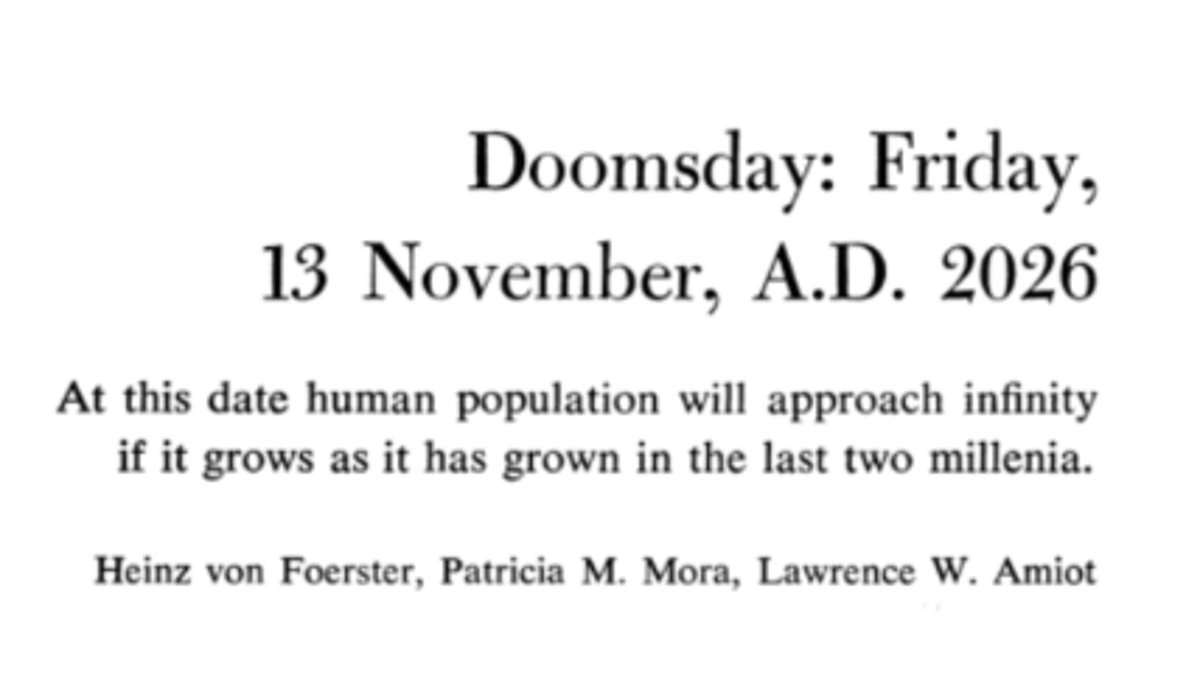
In 1960, Science, one of the world's leading science journals, published an article suggesting exactly when the world will end. Titled 'Doomsday: Friday, 13 November, A.D. 2026', the study was written by Heinz von Foerster, an Austrian-American professor and cybernetics expert and two of his students, Patricia M. Mora and Lawrence W. Amiot. Writing in the study, the trio argued: 'Our great–great–grandchildren will not starve. They will be squeezed to death.'So, with just one day to go before this alleged 'doomsday', is it time to panic? Thankfully, Professor Alan MacEachern, a professor in history at Western University, has set the record straight. Writing in The Conversation, he reassured: 'We will probably not all wake up on Friday, November 13 "squeezed to death."' Titled 'Doomsday: Friday, 13 November, A.D. 2026', the study was written by Heinz von Foerster, an Austrian–American professor and cybernetics expert and two of his students, Patricia M. Mora and Lawrence W. AmiotThe article claimed that on 13 November, the human population will 'approach infinity,' at which point it will effectively annihilate itself. This prediction was based on population growth over the previous 2,000 years. And although extreme, it was regularly cited in textbooks on everything from genetics, to ecology and demography. The five most likely causes of human extinction Rogue AINuclear warEngineered bioweaponsClimate changeNatural disasters or asteroid strike However, Professor MacEachern points out a huge flaw – the global birth rate is now significantly lower than it was when the article was published. This suggests the prediction of doomsday on 13 November is based on outdated figures.'Only around 1993 did that accuracy begin to falter and the global population began falling behind the forecasts,' Professor MacEachern explained. 'Today, the global birth rate is slightly less than half the 1960 rate.'Professor MacEachern also points out that the lead author, Heinz von Foerster, was a stage magician at one point in his life. As a result, the scientist may have used elements of his tricks in his paper.'Borrowing the classic language of stagecraft, an effective illusion relies on three parts: the setup, the extraordinary turn and the final reveal that returns the situation to normal,' Professor MacEachern explained. 'Von Foerster and his co–authors' article gained attention because it was an ordinary scientific article wrapped in an extraordinary title and conclusion. 'It retained significance because it was firmly grounded in research and argument. The article claimed that on 13 November, the human population will 'approach infinity,' at which point it will effectively annihilate itself'To draw the world's attention to a serious matter by way of absurdity — that's a good trick.'So, with November 13 just one day away, you can rest easy. Professor MacEachern added: 'We will all wake up on 13 November to an ordinary day. 'Nonetheless, this article remains exemplary, for blending rigorous science with the art of stagecraft to staggering effect.'While tomorrow will very likely pass by uneventfully, Mark Woolhouse, Professor of Infectious Disease Epidemiology at the University of Edinburgh says the prediction still matters today. 'The latest doomsday will pass uneventfully, but there's always another waiting round the corner – it's a recurring theme of human history,' he explained in an article for The Conversation. 'Scientists may have taken the mantle from prophets and mystics, but are they really any better?'The "scientific" predictions of population growth of the 1960s and 70s proved no more reliable than the doom-mongering of Nostradamus. 'There are too many parallels between that episode and today's predictions for any complacency.'Many of today's scientists are genuinely and deeply worried about global threats (my own top concern is another pandemic). 'There is a wealth of scientific evidence and opinion underpinning those fears. Even so, it would be irresponsible to ignore the lessons of recent history and risk making the same mistakes again.'Friday, November 13 2026, is an opportunity for scientists to reflect that, when it comes to prediction, a little humility goes a long way. 'Anyone who interrogates predictions of catastrophe is doing due diligence, and good scientists should welcome it.'
Is the world going to end tomorrow? Scientist debunks wacky 1960 study claiming 'doomsday' will occur on 13 November 2026
Full Article
Original Source
Read the full article at Dailymail →KhanList aggregates and links to publicly available news content. We do not host full articles from third-party sources. Always verify important information with original sources.