
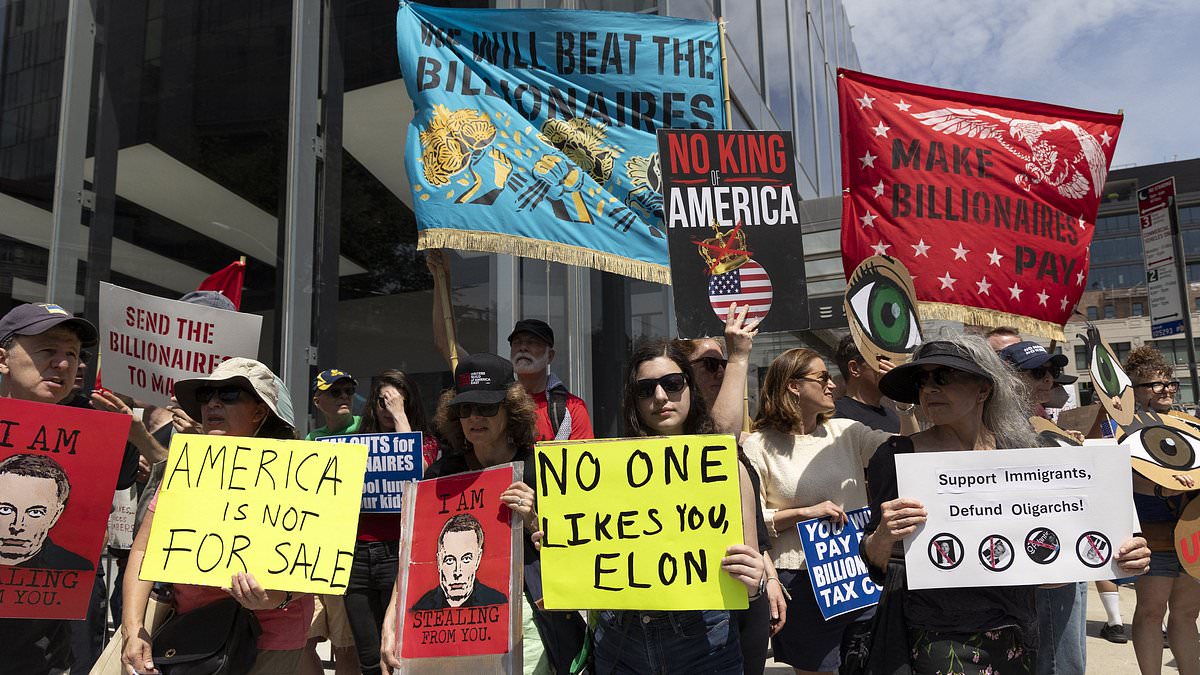
Getting stinking rich used to be a big part of the American Dream, but try telling that to the protesters waving placards at rush-hour traffic outside the main Tesla showroom in Silicon Valley last week.One of them, a retired software engineer who gave his name only as Eric, clutched a sign that read: 'The maggots are getting fat.'The maggots in question are California's 250 or so people worth more than $1billion – and the enthusiasm with which passing cars honk their horns in support of this 'Billionaire Takedown' demonstration suggests that many agree with Eric and his dozen or so fellow protesters. 'I don't mean it personally but billionaires should not exist,' he assured me rather unconvincingly. 'Nobody should be worth billions.'That's a deeply ironic statement given we are standing in a place that has produced so many of them – the main drag in Palo Alto, the suburban town that was the birthplace of Silicon Valley and where most of the world's biggest tech giants spent their formative years.California has been so successful as a crucible of industrial and business innovation that, if it were a country, it would have the fifth-biggest economy in the world, fully 8 per cent ahead of Britain's.The billionaires living here have a combined net worth of a staggering $2.4trillion (£1.8trillion) – equivalent to roughly half the state's gross domestic product.There was a time when Americans collectively admired billionaires because they truly believed that, with enough hard work and a bit of luck, anyone in the country could become one. Pictured: Anti-billionaire protesters in New York last year But such is the ferocious backlash against the ultra-wealthy, especially those in tech, from Americans struggling to pay basic bills, that Californians are now on the verge of pushing through the world's first tax on billionaires.Today, Californians voting in the crucial midterm elections for the US Congress will also be asked to vote on a measure called Proposition 40.The deeply controversial 'Prop 40', as it's popularly known, will levy a one-off 5 per cent tax on the entire assets of any California resident worth more than $1billion (£750million).Its supporters claim it will raise $100billion (£75billion) which will be used primarily to address federal cuts to healthcare, passed by Republicans in Congress in Washington. Most ordinary Democrats say they support the wealth tax but party leaders are split on whether to back Prop 40, which was originally put forward by a health union boss.There are few votes to be lost nowadays by going after the likes of California resident Mark Zuckerberg, the unlovable, all-powerful boss of Facebook and Instagram owner Meta, which agreed in August to pay $17billion (£13billion) to settle lawsuits over the harm the social networks have been doing to children.The Prop 40 measure comes at a time when many Americans increasingly see the tech barons as bogeymen: destroying their jobs with artificial intelligence, their environment with vast data centres and their democracy by exploiting the political power that their mind-boggling wealth gives them.At a pro-Prop 40 rally in San Francisco last month, far-Left Senator and former candidate for the Democratic presidential nomination Bernie Sanders thundered: 'People all over the country are asking the same question: how many bloody mansions do you need? How many yachts do you need? How many private jets and islands do you need?'Few will deny that wealth inequality is growing. After all, we're no longer talking about billionaires but, in Elon Musk, history's first trillionaire. Pictured: Google co-founder Sergey Brin, who has warned that California – no longer his primary residence – is heading the way of the Soviet Union, which his family fled in 1979It's also true that America's tax system is heavily skewed in favour of the ultra-wealthy, allowing some billionaires to avoid income tax completely by borrowing money against the value of their shares instead of paying themselves a salary.But is arbitrarily dipping into the pockets of the richest people the right way to go about solving these issues?The billionaires are certainly not taking it on the chin, angrily claiming this is a shameless asset-grab by spiteful socialists motivated by envy that will catastrophically backfire on California, as its main job-creators decamp to other US states.A coalition of some 70 billionaires has thrown an estimated $397million (£296million) into a long-running campaign that, if polls are right, has substantially reduced the number of Californians likely to vote for Prop 40.One of their craftier tactics has been to introduce two more financial Propositions, 41 and 42, which – if passed – would effectively nullify Proposition 40.These billionaire campaigners are led by Google co-founder Sergey Brin who has warned that California – no longer his primary residence – is heading the way of the Soviet Union, which his family fled in 1979.Others include the British billionaire, venture capitalist Sir Michael Moritz. Now living in San Francisco, Sir Michael complains that people like him 'have become pinatas for politicians' – a reference to the brightly coloured papier-mache containers filled with candy that are smashed open with a stick at celebrations.He adds: 'Every time I see a story with "billionaire" in the headline, I know it is meant as a swipe.' Although he accepts that economic inequality needs to be 'narrowed', he favours doing it by eliminating 'loopholes' in the US tax system that enable the super-rich to drastically minimise their taxes. Mark Zuckerberg (pictured) has a home with other super-wealthy residents in the fast-growing community called Incline Village in low-tax NevadaInstead, he and his fellow billionaires argue, staunchly Democrat California is using its richest citizens as a money pot from which there is no guarantee they won't return again for more funds.For although Prop 40 officially allows only a one-off tax, few doubt that – if it is successful – politicians will be sorely tempted to do it again. And next time, some fear, they might well target people who have rather less money than a billionaire.Politicians around the world, including in the UK, have been weighing up the merits of introducing a wealth tax of their own, and the outcome of the California vote will be watched with intense interest.Britain's ultra-rich are already fleeing in large numbers following a succession of Labour tax changes, taking with them at least £120billion to more welcoming destinations such as Switzerland, Monaco and the United Arab Emirates, according to a recent analysis by Bloomberg.That jaw-dropping figure – which includes the £2.6billion fortune of hedge fund manager Chris Rokos, who announced in September that he was relocating to Greece – is more than the combined wealth of the billionaires who have chosen to stay.And yet Left-wingers – including trade union leaders – are threatening to make that exodus even bigger by pressuring Andy Burnham's government to enforce Britain's own wealth tax.An alliance of more than 100 UK-based millionaires, including football presenter Gary Lineker, and the group Tax Justice UK, is proposing an annual 2 per cent tax on wealth above £10million.Burnham has indicated he may be open to a wealth tax, warning his government may have 'to ask for a little more' from the richest people in Britain. Many Americans increasingly see the tech barons as bogeymen: destroying their jobs with artificial intelligence, their environment with vast data centres and their democracy by exploiting the political power that their mind-boggling wealth gives them. Pictured: Protests outside a Tesla dealership in March last yearBut while UK-based billionaires are having no trouble finding a new country as their home, it's even easier for their US peers who can simply move state, swapping a high-tax jurisdiction for a lower one.The Silicon Valley brigade need only take a four-hour drive to the other side of scenic Lake Tahoe where, just over the border in low-tax Nevada, there is a fast-growing community for the super-wealthy called Incline Village, where the likes of Mark Zuckerberg, Sergey Brin and Oracle boss Larry Ellison already have homes. So there's not even any need to go as far afield as Texas or Florida.Prop 40 supporters say that the billionaires are just scaremongering about leaving California completely, as they will always want to be close to Silicon Valley – which is also home to the tech hub of Stanford University – and enjoy the sunny skies and beautiful beaches of the Golden State.Losing 5 per cent of their wealth, they reason, is hardly going to bankrupt these people. Ultimately, they will cough up and stay put. However, history suggests they could well be wrong.Tired of high taxes, woke policies, soaring homelessness and stifling regulations, business leaders and their companies have been leaving California for years. And that, of course, was before the new levy had been touted.Part of the problem is that California's state government has run up the highest debt of any state in the country: $497billion (£370billion) at the end of 2023.Although Prop 40's tax would be retroactive, affecting anyone living in California as of January this year, a clutch of the state's most prominent billionaires – including Palantir boss Peter Thiel, Sergey Brin and his Google co-founder Larry Page – have already left the state, partly in anticipation of Prop 40.But no departure was a bigger economic blow than that of Elon Musk, who moved to Texas in 2020, taking his multi-trillion-dollar electric car and space businesses with him, complaining that California had become 'entitled' and 'complacent'.It's little surprise, then, that the politicians who actually have to manage the state's straitened finances are opposed to Prop 40.They include Gavin Newsom, the Democrat governor and likely 2028 presidential contender, who says it threatens the 'innovation economy' and could cause long-term damage. Even some trade unions oppose it, arguing that the one-off windfall it would bring is not worth the threat it poses to state finances. In another blow for Prop 40, several academic studies have challenged its backers' claims that it will bring in $100billion, estimating instead that the tax losses from billionaires leaving would actually substantially outweigh the expected gains.All things considered, there seems to be so little logic to it that there may well be something in Sir Michael Moritz's claim that the wealth tax is being driven by personal spite.Ro Khanna, the Democrat congressman whose district encompasses much of Silicon Valley, certainly sounded menacing when he warned billionaires in August that they had better accept Prop 40 or face something much worse. Socialist New York mayor Zohran Mamdani and his supporters 'want your heads… they are coming with pitchforks,' Khanna warned.Emmanuel Saez, one of the academics who dreamt up Prop 40, admitted last week that it had been a strategic decision to target billionaires because 'they are no longer very popular'.But do ordinary Californians really hate their tech billionaires so much?In the manicured Silicon Valley suburb Atherton, often cited as America's richest town and whose quiet leafy streets house California's highest density of billionaires, I ran into longtime local Elena Hobbs-Minor, just 100 yards from the $25million (£19million) estate where ex-Google boss Eric Schmidt once lived.Standing outside a gleaming new modernist mansion, currently on the market for just shy of $50million (£37million), she admitted Prop 40 is 'a sensitive subject' here.Her main worry about losing the billionaires was the effect it would have on local taxes, which are already high. They often give generously to local causes, she added, particularly the local police who are now kitted out with an arsenal of impressive gear including new motorcycles, numberplate-reading cameras and drones.'Some can be jerks but I like a lot of them,' she said of her plutocratic neighbours. 'They're quite neighbourly.'Hamid Nikkho, a property developer who is selling that $50million mansion and had popped by to check on the 200-year-old olive tree he'd just planted in the garden, admitted people in his line of business were waiting anxiously to see if there will be a sudden exodus of potential customers.How will he sell this place if the billionaires aren't around? 'I'll have to cut [the house] in half,' he joked.People who don't benefit directly from the tech barons' billions are predictably less sympathetic towards them.Retired software engineer Joel Gartland, who lives in Palo Alto, insisted that Americans still admire people who work hard but they wonder if billionaires 'are really worth that amount of money'. This was a sentiment I heard repeatedly.He resents how the US financial system is stacked in favour of the super-rich, and cited the billionaire investor Warren Buffett, who once said it was 'outrageous' that his secretary paid a higher effective tax rate than he did.However, Gartland saw drawbacks in Proposition 40, especially over how officials would be able to accurately assess how much each billionaire is worth. The latter, he said, 'can play all kinds of games with assets that will make it very difficult to target them'.So is everyone in the firing line opposed to Prop 40? Jensen Huang, the co-founder of the computer chip giant Nvidia – who's worth some $200billion (£149billion) – has said he is 'perfectly fine' with the tax.Back at the protest outside Tesla, demonstrators were convinced there will be another attempt if Prop 40 is rejected narrowly.Retired judge LaDoris Cordell, a regular protester, told me the current crop of billionaires 'have decided that, because they make so much money and they're so smart, that they know how to rule the world'. She's talking principally about Elon Musk.For many, the 'billionaire takedown' that Prop 40 represents is as much about politics as money. READ MORE: Trump claims he's in 'no rush' to restart Iran bombing on midterm elections eve as unpopular war tanks GOP odds of power: Live updatesREAD MORE: Your guide to the 2026 midterm elections: Everything you need to know about when voting closes and when we can expect the results
Is the Golden State about to kill its golden geese? Today California votes on whether to impose a punitive tax to grab 5pc of the entire assets of its 250 billionaires. So could Labour's class warriors do the same here?
Full Article
Original Source
Read the full article at Dailymail →KhanList aggregates and links to publicly available news content. We do not host full articles from third-party sources. Always verify important information with original sources.