
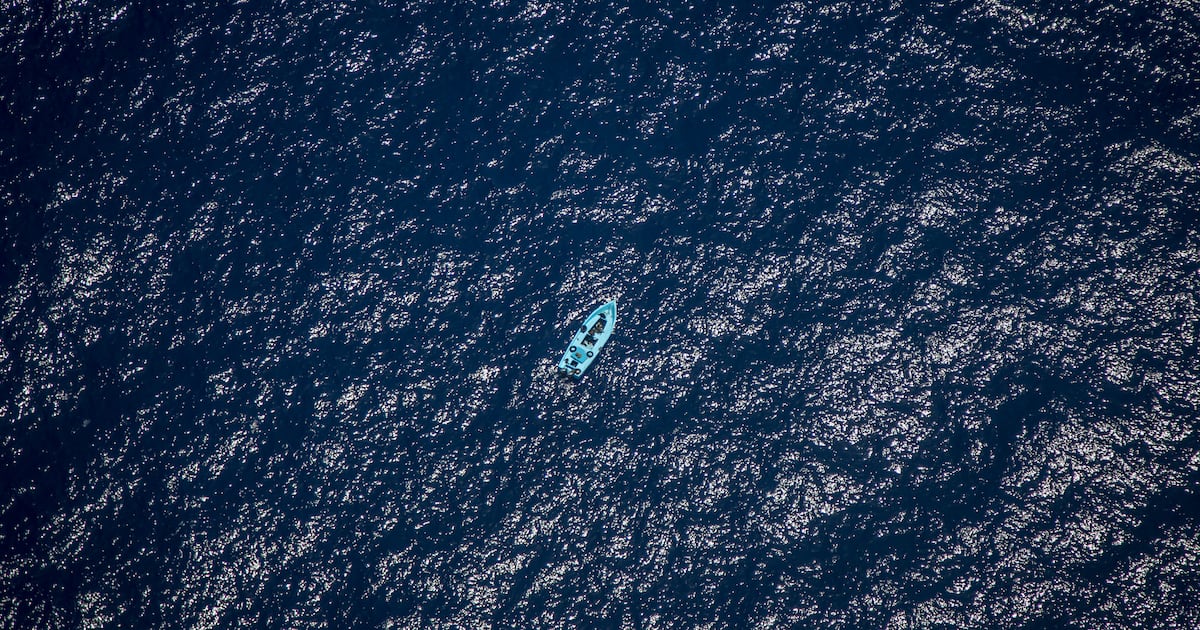
The Seabird 1 circles the empty blue boat, which bobs eerily in the Mediterranean Sea below.Then, almost immediately, another sighting nearby. Is that a body in the water? Tactical co-ordinator Neeske Beckmann isn’t certain. Sometimes, the crew spot bodies floating, glinting white, their faces bloated and pale from so long in the water. This sighting turns out to be debris. Even if it had been a body, it probably would not have been retrieved. Civil search planes spotted 14 bodies over two days in August. Europe's Borders The Seabird 1 is one of three civil search aircraft operated by German organisation Sea-Watch, in collaboration with the Swiss Humanitarian Pilots Initiative. About a quarter of its flights pass without seeing much; during another quarter the crew spot empty boats; and about half the time they see boats with people on board, Beckmann says. On this flight they see two empty vessels: a black boat, from which 28 people – including four minors – have been rescued by NGO ship Life Support; and the blue boat, the fate of its passengers uncertain.It’s likely they have been intercepted by the so-called Libyan coastguard, a collection of militias equipped and encouraged by Europe to prevent those trying to make this crossing from reaching European territory. The Seabird’s crew had even observed a Libyan boat from above about two hours earlier, speeding along purposefully.READ MOREThe Mediterranean Sea has been described as a mass graveyard, where tens of thousands of people trying to reach European territory have died over the past decade. Almost 27,000 have died in the Central Mediterranean since 2014, according to figures collected by the International Organisation for Migration (IOM). The journey usually stretches between Libya or Tunisia and Italy or Malta.Those attempting it are fleeing war, poverty, persecution and other challenges, usually in Africa, the Middle East and Asia. Many will have a legal right to protection if they can make it to Europe; others – including climate change refugees – might not. The death toll in the Central Mediterranean includes at least 872 this year alone, according to IOM, though some civil society groups put the death toll higher. Bad weather at the beginning of the year led to an untold number of drownings, coming to public attention in Italy when bodies washed up on the shores in Sicily and Calabria. In a cemetery in Lampedusa visited by Pope Leo XIV last month, a plaque remembers those who died in Cyclone Harry. “In this place they rest. Muslim and Catholic. Old, young. Black and white. All migrants dead in the sea in search of freedom,” reads another memorial.Last year sea arrivals to Italy dropped to less than half of 2023’s figures. Yet civil society groups in the area believe the same numbers are still trying to make the journey.Between January and July, more than 14,400 people were forced back to Libya, including more than 1,200 women and 300 children. Since 2017 more than 193,000 have been intercepted – thrown back into a cycle that involves militias and smugglers and unspeakable cruelty, where crimes against humanity have been documented. There they are often locked up indefinitely, with deaths occurring from violence, starvation or medical neglect.The EU has signed a range of migration externalisation deals, with neighbouring Tunisia among them. More people are forced back there after attempting to travel through an area of sea that the Seabird’s crew says they are banned from operating in. A memorial for a baby at a cemetery in Lampedusa, which includes the bodies of people who have died in the Mediterranean Sea Satellite phones are also prohibited there, they say, making it vastly more difficult for those on board to issue a distress call. The EU has been accused of using technology to track satellite phones to aid interceptions. Asked about this, a Frontex spokesman said he could not discuss “technical or operational capacities”, but could say that while Frontex is “not conducting indiscriminate surveillance of migrants’ private communications,” information “concerning a potential distress situation” is “assessed and, where appropriate, passed on to the competent rescue authorities with the objective of protecting and saving lives.”[ A decade on from crisis, Europe claims control of migration — at a human costOpens in new window ]Beckmann has been flying with Sea-Watch for more than eight years. She sees their role as providing necessary eyes in the sky. “Authorities are trying to make a black box out of” the Central Mediterranean, Beckmann says. “We started really documenting everything we saw, starting with boats in distress but also the behaviour of state actors.”The crew flies to sites where distress calls have been reported, or to monitor interceptions. Often they patrol, aiming to cover as large a stretch of sea as possible. “It’s really tricky to fly in the right place at the right time on the right day,” says Beckmann.Neeske Beckmann, a tactical co-ordinator with Seabird 1, in Lampedusa Seabird 1 is often the only civil aircraft doing this work. Beckmann says they aim “to shed light in the darkness ... We’re looking from above and seeing certain things, behaviour of European militaries, of Libyan militias, of the European Border Agency ... seeing how well designed the machine is to close Europe’s borders and let people die.” The European Commission and the Italian coastguard – which does carry out rescues – were also contacted for comment.Boats can be difficult to spot, especially for volunteers flying for seven or eight hours, scanning water topped with white caps. Visibility should extend four miles in each direction, though the sky can be hazy. Rubber boats often blend with the water – black, grey, blue, white. Wooden boats are usually light grey and light blue, while fibreglass vessels are often white, grey, and black. Iron boats are normally a rusty colour, and very dangerous to sail in. Some are double deckers, making it impossible to know how many are on board, while increasing the chances of fuel burns or suffocation.In terms of what their crews have witnessed, the “general increased violence in the last year is really noteworthy,” Beckmann says. Incidents documented include Libyan vessels, donated by European countries, “ramming the boats, throwing things at [those on board] while chasing them, beating them with sticks, shooting in the water. This is sadly the normality ... This happens and there are no consequences.”When asked about this, a spokesman for the European Commission said the EU has “raised all the recent issues” and stressed the “importance of taking all necessary measures to ensure Libya’s full compliance with national and international obligations.” Libya is territorially split. The EU recently confirmed a plan to establish a new co-ordination centre in eastern Libya, which is controlled by military commander Khalifa Haftar, despite it only formally recognising the rival Tripoli-based government. “What the EU has done now [in western Libya] they’re copying and pasting that to eastern Libya,” says Beckmann. “Now they’re going to also build up another so-called coastguard there, and what is horrifying also here is the militia that they’re also baptising.” She is referring to Tareq Bin Zeyad, a group accused of war crimes by Amnesty International, including “unlawful killings, torture and other ill-treatment, enforced disappearance, rape and other sexual violence, and forced displacement”.A vessel operated by the so-called Libyan coastguard is seen sailing below Seabird 1 At sea, says Anna Giannessi, a media airborne officer with Sea-Watch, “we [have] encountered them many times. They’re extremely violent ... Nobody in good conscience” could work with them.A spokesman for Frontex says it “operates under a comprehensive framework of accountability and scrutiny”, and its role in the Central Mediterranean is to support EU member states, “including through aerial and maritime surveillance, situational awareness and other activities within its mandate for EU external border management,” while “contributing to saving lives at sea.” [ State will be ‘buying seats’ on deportation flights run by EU Frontex border agency, O’Callaghan saysOpens in new window ]He says its exchange of information with “competent authorities” in Libya “is linked to search-and-rescue obligations under international maritime law”. This “should not be confused with political or operational co-operation with Libyan authorities,” he says.A European Commission spokesman confirms that efforts are “under way for the setting up of Maritime Rescue Co-ordination Centre (MRCC) in Benghazi,” which should be operational in six months, and that this is being supported by voluntary contributions from member states.He says EU engagement with Libya remains “indispensable,” and that the “evidence that this system works can be seen in the decrease in the number of illegal arrivals to Europe”. The EU, he says, is “providing targeted financial and operational support to strengthen border management, search and rescue and anti-smuggling capacities, and reduce illegal departures and the loss of lives at sea, alongside substantial support for the protection of the rights of migrants and refugees.”A crew member with Seabird 1 Civil society and human rights groups say European antimigration policy has become increasingly ferocious in the past decade. In June, politicians in the European Parliament chanted “send them back” after approving what is known as the “Return Regulation”, which could enable people to be transferred out of Europe to countries they have never been to.Michael O’Flaherty, the commissioner for human rights of the Council of Europe – which is separate from the EU – raised his concern that these could become “human rights black holes”. Fabrice Leggeri, who directed EU border agency Frontex from 2015 to 2022, is now an MEP for Marine Le Pen’s far-right National Rally party.Brussels-based Sofia Stimmatini is one of about 10 volunteers with Mediterranean Memory ETS, an organisation helping families identify deceased or missing relatives. She says they know of dozens of bodies buried in Italy this year, many of them unidentified. Photographs or DNA are not always taken by Italian authorities, she says, making it difficult to identify loved ones if families step forward. Between January and early May, her organisation had about 100 requests from families looking for missing loved ones, many of whom had disappeared without trace.“There is this rhetoric that there’s a drop in arrivals in Italy,” Stimmatini says, emphasising that it is necessary to ask why people are not making it that far. She said there were fewer arrivals, but more deaths. On the frontline island of Lampedusa, Italian holidaymakers walk through the streets in swimsuits wet from the sea; drink aperitivos; eat seafood, focaccia and gelato; sunbathe and sail out for short trips on leisure boats. Evidence of the tragedies taking place nearby are not immediately obvious. New arrivals are held at a “hotspot” and quickly transported elsewhere in Italy. The Aurora 2, a rescue vessel operated by German organisation Sea-Watch Tourists mill around as, in port, the Aurora 2 waits for an alert – a warning that a boat is in trouble.A lot of the more recent rules targeting search-and-rescue operations are meant to “make us lose days, make us lose time,” says Rebecca Giarola (30), a recent head of mission on the Sea-Watch rescue ship. Between 2023 and 2025, NGO ships spent 700 days in detention and 822 days at sea travelling to faraway ports in Italy – a total of 330,000km of travel – according to a statement issued by dozens of involved organisations.Giarola says the behaviours of NGO ships have had to shift in response. Many use small ships and do short trips now, even leaving and returning within a day. Sea-Watch’s 14.5m-long Aurora 2 can potentially fit 72 rescued people, along with its crew of seven. Yet it is a much smaller vessel than those used by NGOs in the past, meaning it cannot carry enough fuel to travel to faraway ports, when ordered to go there by Italian authorities. This is all due to a “new Europe that is going more and more towards [the] far right and militarised ways of doing politics and controlling borders,” Giarola says. Rebecca Giarola, head of mission on the Sea-Watch civil rescue vessel Aurora 2 Giannessi, the Sea-Watch media officer, says they want regular Europeans to realise that condoning abuses against refugees or migrants can quickly shift into allowing them against anyone in a population. Most Europeans have more in common with people arriving on a boat across the Mediterranean than they have with the ultra wealthy, she suggests.Millionaires and billionaires caused complications for the Seabird 1 in late July. Its crew struggled to refuel the plane because of a tech titan gathering in nearby Sicily, which meant airport parking space was taken up by private jets.For them, it was another reminder of whose lives are prioritised and whose are regarded as disposable; the latest manifestation of a global inequality crisis, in which the Mediterranean Sea continues to be a flashpoint, a site of deliverance and a mass grave. Series concludes[ Part I. Jack Power: The Estonian city that fears it is next on Putin's listOpens in new window ][ Part II. Paddy Smyth: Finland prepares for the unthinkableOpens in new window ]
‘Is that a body in the water?’ A flight over the ‘mass grave’ that is the Mediterranean Sea
Full Article
Original Source
Read the full article at Irishtimes →KhanList aggregates and links to publicly available news content. We do not host full articles from third-party sources. Always verify important information with original sources.